|
|
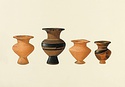
Fusiform shape. Milky stripes around shoulder and body.
Red clay mottled with dark. Grave 5 (3). Leica, 6-175, 81-308 ... 18 March 1936 ... Grave 5 (3). |
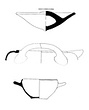
| Concave lid for a large pot; plain rim. Arched handle across the middle of the top.
Coarse pinkish-buff clay, unglazed. Grave 5. 2084 Leica, 81-279 PD 1057 ... 19 March 1947 ... Grave 5. |
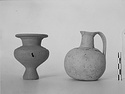
| The body intact, the neck broken and repaired; part of the lip missing and chips from shoulder. Flattened spherical body, narrow tapering neck and flaring lip; band handle, from lip.
Buff clay; unglazed; ... 22 May 1939 ... Hesperia 20 (1951), pl. 39 a-2 (Grave 5). |
| Intact. Wide mouth with flat projecting lip, turnip-shaped body and solid conical high stem. Two grooves around shoulder.
Sandy buff clay, unglazed, highly micaceous; finer buff slip, much worn. Grave ... 22 May 1939 ... Grave V = Grave 5, 1. |
Fusiform shape. Foot chipped; also lip. Milky stripes around base of neck, around shoulder, and around body.
Dark gray clay on surface and in breaks on one side. Break on other side, red. Grave 5 (5) ... 18 March 1936 ... Grave 5 (5). |
Inscribed columnar grave monument.
A small columella complete with setting tongue.
Three lines of the inscription preserved.
Hymettian marble. Found in wall of the modern house 633/4, at the north foot ... 8 November 1938 |
Columnar grave monument.
Broken below, and the top chipped; in the center of the top, a small hole.
Three lines of the inscription preserved.
Hymettian marble. Found in the wall of the modern house 637/7, ... 20 November 1933 |
Small inscribed stele.
Preserved complete including tongue to set into base. Straight moulded top.
Inscribed with three lines and a part of a fourth.
Grayish marble. Pre-excavation. Found in the modern ... 5th. or early 4th. centuries B.C. |
|
|