|
|
9/Ι at 59.00m. General. Coins:
8 May 1933 #1-#11
9 May 1933 #36-#39 ... 8-9 May 1933 ... 9/Ι at 59.00m. General. |
Tins 8-12.
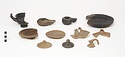
27 lamp fragments, a "D" ware plate and an early (?) gouged jug, micaceous water jars and amphorae. Some joins were noted between fills III and IV, but in general the fills are distinct ... Mid-3rd. c. A.D ... Some joins were noted between fills III and IV, but in general the fills are distinct. |
Cistern shaft, part of cistern system in Η-Ι 16-17. Filling disturbed to bottom; general run of the pottery is to late Hellenistic, lamps as late as Knidos type. Finds from 60/ΙΘ-62/ΙΘ, 61/ΙΗ. "Some Arretine" ... 5 May 1932
18 June 1932 ... Filling disturbed to bottom; general run of the pottery is to late Hellenistic, lamps as late as Knidos type. |
| Initially was recorded as disturbed saucer grave, but identified as pyre by SIR.
Found by gardener washing out of scarp during the winter rains. The location is just south of an east-west road; there ... 1962 ... The location is just south of an east-west road; there were traces of houses in this general area. There are signs of burning on some pottery. |
House K: Brown fill (publ. House U). Filling between terrace wall and house wall at the extreme west end of the Areopagus; a brown gravelly filling of early Roman date found here undisturbed but occurring ... Early Roman ... Filling between terrace wall and house wall at the extreme west end of the Areopagus; a brown gravelly filling of early Roman date found here undisturbed but occurring also throughout this general vicinity, sometimes with later intrusions. |
Herulian debris over the Library of Pantainos.
(Within this area the "Sculptor's Workshop", Iota, "Stoa" Room 1 has a group number of its own for the destruction fill R 14:2)
(Note also that the "Bone ... (Within this area the "Sculptor's Workshop", Iota, "Stoa" Room 1 has a group number of its own for the destruction fill R 14:2)
(Note also that the "Bone Factory" in the Library, Q-R 14:1 is a later, post-Herulian deposit)
(But in general the good Herulian fills included under Q-R 13-14:1)
MC reports that in any of these rooms where she has listed "Herulian debris" the filling is all one thing. |
Greek House J, under room 8 of Roman House H.
Typical though very fragmentary pyre pottery lay dispersed in a stratum over bedrock with pottery ranging from the 5th to the mid-3rd c.
In same general area ... Early 4th c. B.C.? ... In same general area as pyre Q 20:4, it must come from a different, earlier pyre. |
May be of Hellenistic origin when cistern system went out of use.
For a general note on the cistern see Nb. ΟΕ III, pp. 246 ff.
Objects from B 586 various depths (no subdivision): S 2324-S 2330,
P 34894, ... Late 2nd-early 6th c. A.D ... For a general note on the cistern see Nb. |
Well 19: Latest Mycenaean. Near Klepsydra. Diameter mouth 1.25-1.35m., narrowing about a third of the way down and becoming rectangular, 0.90-1.0 to a side. Muddy at m; water collecting rapidly at 8.m ... Late Mycenaean ... Closed deliberately as a part of a general clean-up of squatters' dwellings or warehouses, probably following a shift in population from the congested citadel area to the open and now secure areas below it.
|
Roman well, stratified.
Finds from the earth (not recorded in a subdivision):
P 7995, P 8036, P 21834, SS 6338, IL 483, IL 486, BI 309, BI 310,
BI 314.
According to the excavator the shaft had been cleaned ... 2nd-4th c. A.D ... Despite the general paucity of the well fill (only 21 tins of pottery from -7.00m to bottom), a rather large number of amphorae, micaceous water jars and other handled containers were represented among the sherds and some stratification is apparent. |
Cistern at the southeast foot of Kolonos Agoraios.
Nbp. 2369: Two chamber cisterns, 88/ΛΔ and 100/ΚΘ, united by a long straight passage running almost due N-S. A draw shaft at 95/ΚΘ is set just off the ... Late 2nd-early 1st c. B.C.-86 B.C ... Nbp. 1787: This cistern contained a hopeless mixture of sherds, from hellenistic to late roman ... One can say in a general way that the hellenistic fill lay over the bottom of this cistern and the roman above it, but every basket of Hellenistic contained also Roman sherds.
|
| Rubbish Dump in mouth of abandoned well in Tholos Trench F, Kitchen. Filled with ash, charcoal, broken pottery, roof tiles.
Also from Trench L.
13 March 2014 by Ann Steiner
The deposit has four components ... Ca. 425-400 B.C ... Also from Trench L.
13 March 2014 by Ann Steiner
The deposit has four components. In general it is vaguely funnel-shaped, but asymmetrically so.
|
Washed-in filling at the base of the Acropolis cliffs, some 7m. east of the Klepsydra; the fill was characterized by teh fragments of a series of red-figured oinochoai of special shape, of the late 5th ... Late 3rd c. B.C ... The characteristic shape and decoration show certainly that the oinochoes were made for some special cult purpose. the armed Athena, in the style of the Athenas of the Panathenaic amphoras, on the necks of two of the vases, and the helmeted Athena who mounts a chariot in the figured scene on the body in, apparently, every case suggest not merely a general connection with the cult of the goddess,but a specific association with teh festival of the Panathenaia; while the mammae which appear on the shoulders of all teh vases point with even greater certainty to a fertility cult. |
|
|