|
|
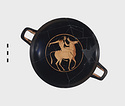
| Mended from several pieces; fragments missing. Thin foot strongly thickened at the edge; a groove around the upper surface.
Inside, a reserved band around the tondo. Within, an ivy-crowned, bearded ithyphallic ... 4 June 1954 ... Red for inscription and wreath.
By Epiktetos.
For the three relief lines seen on the amimal's knees, and the stripe on his breast, cf. the signed eye-cup in Leningrad, Leningrad 645: ARV, p. 45, no. 4; JdI 44 (1929), p. 155, fig. 6. |
Floor fragment. Max. dim. 0.045; est. diam of tondo 0.11. H. A. Thompson, Hesperia 17, 1948, pl. 68:1.
I, satyr (most of wreathed head with wrinkled brow) to right. Above:
Behind him, part of the reserved ... Ca. 510-500 B.C ... Satyr reclining against a pillow, peering into an amphora: Baltimore, Johns Hopkins B 3 by Epiktetos (ARV2 75, 56; Addenda 168). ... E 24 by Epiktetos (ARV2 75, 57; Addenda 168). |
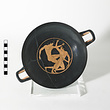
Mended with small missing pieces, including most of foot, restored in plaster and painted. Glaze cracked slightly on inside. H. 0.065; diam. at rim 0.185; diam. of tondo 0.103; est. diam. of foot 0.083 ... Ca. 510 B.C ... Red: wreath; inscription (faint).
Epiktetos (ARV2 76, 81). |
| Mended from four pieces. Lightly stepped foot.
Reserved band around medallion. Within, two boxers, boxing with bare hands; the victor is about to strike his opponent who is falling to the ground and holds ... Ca. 500 B.C ... Late work of Epiktetos. Cf. ARV, pp. 46-47, nos. 29, 24, 25, and note Kraiker's comment on the long noses and long drawn-out eyes of his late period. |
Mended with missing pieces restored in plaster and painted. Two concentric circles with central dot on underside of floor. H. 0.082; diam. at rim 0.178; width with handles 0.252; diam. of tondo 0.078; ... Ca. 510 B.C ... Red or white (flaked): inscription.
Epiktetos (ARV2 76, 80; Paralip. 328, 80: the number wrongly given as P 24138; Addenda 168). |
Mended and complete. Glaze abraded on one handle. H. 0.065; diam. at rim 0.19; diam. of tondo 0.106; diam. of foot 0.08. Themelis, Agora: Guide, fig. opp. p. 62; M. Lang, Socrates in the Agora (Agora Picture ... Ca. 500 B.C ... Vermeule, Aspects of Death in Early Greek Art and Poetry, Berkeley 1979, p. 160 and p. 246, note 21; and the abstract of a paper read by Ann Steiner at the annual convention of the AIA in December 1982 (AJA 87, 1983, p. 261).
Epiktetos (ARV2 76, 82; Addenda 168). |
Wall fragment with a little of projecting rim. Glaze misfired reddish brown in places on outside; a bit greenish on inside. Max. dim. 0.074.
Fight(?). The fragment preserves the raised, bent right arm ... Ca. 510-500 B.C ... For ivy on the rim, the closest parallels appear on the rims of these four calyx-kraters: Villa Giulia, no no. by Epiktetos (ARV2 77, 90; Addenda 169); Copenhagen, N.M. 126 by the Troilos Painter (ARV2 297, 11; Addenda 211); Louvre CA 5950, which may be by Psiax (p. 27, note 2 and p. 88, note 6 above); and Lecce, inv. 610 (CVA, Lecce 1 [Italia 4] pl. 10 [161]:1, 2). |
Two non-joining fragments, a of neck and shoulder, b of rim, neck and shoulder. Max. dim. a) 0.095, b) 0.085.
Fragment a preserves the filleted head of a man and the head of a muzzled horse, both to right ... Ca. 520 B.C ... Harnessing scenes are very rare in red figure; the only ones known to me thus far are: Munich 2420 from the Pezzino Group (ARV2 32, 3; CVA, 5 [Deutschland 20], pl. 221 [936]:3; Mind and Body, p. 312, no. 199; Addenda 157); Vatican 16575 (506) by Epiktetos (ARV2 73, 27; Addenda 168); and Louvre G 196 by the Troilos Painter (ARV2 296, 2). |
|
|