|
|
| The original side edges of the foot are preserved, with a small part of the body of the base above. The foot itself is broken off at about half its height. A small groove between foot and vase, on the ... May 1933 ... ABV, p. 21, no. 3 (Painter of Eleusis 767). |
Flat bottom; high, flaring upper wall; one vertical band handle (missing but restored correctly as indicated by handle attachments), and one horizontal rolled handle.
Inside all glazed except for a reserved ... LG II ... Cf., C.V.A., Cambridge 1[6], 1 [239], 16; Δελτ. 28, 1973, Μελ., pl. 10, α,β 9 (with lids) ; unpublished examples include one from Merenda on display in the Brauron Museum and another from Eleusis in the Eleusis Museum |
Fragment preserving part of bottom and of sides.
Glazed inside and out.
Type common in the later Geometric graves at Eleusis: cf. P 1654. From selected sherds found within or under apsidal house floor; ... 21 November 1932 ... Type common in the later Geometric graves at Eleusis: cf. P 1654. |
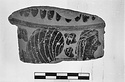
Legs and lower half of wings of Eros flying to right; he wears soft leather shoes; the lower left part of a sash which he is holding. Between his legs and wings a dotted rosette.
No relief contour.
Compare ... Compare p 121, Agora p. 18995, Eleusis lid and deningrad II (CR. 1881, Pl. 3) |
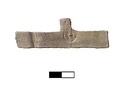
| Twenty-one long, narrow, flat, rectangular strips, twelve with a tab at the side, (one bent over), nine slightly shorter, without tabs.
All stamped at the middle with a small circular stamp: a kernos, ... 14 May 1937 ... All stamped at the middle with a small circular stamp: a kernos, from which protrude two ears of wheat, within a wreath: coin type of Eleusis. |
| Obverse: a lidded biconical vase (kernos ?) with a vertical branch on either side, through the handles.
Reverse: plain.
Cf. Money of Eleusis issued in name of Athens, cf. Svoronos (1923), pl. 104, no ... 22 February 1938 ... Money of Eleusis issued in name of Athens, cf. |
Inscribed fragment.
Inscribed face, left face, and rough picked back preserved.
Treasure record from Eleusis.
Seven lines of the inscription preserved; stoichedon.
Left edge worn away so first letters ... 5th. century B.C ... Treasure record from Eleusis.
Seven lines of the inscription preserved; stoichedon.
|
| Neck and handle mended from several fragments. Flat bottom; squat body; trefoil lip.
On neck, maeander panel, bordered by two stripes on bottom and one on top; striped handle; the rest of the vase glazed ... 6 May 1932 ... A simple example of the type of oinochoe common in Isis grave at Eleusis (CVA Athens, 1, 1.3). |
|
|