|
|
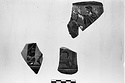
| From the neck of a large volute krater? Boxers confronting each other; on either side a judge with a staff. Groups of white dots on the judge's cloak. East footing trench of wall B. Leica ... 27 March 1936 ... ABV, p. 480, no. 7, Edinburgh painter. |
| Three non-joining fragments giving small part of shoulder and of the picture. Cylinder.
Shoulder: palmettes.
Scene. Fragment a): head, chest and right hand of the Minotaur, upper part of a woman left, ... May-June 1954 ... Fragment c): foot of Theseus and lower half of a woman looking out.
Edinburgh painter. |
Lower part of body, all of foot. Spill of glaze on inside. P.H. 0.087; diam. of foot 0.052.
Woman (lower half of chiton, feet) to right. Below, egg pattern with dots.
The Painter of the Edinburgh Oinochoe ... Ca. 430 B.C ... Below, egg pattern with dots.
The Painter of the Edinburgh Oinochoe (ARV1 758, ---; ARV2 1217, 5). |
Body fragment, mended and strengthened with plaster. P.H. 0.095; W. 0.078.
Two women (all of left except for head and shoulders; only the lower drapery and foot of right) facing, the right one probably ... Ca. 430 B.C ... The right woman wears a chiton and himation.
The Painter of the Edinburgh Oinochoe (ARV1 758, 4; ARV2 1217, 4). |
Wall fragment. Glaze dull and misfired reddish here and there on inside and outside; slightly abraded. Max. dim. 0.107. H. A. Thompson, Hesperia 17, 1948, pl. 67:4; Matheson, Polygnotos, p. 354, cat. no ... Ca. 440 B.C ... Cristofani, Materiali per servire alla storia del vaso François [Bollettino d'Arte, Serie Speciale 1], Rome, 1980, fig. 65: the figure of Theseus) and in the slaying of the Minotaur on the cup in Munich by Archikles and Glaukytes, 2243 (ABV 163, 2; Paralip. 68, 2; Addenda 47), also on a late-6th-century cup in Taranto by the Edinburgh Painter (ABV 476, 3): there the lyre is hanging up. On Bologna 177, a stamnos by the Agrigento Painter (ARV2 577, 53; Philippaki, Stamnos, pl. 48:3, side A only), Theseus and the Minotaur appear on the obverse, and a man offering a lyre to a youth, accompanied by a male, appears on the reverse, but it is far from certain that the two scenes are connected (Beazley separates his description with a period, not a semicolon, indicating that he considered the two unrelated; see ARV2 p. xlvi). |
|
|