|
|
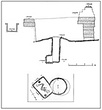
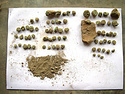
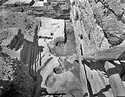
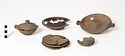
A drain pit with red gravely fill. Coins:
5 April 1939 #1-#8
Pottery continuing to at least 3rd c. A.D. ADDENDA: See also tins Lot ΝΝ 70, ΝΝ 71.
ADDENDA: P 14822 probably also belongs ... Mixed Hellenistic to Roman ... A drain pit with red gravely fill. |
This shaft in the NE corner of House A, Room III, depth of one tile, is perhaps connected with drain A. Coins:
13 May 1940 #1-#13
14 May 1940 #2-#101 ... Early 3rd. c. B.C ... This shaft in the NE corner of House A, Room III, depth of one tile, is perhaps connected with drain A. |
Grave over Drain A1 (House A)
*Now A 18:9 (SIR). Asterisk: A 20:2* ... Grave over Drain A1 (House A)
*Now A 18:9 (SIR) ... Asterisk: A 20:2* |
Early cutting beside Great Drain: 103-111/Λ-ΛΓ (= "Deep cutting" Pit at 107/ΛΑ).
Abandonment filling in channel for early drain; the fragment of a red figured bell krater, P 17000, probably to be dated ... Ca. 425-395 B.C ... Early cutting beside Great Drain: 103-111/Λ-ΛΓ (= "Deep cutting" Pit at 107/ΛΑ).
Abandonment filling in channel for early drain; the fragment of a red figured bell krater, P 17000, probably to be dated between 400 and 397 BC, is the latest dated object from the deposit, otherwise a consistent filling of the last quarter of the 5th. c. with some earlier material.
... For other fills related to Early Drain and giving date for building of Great Drain, see B 19:7 and B 19:12. |
| Grave over drain A1 (House A). Date based on the fact that the lopas has the upturned handle and the flat rather than domed lid, not found in examples from the later pyres. LT
West of House C. Pottery ... First half of 4th. c. B.c ... Grave over drain A1 (House A). ... Its integrity as a single pyre was not recognized until later. ... Originally A 20:2.
Published together with A 18:3 in Hesperia 47. |
Great Drain South (ca. 70-113, from SW edge of section as far north as the Roman Bath) Hellenistic Sand Fill. Silted-up filling of the southern branch of the Great Drain, abandoned due to some damage at ... 4th. c.-86 B.C. |
E.L. Smithson: Group H: Collapsed well west of the Great Drain.
First described as 105-107/Protogeometric Pit ... Protogeometric |
This deposit represents the Hellenistic fill from 50-54/ΣΤ-Η. A mixed green sand drain fill exists a bit father south (nbp. 135). Coins:
14 May 1934 #1-#175
15 May 1934 #1-#70 ... 14 May 1934 ... This deposit represents the Hellenistic fill from 50-54/ΣΤ-Η. A mixed green sand drain fill exists a bit father south (nbp. 135). |
| Filling in eastern channel at W. end of casting pit A 16:1. Early Roman (1st c. A.D.) but with some later disturbances (3rd. and 4th. c. A.D. and Byz.). P 25747 (VG thinks strayed from A 16:1)
Estimated ... 1st. c. A.D. |
| Report on sorting of pottery, August 1951, by H.S. Robinson [nb p. 3666].
Cistern discovered and dug to 1.60m., vi/10/36; dug to bottom iv/22/37-v/6/37. Diam. At mouth 0.26m.; neck begins to widen out ... 1st. c. B.C. to post-Herulian |
"baskets" 1-5 Coins:
22 April 1937 #7
23 April 1937 #17-#18
24 April 1937 #1
coins from Dump:
28 May 1937 #31-#32 ADDENDA Top-early 4th. c. consistent with coins of Licinius and Maximinus in good condition ... post-Herulian |
Coins:
26 April 1937 #1-#7
27 April 1937 #2-#5
28 April 1937 #1 ... 1st. c. B.C.-1st. c. A.D. |
"baskets" 11-12 Coins:
29 April 1937 #1-#2
6 May 1937 #1 d5.20m.-Bottomd.
ADDENDA Bottom-see 1970 Hayes's list ... 1st. c. B.C.-1st. c. A.D. |
According to dates of finding: 'Mixed Greek and Roman'. |
Chronology based VG's analysis of jars and stamps, 12 June 1957.
P 25802: Pergamene and Arretine fragments, recorded along with the wine jars, but the pottery apparently not kept separate and these pieces ... To ca. 140 B.C. |
Fillings to either side of the Great Drain, in the southern part of the area west of the Areopagus; various levels, late 6th. and early 5th c. B.C. to Sullan destruction. Coins:
26 July 1946 #1-#2
30 July ... Late 6th. c. B.C.-1st. c. A.D. |
| Pit and drain at SE corner of Apollo Temple. Antedates building of Apollo Temple which was assigned to a date 'late in the third quarter' ... 3rd quarter 4th c. B.C ... Pit and drain at SE corner of Apollo Temple. Antedates building of Apollo Temple which was assigned to a date 'late in the third quarter'. |
Ostrakon deposit, sand fill in a shallow channel in bedrock at the bottom of the Great Drain in the valley between the Areopagus and the Hill of Nymphs.
This group of ostraka may well come from a single ... Ca. 490-480 B.C ... Ostrakon deposit, sand fill in a shallow channel in bedrock at the bottom of the Great Drain in the valley between the Areopagus and the Hill of Nymphs.
This group of ostraka may well come from a single ostrakophoria, but there is always the possibility that the water of the drain may have carried down earlier or later pieces ... 172 ostraka and a small amount of contemporary pottery, with a few later intrusions. |
Pocket N of drain C A. Walker coin deposit ... Pocket N of drain C ... A. Walker coin deposit |
Drain Trench at 62/ΜΗ.
The presence of a number of fairly well preserved vases of good quality suggested to the excavator the possibility that the cutting might once have contained a burial. No skeletal ... 325-300 B.C ... Drain Trench at 62/ΜΗ.
The presence of a number of fairly well preserved vases of good quality suggested to the excavator the possibility that the cutting might once have contained a burial. No skeletal remains were found; the content is however unusually consistent in date for a dumped filling. |
Filling of Middle Drain (Tr. H+F in Section Ζ). Sand and gravel filling of the old course of the west branch of the Great Drain, a large (ca. 1.00m. deep and 1.30m. wide) underground channel in the area ... 150-100 B.C ... Filling of Middle Drain (Tr. H+F in Section Ζ). Sand and gravel filling of the old course of the west branch of the Great Drain, a large (ca. 1.00m. deep and 1.30m. wide) underground channel in the area of the Tholos. |
Ca. 73-81/Drain. Fillings associated with the construction of the Great Drain South, especially the fill thrown in behind the east wall of the drain at the time of its building.
Cf. A 20-21:1 and B 19:7 ... Ca. 425-400 B.C ... Ca. 73-81/Drain. Fillings associated with the construction of the Great Drain South, especially the fill thrown in behind the east wall of the drain at the time of its building.
Cf. A 20-21:1 and B 19:7.
|
Dumped fill in shaft. Estimated Grid ... Byzantine |
Great Drain sand fill under Roman bath including small area at north end under tiles that was excavated separately.
See also A-B 19-20:1 for additional Great Drain sand fill at ca. 70-113/* Subdivisions: ... 30 July-11 August 1947 ... Great Drain sand fill under Roman bath including small area at north end under tiles that was excavated separately.
See also A-B 19-20:1 for additional Great Drain sand fill at ca. 70-113/* |
| Side-chamber at the bottom of a circular shaft. AA 27; ST 103 from shaft above burial. PD 427 ... Neolithic |
Accumulated fillings in a system of underground drains at west end of section ΔΔ with northward continuation into and across Section Υ.
The filling in the "underground passages" in section ΔΔ appears to ... 3rd c. B.C.
2nd c A.D ... Accumulated fillings in a system of underground drains at west end of section ΔΔ with northward continuation into and across Section Υ.
... B.C.; but drain channels, pits and cuttings, etc. in Υ are partly Early Roman, some mixed to Late Roman or later.
... More extensive disturbance in east branch indicated by fragments of dipper, 2nd c. plate, at least five moldmade bowls, a Roman lamp. |
Material from trenches:
a) 1.00-7.00m. from East End of Stoa.
b) 18.40-21.40m. from East End of Stoa.
c) 46.60-48-60m. from East End of Stoa.
d) 51.00-53.00m. from East End of Stoa.
e) 79.00-81.00m. from ... 2nd c. B.C ... Material from trenches:
a) 1.00-7.00m. from East End of Stoa.
b) 18.40-21.40m. from East End of Stoa.
c) 46.60-48-60m. from East End of Stoa.
d) 51.00-53.00m. from East End of Stoa.
e) 79.00-81.00m. from East End of Stoa.
Includes drain trench in front of back wall of Stoa (some disturbed, some undisturbed fill), soft fill above stone drain, fill from within stone drain, channel behind stylobate. |
Rectangular cutting, not entirely preserved, west of underground drain. Contained good black glazed pottery, some stamped, and a little coarse ware, along with bits of bone and part of a skull ... Third quarter 5th c. B.C ... Rectangular cutting, not entirely preserved, west of underground drain. Contained good black glazed pottery, some stamped, and a little coarse ware, along with bits of bone and part of a skull. |
Circular well cut through the old road after it had gone out of use, and filled probably at the time of the building of the drain and building A, and the throwing of fill over the road ... Ca. 430-400 B.C ... Circular well cut through the old road after it had gone out of use, and filled probably at the time of the building of the drain and building A, and the throwing of fill over the road. |
Actually in 38/ΙΕ, nbp. 766).
Pit contained at top much pottery and a few coins; sand for about 0.70m below, produced little pottery but many coins including some 2nd century Imperial and one of Salonica ... 3rd c. A.D. |
Fillings in a stone-curbed well in the industrial area west of the Areopagus. Diameter (shaft)1.45m. Water level -5.20m. Drain at mouth 0.58m., increasing to a regular 74m. Coin:
24 July 1947 #5 Subdivisions: ... 350-325 B.C./3rd c. B.C ... Fillings in a stone-curbed well in the industrial area west of the Areopagus. ... Water level -5.20m. Drain at mouth 0.58m., increasing to a regular 74m. |
| Marcie Handler ... Fill within the drain from the basin on the west side of Roman Room B through Wall A.
After we removed the fill within the basin on the west side of Roman Room B (BZ XXVII p. 5325), we began excavating ... Late Roman ... Fill within the drain from the basin on the west side of Roman Room B through Wall A.
After we removed the fill within the basin on the west side of Roman Room B (BZ XXVII p. 5325), we began excavating in the cutting on the east face of a conglomerate block that is part of Wall A. ... The cutting is probably a drain that carried water from the basin through Wall A and onto the North-South Road. |
| Homer A. Thompson ... PG grave to NW of Pier 19 (Grave 4).
It consisted of a rectangular pit, oriented north-south, cut into bedrock. Only the lowest part of the tomb pit was preserved; the upper part was cut away in the Classical ... Earlier-Developed Protogeometric ... It consisted of a rectangular pit, oriented north-south, cut into bedrock. ... On it were a few bone fragments of a child and six vessels.
The tomb as preserved, was first encountered by workmen constructing a drain for the Stoa and the relative positions of the vases and the human bone were not accurately recorded. |
Pits at 95/ΚΑ and 97/ΚΑ, in bottom of Post Sullan drain. Sandy filling in two pits in the bedrock, about 2.00m. apart, at the bottom of the so-called Post-Sullan drain, which replaced the abandoned section ... To ca. 86 B.C ... Pits at 95/ΚΑ and 97/ΚΑ, in bottom of Post Sullan drain. Sandy filling in two pits in the bedrock, about 2.00m. apart, at the bottom of the so-called Post-Sullan drain, which replaced the abandoned section of the southern branch of the Great Drain several meters to the west (cf. A-B 19-20:1). |
Located beneath line of Poros Gutter, from a square settling basin cut in bedrock at the north end of Trench II, South of Theseion, 1.30m below the modern road surface. The basin is lined with rough-picked ... Last quarter of 5th c. B.C.-early 4th c. B.C. |
Channel J (in ΗΗ)
Cutting that probably originally held a drain. Packed with amphoras and other coarse pottery. It tapped the poros aqueduct wall just East of our explanatory trench at the East end of ... 1st c. B.C. - early 1st. A.D ... Channel J (in ΗΗ)
Cutting that probably originally held a drain. Packed with amphoras and other coarse pottery. ... Then it swung sharply NW and N as though to avoid some building and moved down at great depth (1.62m)as though along a street. |
Small fill; most pottery Hellenistic but a few fragments of early Roman present. Coins:
27 May 1937 #3-#4 ... 265-200 B.C. |
Drain channel system along the line of an ancient north-south road, the channel in part at the surface and in part tunneled and accessible by shafts. Over a considerable part of this channel the hard water ... 2nd-early 3rd c. A.D ... Drain channel system along the line of an ancient north-south road, the channel in part at the surface and in part tunneled and accessible by shafts. Over a considerable part of this channel the hard water deposit at the bottom, belonging to the period of use, is consistently of the second and early third centuries, although coins of Gallienus in the upper part of the filling show that the channel was not abandoned before the time of the Heruli. The channel actually extends over a considerable area (E-F 5-6).
|
Well under Poros Building Drain at 62/ΛΣΤ, west of the Areopagus. Digging abandoned at 6.10m due to a collapse of the soft bedrock at the west. Small amount of supplementary filling was added in the upper ... Ca. 520-480 B.C ... Well under Poros Building Drain at 62/ΛΣΤ, west of the Areopagus. Digging abandoned at 6.10m due to a collapse of the soft bedrock at the west. Small amount of supplementary filling was added in the upper part of the well, probably when the cutting was bridged over to allow for the building of the Poros Drain.
Fill dated to ca. 520-480 B.C., top fill dated to mid-5th century B.C. in Agora XXX, represented by P 20867. |
Well (diameter 0.91m, water level -7m) in House H, Room 10 (and pit over). Plain shaft cut in stereo; pit at mouth of well,reused as drainage pit at start of tile drain running west.
Scanty use filling ... Ca. 425-400 B.C ... Scanty use filling at bottom; above this, a broken bedrock fill and above that a dumped filling. The upper part of the well was lined with tiles in the second half of the 4th. c. for use as a collecting basin for a water system, a channel of which entered the well shaft. ... P 18400, although found in the drain channel, appears to be a good 5th c. collar rim type,and was perhaps dislodged in this same disturbance. |
Deposit of black glazed table ware found with a mass of bones, iron waste and burning. Coins (from above Hellenistic/associated floor):
7 April 1948 #10-#11 ... 375-325 B.C. |
The cistern at 70/ΝΗ and the channel [65/ΞΑ] between chambers 70/ΝΗ and 63/ΞΒ seem to have a uniform dumped filling of first half 2nd c. A.D ... First half of 2nd c. A.D. |
Water channel in north part of section. Coins:
20 February 1936 #2-#3
Five stamped amphora handles; Type 48 A lamp; one-third of bowls long-petal; one long-petal mold ... Second half of 3rd c.-Early third quarter of 2nd c. |
| Hellenistic Pyre below packed clay floors of Room 2; west of Late Roman wall extension, below tile platform terracotta drain installation, bordered on the north by bedding foundation stones of crosswall ... Ca. 300 B.C ... Hellenistic Pyre below packed clay floors of Room 2; west of Late Roman wall extension, below tile platform terracotta drain installation, bordered on the north by bedding foundation stones of crosswall between rooms 2 and 3 ... Pyre pots mostly smashed, in a layer of ash and carbon defined as half of a circle. |
| Identified as Pyre by SIR.
Debris filling of the middle of the 4th c. B.C. including the remains of a sacrificial pyre.
Objects dispersed in red-clay fill uncovered in removal of modern staircase. A broken ... 4th c. B.C. disturbed ... B.C. including the remains of a sacrificial pyre.
Objects dispersed in red-clay fill uncovered in removal of modern staircase. A broken drain tile "immediately above" this area suggested to the excavator that the deposit may have been washed in. Pottery from the fill is a mixture: much 4th c. but also later material. |
Water channel in north part of Section: Channel Mouth 4. Coins:
22 February 1936 #16-#18
24 February 1936 #1-#2
Twenty stamped amphora handles; type 38 lamp; type 56 A lamp; over half of bowls long-petal ... 120-86 B.C. |
| Mycenaean Small Chamber tomb.
The cist measures 1,90m E to W, 0.75-0.90m N to S, max. depth -1.30m. Nothing was found in it; cleaned in modern times and used as a cesspool. Some of the SW part of it had ... Myc. IIIA, early 14th c ... Nothing was found in it; cleaned in modern times and used as a cesspool. Some of the SW part of it had also been cut away in Roman times by a terracotta drain. All that remains of the chamber is a small segment with a maximum preserved dimension of 1.20m, which is bordered on the north by a modern wall and on the east by a cesspool. ... It must have been from the north as the hill slopes downward in this direction, but everything was cut away in modern times if not earlier. A terracotta Roman drain cuts across the chamber from SE to NW and its bottom is slightly below the floor of the chamber.
|
Drawshaft of a complex cistern system with two chambers (D 11:4, E 11:1), two more drawshafts (D 11:3, D 12:2), and two blind tunnels, all of which were filled later than D 11;2. Coins:
26 March 1936 #1 ... 300-215 B.C. |
| Cistern at 53/ΚΓ and channels. The pottery in the cistern and in the two channels was a thoroughly mixed lot of broken material from 5th c. B.C. to 4th c. A.D. and all seemed the same except the bottom ... 5th c. B.C.-4th c. A.D. |
Dug bedrock filling in a well of unusually large diameter (1.35m.), possibly the original source of water for a factory for making terracotta figurines (water for the workshop with waterproofed floor and ... 4th. c. B.C ... Dug bedrock filling in a well of unusually large diameter (1.35m.), possibly the original source of water for a factory for making terracotta figurines (water for the workshop with waterproofed floor and basin, and pottery basin set into the ground, at junction of Great Drain and Post Sullan drain).
|
| This cutting was filled in at the time Road 6 was laid. Homogeneous dumped fill.
This deposit represents fill which was brought in at the time Road 6 at the west end of the Middle Stoa was laid to fill ... Ca. 480 B.C ... This deposit represents fill which was brought in at the time Road 6 at the west end of the Middle Stoa was laid to fill in a deep gully which had formed in the earlier road, Road 7. It remains uncertain whether the gully was natural or whether it was partially manmade as a southern continuation of the Great Drain which was never finished. |
| David Scahill ... Below packed clay floors in Room 2 of Classical Building II; bordered on east and south sides by polygonal cross wall and back wall extension for Classical Building. Late Roman wall and drain installation ... LHIII A:1 ... Late Roman wall and drain installation above west side. ... Toward the west against the north side, a bronze dagger and spear point ... See also IL 1980 (ΒΕ 2157), a lead clamp for pot mending, from collapse of drain into tomb. |
At the top was roughly square, but below was rounded. The walls were built of small stones laid without much effort where large ancient blocks ( some belonging to Great Drain) formed the sides. At the ... Turkish ... The walls were built of small stones laid without much effort where large ancient blocks ( some belonging to Great Drain) formed the sides. At the bottom was bedrock, a greenish clay hard and rock. |
| Not completely excavated due to instability of chamber walls and water. Sherds of all periods - Greek, Roman and Byzantine - were found in it [nbp. 424].
Re-examined in 2010. Photos and notes on NB pages ... 10th c. A.D ... Photos and notes on NB pages listed below.
2010 Final Report
Cistern G 14:3 is plaster lined and built with stone, at least in its upper portion, and contains a series of footholds at the northeast and southwest. Around its mouth is the remains of a square platform of tile, stone and mortar, with a segment of a square ceramic drain running along the northeast. |
| Located in Middle Stoa, west, south aisle, beneath pressure pipe (cf. A 4900). The siting of the well is remarkable in its proximity to Well I 13:3, also Geometric in date, which was found in 1968 only ... Second half of 8th c B.C ... Located in Middle Stoa, west, south aisle, beneath pressure pipe (cf. A 4900). The siting of the well is remarkable in its proximity to Well I 13:3, also Geometric in date, which was found in 1968 only some 1.70m to the northwest (under the Klepsydra Drain).
... The filling coincided with, or soon followed, the destruction of a nearby cemetery of cremation burials. |
Well C - Passage, belongs with II - Brick Shaft. All dumped fills. No objects catalogued from Well C of section ΟΑ. One object (I 5422) catalogued from modern fill in shaft, one from dump (I 5545). Coins: ... 2nd c. A.D.- Byzantine |
Tiled well near the SW corner of the market square between the Southwest Fountain House and the Great Drain, three fills noted: lower fill of earth and stones with a few fragments only of coarse pottery ... 4th-2nd c. B.C.
100-70 B.C ... Tiled well near the SW corner of the market square between the Southwest Fountain House and the Great Drain, three fills noted: lower fill of earth and stones with a few fragments only of coarse pottery (none inventoried, containers 66-71); middle filling a heavy deposit primarily of table ware, apparently a gradual accumulation; upper supplementary fill. Although carefully constructed this shaft seems never to have served as a well but only as a rubbish dump for neighboring establishments.
... Long-petal bowls found at all depths, suggesting fill was dumped rather that accumulated over a period of time. |
A well (diameter 1.10m) at the east edge of the valley road leading from the SW corner of the Agora, about 90m SW of the Tholos. The mouth of the well was subsequently covered by the east wall of the Great ... Ca. 500-480 B.C ... A well (diameter 1.10m) at the east edge of the valley road leading from the SW corner of the Agora, about 90m SW of the Tholos. ... It was filled at about the time the Great Drain was built.
1. ... From -6m to -9m : a substantial deposit of potter's clay containing cinders and including a few water pots.
4. |
Part of the cistern system 44/ΙΓ - 46/ΙΑ - 42/Θ. The filling of the 46/ΙΑ cistern shaft, with the exception of a little Roman at the top, was the same as the bottom fill of 44/ΙΓ - late Hellenistic, running ... Late 2nd-early 1st c. B.C. |
Cistern System #3: West Chamber at 69/ΛΣΤ, joined by a crooked passage to 69/Λ. Under the southwest corner of the Hellenistic Building to the north of the Temple of Hephaistos. Upper fill of early 1st ... 175-125 B.C. |
| Marcie Handler ... Continued from 2000 season, 10-12 July 2000; BZ XXIII p. 4472.
The hoard was originally excavated during the 2000 season (Lot BZ 1049, 5th-6th centuries AD), from a higher elevation through a gap in the ... 10-12 July 2000
21-22 July 2003 ... The hoard was originally excavated during the 2000 season (Lot BZ 1049, 5th-6th centuries AD), from a higher elevation through a gap in the stones of Wall A, and was thought to be the bottom of a foundation trench for the wall. The original excavators bottomed out on a tile, thought to be part of a drain (which was actually the bottom of the basin/latrine). |
Well in Room 1 of south aisle of Stoa. The well is lined with bricks and tile. This lining is preserved to a level of 52.733 m., which is approximately the same as the level off the late threshold of the ... 5th-6th c. A.D ... A channel had been dug through bedrock with its bottom at 49.321 m. ... Broken drain tiles were found further up in the channel. ... Pottery dated in the 5th century with a few 6th c. sherds. |
| Margaret Crosby ... Grave 1 (Grave XXVI: EG) Urn cremation (trench-and-hole), adult male?
[JP]
Boots or Booties Grave. Near the west branch of the Great Drain, about 100m to the southwest of the Agora horos inscription ... Early Geometric I ... Near the west branch of the Great Drain, about 100m to the southwest of the Agora horos inscription. According to Young's publication "the burial found in 1948 to the southwest of the Agora, was made in a pit cut into the bedrock, roughly rectangular in shape, with a maximum east-west width of 0.65m. ... In later times a watercourse, perhaps a tributary of the Great Drain, passed over or just to the south of the grave, and silt deposited by the water had filling the amphora to within twelve centimeters of its mouth. |
| Pyre in cut in E-W street, layer 7 (Pyre 14). North edge of Piraeus street, west of the Great Drain Bridge, in the area west of Areopagus.
RSY-Pyre.
Pottery, a little burnt bone, and patches of charcoal ... 250-240 B.C ... North edge of Piraeus street, west of the Great Drain Bridge, in the area west of Areopagus.
... The pyre was uncovered in digging a thin layer rich in marble chips. ... Organic material:" a minimum of bits of burned bone". |
Grid notation in error as 99/ΚΑ sometimes.
A well (diameter 1.20m; diameter inside tiles at bottom 0.85m) in the industrial area west of the Areopagus, at the bottom of the valley, about 10.00m. east of ... 3rd. c. B.C ... Grid notation in error as 99/ΚΑ sometimes.
A well (diameter 1.20m; diameter inside tiles at bottom 0.85m) in the industrial area west of the Areopagus, at the bottom of the valley, about 10.00m. east of the Great Drain.
At the bottom of the well four series of well-tiles were found in place; at the top the bedrock had broken out, to a depth of over 2m., forming an irregular pit. |
| Anne McCabe ... Enchytrismos burial of an infant in Byzantine Room C, L/15-2/13, at 52.915m. Although disturbed by roots, the skeleton (AA 373) was articulated and lay parallel to Wall 1, with head at the NW and feet ... 14-15 June 2007 ... The skeleton was covered by a heap of coarse sherds (Lot ΒΗ 504) including a large one decorated with incised lines. ... Work in the northern part of Room C in 2003-2005 revealed few clues about the use of the space; however the fact that Drain 1 emptied into the "room" may indicate that it was a courtyard. |
Connected with G 14:3.
There was a layer of Late Roman fill. It rested over a layer of 2nd c. B.C Hellenistic and then another of 4th c. B.C Hellenistic; the passage between the two cisterns contained ... Late Hellenistic ... There was a layer of Late Roman fill. It rested over a layer of 2nd c. ... Therefore, it appears that this cistern had several periods of use: Hellenistic (at least one phase contemporary with the 2nd century B.C, phase of House E to the north), Late Roman (probably associated with the amphora and perhaps also maybe the platform and the drain), and finally Byzantine.
|
| Laura Gawlinski ... Bronze foundry north of bridge on Piraeus street, east of Great Drain.
Keyhole-shaped bronze casting pit, cut into bedrock.
2016: Continuation of the excavation of a rectangular pit with foundry debris, ... Late 6th-early 5th c. B.C.
(Late Archaic/ Early Classical) ... Bronze foundry north of bridge on Piraeus street, east of Great Drain.
Keyhole-shaped bronze casting pit, cut into bedrock.
2016: Continuation of the excavation of a rectangular pit with foundry debris, first excavated in 1949. ... Pit cut into bedrock at west and north; fill continues beneath later wall (“Wall A”) at east. Appears to be cut into fill at south, but that area is disturbed by a modern water pipe from the landscaping of the Agora. ... Seven standing mudbricks line the bedrock wall at south, surrounding a ceramic stand, hand-formed on a cut bedrock base. |
Hellenistic fill South of Middle Stoa near NW corner of Heliaea. This fill contained material later in date than that which made up the middle Stoa Building Fill.
Only the coins (and a few amphora handles ... To ca. 140 B.C ... Only the coins (and a few amphora handles [why only these?]) ... See Hesperia 57 (1988), pp. 88-89 for a description of the dating and "The lots collected in Kleiner's Deposit III, however, do not seem to form a logical stratigraphic unit ... " ... Descriptions on coin envelopes:
Hell fills of middle stoa and s of drain c (lowest);
Hell fill over intermediate strosis + cutting intermed. strosis 22/ΛΒ;
20/ΛΔ Hell fill.
|
Investigations in the area around the Tholos, especially to the east and south of the building, between it and the Great Drain, and not otherwise specified as deposits.
This "deposit" has no form. It ... various levels and dates ... Investigations in the area around the Tholos, especially to the east and south of the building, between it and the Great Drain, and not otherwise specified as deposits.
... It is comprised of several trenches in the area of the Tholos, labeled Trench A-Trench BB. Some features in the labeled trenches have separate deposit numbers.
e.g. |
House R, fill under drain tiles and fillings associated with house K in industrial area, including what was C 19:15, plus C 19:16 and
C 19:17.
a) House built as dwelling in second half of 5th.c.
b) Used ... Ca. 5th and 4th c. B.C ... House R, fill under drain tiles and fillings associated with house K in industrial area, including what was C 19:15, plus C 19:16 and
C 19:17.
a) House built as dwelling in second half of 5th.c.
b) Used as marble-workers' shop from beginning of 4th. c. to near middle of century. Rebuilt as an industrial establishment about middle of 4th. c.
c) Area built over in Hellenistic times.
A small amount of material can probably be associated with the original period of the house (cont. 662) and at some points where the excavation was carried to bedrock pottery of the 6th c. was found. |
|
|