|
|
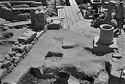
| A well in the courtyard (Room 8) of a Byzantine House of Period II. The well was covered by a large squared poros wellhead and a marble puteal (apparently neither inventoried). Within the well shaft, the ... 14 July-9 August 1989
2-13 July 1990 ... A well in the courtyard (Room 8) of a Byzantine House of Period II. ... Within the well shaft, the stratified deposit produced two dumped filings of debris that resulted from two distinct destructions, and these were separated by a filling that had accumulated during the Byzantine period of use. A smaller amount of fill at the very bottom of the shaft gave evidence for an earlier period of use of latest Roman date (Hesp. 66 (1997), p. 528). |
| Extract from notebook ΠΘ XIX, pp. 3644-3646. Well at 105/ΝΗ (report on sorting of pottery, July 19, 1951 - H.S. Robinson).
"Not a useful well" HSR.
Well dug to 1.50m., vi/9/36; dug from 1.50m. to bottom ... Early Roman; use fillings of 2nd. c. B.C. and 1st. and 4th. c. A.D.; dumped filling of late 4th. c. (HSR)
Fill I: 2nd. c. B.C.
Fill II-V: to second half of 4th. c. A.D.
Fill VI: mixed to Byzantine ... A.D. respectively, represent "period of use' of the well. For perhaps two centuries thereafter the well must have been out of regular use; cont. 4 (ca. 21.30m.) probably dates from this period and contains predominantly pre-herulian wares: wheel-ridged mugs and pitchers, type XXVII lamp frag. ... One coin (iv/9/37 #1) of Constantine II (323-361 A.D.) suggests a late 4th cent. date for this destruction fill. |
|
|