|
|
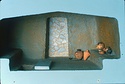
North rectangular stereo-cut pit.
Now Deposit E 19:5. Asterisk: E 18-19* ... North rectangular stereo-cut pit.
Now Deposit E 19:5 ... Asterisk: E 18-19* |
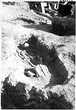
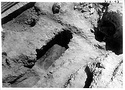
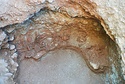
| Grave cut into bedrock (L. 2m, W. 0.58m), head toward E; offerings at south end. Skeleton of a male about 40 years old, laid out with knees slightly bent.
Brann. PD 434, PD 1058 ... 750-725 B.C ... Grave cut into bedrock (L. 2m, W. 0.58m), head toward E; offerings at south end. |
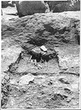
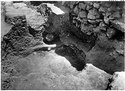
| Cut in bedrock (P.L. 0.50m, W. 0.57m). Head at east, looking west; skull stood upright when found. Lower part of skeleton missing. PD 435 ... 750-725 B.C. |
North and South Rectangular Stereo-cut Rubbish Pits. These two adjacent rock-cut pits, of uncertain original purpose, were filled with deposits of rubbish evidently contemporary and probably dumped simultaneously, ... Second half of 5th c. B.C. |
| Geometric Burial. Burial B in notebook.
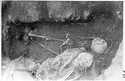
Overlay E 14:13. Skeleton lay on smoothed bedrock, head southward, arms folded on chest, hands below chin. Legs, cut off by later disturbance, probably bent, with ... Late Geometric ... Overlay E 14:13. Skeleton lay on smoothed bedrock, head southward, arms folded on chest, hands below chin. Legs, cut off by later disturbance, probably bent, with raised knees.
|
| Pyre in cut in E-W street, layer 7 (Pyre 14). North edge of Piraeus street, west of the Great Drain Bridge, in the area west of Areopagus.
RSY-Pyre.
Pottery, a little burnt bone, and patches of charcoal ... 250-240 B.C ... Pyre in cut in E-W street, layer 7 (Pyre 14). |
Carefully cut in bedrock with firm footholds on either side. The use filling is represented by a few fragments of water jars (uninventoried), indicating a short period of use. The dumped filling, below ... Ca. 470-425 B.C. |
Well cut through cistern at 40/Θ on Kolonos Agoraios (E 11:1). Two use periods plus an upper dumped fill from which the following objects: B 319, I 3994, SS 5745, T 1235. Coins:
6 April 1936 #18-#21
7 ... First half of 1st c. A.D.
4th-early 5th c. A.D ... Well cut through cistern at 40/Θ on Kolonos Agoraios (E 11:1). |
"Foundry Pit": N-S Cut on 50m. line (area of Stoa, Layer VII, with slag). A foundry pit in the courtyard of a small metalworking establishment outside the Agora to the northwest.
Both the courtyard and ... Ca. 375-350 B.C. |
Well shaft cut through a cistern channel which was then packed with three amphorae (P 3123, P 3125, P 4201) of 1st or at latest early 2nd c. A.D. (These three amphorae could be considered with F 15:2) ... 3rd-4th c. A.D. |
West Road and Drain. (Road, drain and closely related cuts.) Packing in line of ancient road running along the northwest shoulder of the Areopagus. Includes excavation of 1957 titled "Road Area to North", ... Late 6th c. B.C. - Roman ... Includes excavation of 1957 titled "Road Area to North", "North cut road area", "North cut, west of road", (not including "Roman Bath" or "area of A7" notations) ... Coins:
19 April 1939 #2
24 April 1939 #4-#9
25 May 1939 #2-#3
29 May 1939 #1-#3
30 May 1939 #16
31 May 1939 #1-#4
5 June 1939 #1
13 June 1939 #1-#2
16 June 1939 #1
17 June 1939 #1-#2
20 June 1939 #1-#3
21 June 1939 #15-#22
22 June 1939 #1-#6
23 June 1939 #1-#8
17 April 1957 #2-#3
30 April 1957 #2, #7-#8
7 May 1957 #2-#3
9 May 1957 #1-#3
10 May 1957 #1-#3
11 May 1957 #1-#7
13 May 1957 #1-#5
14 May 1957 #1-#20
15 May 1957 #8
16 May 1957 #1
20 May 1957 #6 (east of road against east face of road)
25 May 1957 #1-#4 (late drain in A9 ... around lead pipe)
29 May 1957 #2 (E-W drain next to South Wall of A2)
30 May 1957 #2 (East drain in road ca. |
N-S Cut on 50m. line (area of Road, area of Stoa, area N of Stoa) various levels and dates over the three areas.
Investigations to the northwest of the market square in the area of the road running out ... Prehistoric to Roman |
Two chambers connected by a tunnel, all filled at the same time, but with slight Hellenistic disturbance. Chamber A, to west at 14/ΛΗ, B to east at 14-15/ΛΒ on grid for section RR.
Cistern system ca. 20.00m ... Ca. 325-275 B.C. |
Pyre at N/9-6/1,2, layer 11a.
No formal limits, apparent limits about 0.30-0.40m N-S; 0.50-0.60 E-W (cut into by trench at east) ... Late 575-550 B.C ... No formal limits, apparent limits about 0.30-0.40m N-S; 0.50-0.60 E-W (cut into by trench at east). |
| A cave-in not long after the digging of this shaft destroyed its possible usefulness as a well and thereafter it was used as a dump. Two principle periods of such use were noted, and within these several ... Ca. 575-480 B.C. |
| (Grave XXIX: EG).
Rectangular cutting with remains of charred human bones and both burned and unburned pottery fragments. Bones discarded.
Rectangular trench cut through earth into bedrock, oriented east-west ... Middle Geometric I |
Mouth and upper part of chamber cut away in modern times; two short passages, one to SW, encroaching on Mycenaean chamber tomb; here the builders apparently found the fill too soft for tunneling, so they ... Early third quarter of 3rd c. B.C ... Mouth and upper part of chamber cut away in modern times; two short passages, one to SW, encroaching on Mycenaean chamber tomb; here the builders apparently found the fill too soft for tunneling, so they walled up the end of the passage with stones, including the inscription I5986, then stuccoed the inside of the passage; the other to E. |
| Laura Gawlinski ... Bronze foundry north of bridge on Piraeus street, east of Great Drain.
Keyhole-shaped bronze casting pit, cut into bedrock.
2016: Continuation of the excavation of a rectangular pit with foundry debris, ... Late 6th-early 5th c. B.C.
(Late Archaic/ Early Classical) |
"Symbolon Pit" (Rectangular Pit in bedrock E of Stoa, Room 5). Preserved depth 0.45m, original depth estimated at ca. 1.65m., the upper part having been cut away by successive building operations in the ... Third quarter of 5th c. B.C ... "Symbolon Pit" (Rectangular Pit in bedrock E of Stoa, Room 5). Preserved depth 0.45m, original depth estimated at ca. 1.65m., the upper part having been cut away by successive building operations in the area. |
N-S Cut on 20m. line (area of Road, area of Stoa, area N of Stoa)
various levels and dates over the three areas.
Investigations to the northwest of the market square in the area of the road that bordered ... Protogeometric to Late Roman ... N-S Cut on 20m. line (area of Road, area of Stoa, area N of Stoa)
various levels and dates over the three areas.
... Area North of Stoa:
Habitation earth above gravel: gray minyan, protogeometric
See also cut on 50m. line (E-F 2-3:2). |
Burial disturbed. Located in Middle Stoa, north aisle, "upper trench", piers 3 and 4. Two individuals: small child (ca. 5 yrs. old) and adult female.
In its disturbed state the burial was found (at elevation ... First half of 7th c. B.C ... In its disturbed state the burial was found (at elevation -57.58m E to -57.52 W), resting against the cut scarp of the bedrock in a pocket 0.65m deep and 0.70m across; evidently, it was originally covered by a mass of cobblestones. |
| Laura Gawlinski ... Circular pit uncovered in Early Building II, south of Room E latrine, adjacent to the preserved latrine floor surface. Continues beneath the latrine surface and the western scarp (unexcavated). Fill relatively ... Late 5th c. B.C ... Circular pit uncovered in Early Building II, south of Room E latrine, adjacent to the preserved latrine floor surface. ... Appears to be cut into surrounding harder fills. ... This pit seemed to be cut into surrounding harder fills that were also of the 4th c. |
Cistern A for 1935 (there is another Cistern A, for 1936, D-E 8-9:1) Coins:
16 May 1935 #4-#5
17 May 1935 #1-#2
18 May 1935 #1-#2
20 May 1935 #1-#2
22 May 1935 #1
23 May 1935 #2-#6
24 May 1935 #1-#7
25 ... 16-25 May 1935
6 February 1936 ... Cistern A for 1935 (there is another Cistern A, for 1936, D-E 8-9:1) ... Also, from rock-cut channel leading south from cistern (27/8/1961) S 589, S 590, SS 4316, IL 254, IL 258, IL 286, T 885, T 901, A 578, P 5947, P 6449 and coins ΠΘ-34, ΠΘ-35. |
| Homer A. Thompson ... Cremation burial (trench-and-hole) under S. edge of E-W Street, southern burial. In some records as Grave XLVI.
Neat trench, rectangular as preserved, but may have originally been square, cut partly through ... Early Geometric I ... Cremation burial (trench-and-hole) under S. edge of E-W Street, southern burial. ... Neat trench, rectangular as preserved, but may have originally been square, cut partly through earth, partly into bedrock, to a depth of about 0.25m. ... Be that as it may, a deep, circular urn-hole was cut into the southeast corner of the pyre trench to a depth of 0.45m below the level of the floor, and measuring 0.35m in diameter.
|
Early Roman pit at P/3-6/6,7
Layer 4a in Room 6 of Greek House δ, area P/2,3-6/6,8.
Pit in NW corner of Room 6 bounded by walls of Room to North and West, cut into preexisting layers to east, cutoff by ... 17 May 1971 ... Pit in NW corner of Room 6 bounded by walls of Room to North and West, cut into preexisting layers to east, cutoff by Byzantine pithos to South. ... Top elevation: 55.64m (w); 55.59m (e)
Depth: 0.55m
East-West Width: 1.37m
Preserved North-South length: 1.45m max. |
| Mycenaean Small Chamber tomb.
The cist measures 1,90m E to W, 0.75-0.90m N to S, max. depth -1.30m. Nothing was found in it; cleaned in modern times and used as a cesspool. Some of the SW part of it had ... Myc. IIIA, early 14th c ... The cist measures 1,90m E to W, 0.75-0.90m N to S, max. depth -1.30m. ... Some of the SW part of it had also been cut away in Roman times by a terracotta drain. ... It must have been from the north as the hill slopes downward in this direction, but everything was cut away in modern times if not earlier. |
| Homer A. Thompson ... Cremation burial (trench-and-hole) under S. edge of E-W Street, northern burial. In some records as Grave XLVII.
The western part of the offering trench of the tomb was lost to a Turkish cess pit, and ... Middle Geometric I ... Cremation burial (trench-and-hole) under S. edge of E-W Street, northern burial. ... B.C. had cut away the upper part of the cinerary urn and the adjoining trench filling. ... What survived was the south and east section of the original grave, including a strip of the pyre trench, reddened from burning to a depth of 0.05m, and below it a shallow urn-hole, roughly square, ca. 0.60m to the side, cut through earth almost to the level of bedrock, to a depth of about 0.30m.
|
Mycenaean Deposit (Gully) in front of NE Stoa (corrected from P 7:1).
It consisted of a series of irregular pits, some gradually linked up with one another to form what seemed a natural gully. The largest ... Mycenaean IIIA-B ... The largest pit measuring 1.70m east-west by about 1.20m north-south and having a maximum depth of 0.90m was situated from five to ten meters northeast of the gully proper and was cut at the north by the back wall of Northeast Stoa, which was set down a little into it.
... Because of its proximity to the chamber tombs and because of the exceptional quality of several of the vases, it seems likely that some of the material came from disturbed tombs
Addenda 2025: Pit with Mycenaean pottery cut at the North by NE Stoa. ... Width: 1.70 (E-W). Length: 1.20m (N-S), see p. 4631. |
Construction fill below floor of Brick Building.
Areas involved:
a) Western portion of Room A: packing below floor.
b) Room B: packing below floor of northern,larger room.
c) Fill over water channel in ... First quarter 2nd century, before its end ... Areas involved:
a) Western portion of Room A: packing below floor.
b) Room B: packing below floor of northern,larger room.
c) Fill over water channel in smaller, southern room B; channel discovered by builders of Brick Building,rebuilt by them and covered over.
d) Foundation trench of earlier building beneath Brick Building, filled and covered by builders of Brick Building.
e) "Apparently from below floor of building" (nb.p. 1282).
... It was believed to antedate the construction of the building since the wall of the building seemed to cut it. However, HAT digging in the same area in 1950 (p. 2245), describes what appears to be the same stratum (he does not specifically mention the earlier excavations) as lying on the floor of Brick Building here. |
| Initially uncovered with a diameter of c. 1.05m. Its south side extends under the south wall of the Classical structure and so clearly predates it. The highest preserved portion of the well shaft (at the ... 22 July-9 August 1994
26 June 1995
3-7 July 1995 ... The well is cut through a compact stratum of fill at the top of its the north side; elsewhere it is cut into the gray bedrock. ... Because the south side of the well shaft projects beneath the E-W Classical Wall at J/6,7-2/20, we attempted to leave undug the portion of the well fill that underlies that wall. |
| Mycenaean Chamber Tomb occupies a considerable part of the western half of section ΕΕ; lies about half way up the north slope of the Areopagus towards its eastern end, just below the highest point of the ... Myc. III A:1 ... The rock from which it is cut, is the greenish clayey shale which underlies most of the Agora area.
... It was originally several meters longer but its northern end was cut off by a late Roman retaining wall. ... Across the east and west ends of the chamber there is a low rock-cut bench (average width 0.75m; average height 0.60m). |
| Brian Martens ... It was partially excavated during the 2012 and 2013 seasons. The tomb, located at the center of Room III in the NE area of section ΒΖ, was found under fill surrounding perpendicular mid-to late 6th c ... LHIIIA ... N-S Wall 17 and E-W Wall 18 were found during the 2012 excavation season and were excavated below their lowest courses. The foundations, part of a now-absent structure through the area, were inserted deeply as the result of an anomaly in the soil: the collapsed tomb, cut into the hillside's soft bedrock. |
|
|