|
|
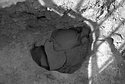
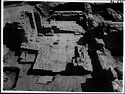
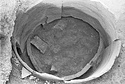
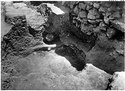
Debris filling in a pit cut in bedrock at W side of House H, Room 10 ... Ca. 425-400 B.C. |
| Dorothy Burr Thompson ... Grave 12 in notebook. Cut in bedrock. (E.L. Smithson: Grave VII: PG) Few bones (discarded). Rectangular cutting in bedrock.
JP ... Early Protogeometric |
Well cut through cistern at 6/ΝΕ (C 9:7).
The stele I 3244 in position in the cistern over the mouth of the well is listed with the cistern deposit C 9:7. Coins:
26 February 1936 #2-#4
27 February 1936 ... A.D. 1st ... Well cut through cistern at 6/ΝΕ (C 9:7).
The stele I 3244 in position in the cistern over the mouth of the well is listed with the cistern deposit C 9:7. |
| Rodney S. Young ... Grave 9 (E.L. Smithson: Grave XVIII: PG). Bones discarded.
JP
Roughly circular pit, about 0.59m in diameter, cut into soft bedrock to a depth of 0.42m. Tomb encountered only about 0.12-0.15m below the ... Protogeometric |
| Rodney S. Young ... Grave 7 in notebook (E.L. Smithson: Grave XXI: PG). Bones discarded. Disturbed and damaged cremation (originally trench-and-hole), the east end cut away, probably contained the burial urn.
JP
It consisted ... Late Protogeometric |
| Rodney S. Young ... Grave 2 in notebook (E.L. Smithson: Grave XV: PG). Urn cremation (trench-and-hole), adult female.
JP
It consists of a roughly rectangular pit or trench cut into bedrock to a depth of 0.35m., measuring ... Late Protogeometric |
Well at 63/ΙΒ (in House H, Room 15). Upper fill mixed Hellenistic to 2nd c. or later. Probably thrown in in Early Roman times when House H was built. Contained many figurines; probably part of Koukla factory ... 12 August 1947 ... Upper fill mixed Hellenistic to 2nd c. or later. Probably thrown in in Early Roman times when House H was built. ... Lower fill with much 4th c. and as late as upper fill into 2nd c. ... Plain shaft cut in bedrock. Fill as far as dug (-1.10m.) |
| Grave 1 in notebook (E.L. Smithson: Grave XXV: PG). No remains. Probable trench-and-hole.
JP
Roughly circular pit measuring 0.39m in diameter cut into bedrock to a depth of 0.72m. Pyre refuse-described ... Late PG/EG I |
| Rodney S. Young ... Grave 6 in notebook (E.L. Smithson: Grave XXII: PG). Bones discarded. Urn cremation (trench-and-hole).
JP
Roughly rectangular trench cut through hard earth into bedrock to a depth of about 0.35m, approximately ... Late Protogeometric |
| North of House G (RSY=Pyre 13).
Concentration of artifacts, small pieces of bone, and burnt material in stratum, no pit discerned. The pyre is cut by the trench of a wall of a Roman house to north. It ... 290-250 B.C. |
| Rodney S. Young ... Destroyed urn cremation. No remains. Originally assigned as part of Tomb C 9:14 (Grave 7)
JP
"Large fragments of an urn were found in the packing of a Hellenistic water channel which cut through a LPG ... Final Mycenaean/Submycenaean ... Originally assigned as part of Tomb C 9:14 (Grave 7)
JP
"Large fragments of an urn were found in the packing of a Hellenistic water channel which cut through a LPG burial area and obliterated the urn and urn-hole of LPG grave C 9:14." ... P 6723, although surely an urn, rust-stained inside from the iron jewelry and within a meter of Grave C 9:14, is much earlier than the offerings in that grave and must have come from still another burial trench in the line of the water channel; a narrow burned strip along the edge of the channel opposite the fragments may be part of that trench.
|
| Rodney S. Young ... Grave 4 in notebook (E.L. Smithson: Grave XX: PG). Bones discarded. Grave of older child.
JP
Rectangular pit, cut into bedrock to a depth of 0.26m, approximately 0.97m long and 0.36m wide. Tomb oriented ... Late Protogeometric |
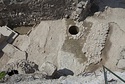
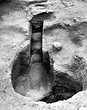
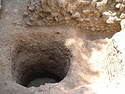
Well (diameter 0.91m, water level -7m) in House H, Room 10 (and pit over). Plain shaft cut in stereo; pit at mouth of well,reused as drainage pit at start of tile drain running west.
Scanty use filling ... Ca. 425-400 B.C ... Plain shaft cut in stereo; pit at mouth of well,reused as drainage pit at start of tile drain running west.
... This system was abandoned and the pit filled probably in the 3rd. c.
a) use and lower dumped filling (425-400 B.C.)
b) Filling behind tiles (450-400 B.C.)
c) Abandonment filling (3rd c. ... P 18400, although found in the drain channel, appears to be a good 5th c. collar rim type,and was perhaps dislodged in this same disturbance. |
| Rodney S. Young ... Grave 3 in notebook (E.L. Smithson: Grave XIII: PG). Urn cremation (trench-and-hole), adult female.
JP
Rectangular trench, measuring approximately 1.10x0.45m, but which may have been larger, cut through ... Late Protogeometric |
| RSY Grave 51.
The grave lay on the slope of the Areopagus in Roman house O, just east of the line where the hillside is scarped for the foundation of the west wall of the house.
Cutting:the pit cut in ... Archaic period/6th or 7th c. |
| Rodney S. Young ... Grave 8 in notebook. Bones discarded. Fragments of an iron pin found on the chest and a fragment of a Protogeometric krater base found beside the body were not inventoried.
JP
Unlined roughly rectangular ... LH III/EPG (date uncertain) |
| Rodney S. Young ... Grave 20 (E.L. Smithson: Grave X: PG). Bones discarded. Pit tomb, inhumation (on bier or in coffin?), perhaps of a child. Little ash and carbon in the filling, but the grave offerings were unburned.
JP ... Developed Protogeometric ... JP
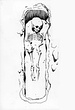
Deep rectangular pit, 1.72m long and 0.70m wide, cut into bedrock to a depth of 0.83m, oriented east-southeast to west-northwest. the skeleton at the bottom of the pit had mostly disintegrated, except for a shin bone in the eastern half of the tomb. ... The se pots, all unburned and clustered together, would have been placed in the area immediately above the feet of the deceased.
c) in the lowest 0.30m, very damp earth with very little ash, much heavy black matter "of a different character", from that in the layer above.
|
| James H. Oliver ... (E.L. Smithson: Grave IX: PG). Two children's skeletons one on top of the other. Cf. PD 329 for PD 430 for second skeleton, same deposit.
PG grave about 25m. SW of Cistern A at 46/ΜΔ.
[In some records, ... Developed Protogeometric |
Cut to east of Exedra. Accumulated road packing between the Stoa of Zeus and the early altar to the east, various levels and dates, as late as early as 6th c. B.C. and as late as 5th c. A.D ... 15-17 April 1935 ... Cut to east of Exedra. Accumulated road packing between the Stoa of Zeus and the early altar to the east, various levels and dates, as late as early as 6th c. B.C. and as late as 5th c. |
Exploration over bedrock inside the Tholos; levels of 6th c. B.C ... 6th c. B.C. |
Mixed filling in a well cut rectangular pit. Debris of the second half of the 5th. c., deposited as late as the second quarter of the 4th. c. B.C ... 4th c. B.C. and earlier ... Mixed filling in a well cut rectangular pit. Debris of the second half of the 5th. c., deposited as late as the second quarter of the 4th. c. |
Dump, 4th c. Cut through a cistern which was probably constructed in the 4th c. B.C, near the southwest corner of the market square. Coins:
25 May 1935 #1 (with L 1809) (disintegrated) Subdivisions:
.1=Upper ... Second half 1st c.-end 2nd c ... Dump, 4th c. Cut through a cistern which was probably constructed in the 4th c. |
Well beneath 4th c. Klepsydra Drain, within foundations of west end of the Middle Stoa. Diameter 0.90m, cut through bedrock, with handholes on sides. Top 4.50m. dumped fill; 4.50-6.15m. period of use ... Mid-8th c. B.C ... Well beneath 4th c. Klepsydra Drain, within foundations of west end of the Middle Stoa. Diameter 0.90m, cut through bedrock, with handholes on sides. |
Trial cut at 26/ΙΣΤ-ΙΖ, Layer I; Circular Building, 22m south of Eleusinion. P 30171, P 30172, L 5818 added on 7 May 1973 ... 4th c. B.C. |
Deposit in bedrock cuttings, probably from a household. (Panathenaic Way Cut III, E1 and E2).
E1: Mixed 7th-5th c. B.C.
E2: Late Geometric-Early 6th c. B.C. Coins:
19 May 1959 #5-#7 ... 5th c. B.C and earlier ... (Panathenaic Way Cut III, E1 and E2).
E1: Mixed 7th-5th c. B.C.
E2: Late Geometric-Early 6th c. |
Crosscut between Middle stoa Piers 1 and 2 from west (south aisle), layer II.
Chiefly late 5th to mid-4th c. B.C. Coins:
2 July 1965 #1 ... Late 5th to mid-4th c. B.C. |
Unfinished well cut in bedrock to the southwest of the Tholos; dumped filling containing much material of the 7th c. B.C. but extending into the 6th ... 7th-ca. 570 B.C ... Unfinished well cut in bedrock to the southwest of the Tholos; dumped filling containing much material of the 7th c. |
Pit 6 in Grave area. South cut, Metroon Section. Pit with burning ... Late 5th. c. B.C. |
| A cave-in not long after the digging of this shaft destroyed its possible usefulness as a well and thereafter it was used as a dump. Two principle periods of such use were noted, and within these several ... Ca. 575-480 B.C. |
7th c. well below east part of Odeion Cavea Trench K). Use filling negligible; dumped filling of the second half of the 7th c. B.C.
Brann Well H. Diameter 1.10m. Cut into bedrock. During excavation seepage ... 650-600 B.C ... 7th c. well below east part of Odeion Cavea Trench K). Use filling negligible; dumped filling of the second half of the 7th c. B.C.
Brann Well H. Diameter 1.10m. Cut into bedrock. |
N-S Cut on 50m. line (area of Road, area of Stoa, area N of Stoa) various levels and dates over the three areas.
Investigations to the northwest of the market square in the area of the road running out ... Prehistoric to Roman ... Layer III-IV: 1st c. A.D.
Layer V-VI: 1st c. B.C.-1st c. A.D.
Layer VII-VIII: 3rd-early 4th c. ... Layer III: 1st c. B.C.
Layer IV: 4th-3rd c. |
| Susan I. Rotroff ... Grave 2 (bis). Cut into by builders of I 5:2. No remains.
Possible contents in I 4-5:1 Layer C (= layer 6, lower building fill), catalogued as ΒΓ 2065 - ΒΓ 2125 ... Middle Helladic or later Bronze Age (date uncertain) ... Grave 2 (bis). Cut into by builders of I 5:2. ... Possible contents in I 4-5:1 Layer C (= layer 6, lower building fill), catalogued as ΒΓ 2065 - ΒΓ 2125. |
Olive Tree Well at 92/ΙΘ.
Cleanly cut, with footholds at northeast and southwest sides ... 7th c. B.C. to first quarter of 6th c. B.C. |
Cistern chamber in the area of the southeast Temple, the mouth cut back in antiquity ... Late 4th - early 3rd c. B.C. |
N-S Cut on 20m. line (area of Road, area of Stoa, area N of Stoa)
various levels and dates over the three areas.
Investigations to the northwest of the market square in the area of the road that bordered ... Protogeometric to Late Roman ... B.C., with later (1st c. B.C.)
Layer VII: 4th c. ... Layer IV: 7th-3rd c. B.C.
Layer V: 8th-7th c. ... Plundered trench of early N-S wall: geometric to 4th c. B.C.
Area North of Stoa:
Habitation earth above gravel: gray minyan, protogeometric
See also cut on 50m. line (E-F 2-3:2). |
Pocket roughly cut in bedrock; its greatest dimensions ca. 1.50m Terracotta figurines; some pottery fragments ... Early 5th c. B.C. |
| Well at 52/Ι, on the lower northeast slopes of the Areopagus. It was cut down and re-used in the late Roman period, in connection with the water channel. Use fill of 1st to early 2nd c.
Dump fill 5th to ... Early to Late Roman ... Well at 52/Ι, on the lower northeast slopes of the Areopagus. It was cut down and re-used in the late Roman period, in connection with the water channel ... Use fill of 1st to early 2nd c.
Dump fill 5th to 6th c. |
| A flask-shaped storage pit or cellar, cut in the rock at the south edge of the levelled top of Kolonos Agoraios. Filled late in first quarter of 6th. c. B.C. (2.95m from east to west by 2.70m from north ... First quarter 6th. c. B.C ... A flask-shaped storage pit or cellar, cut in the rock at the south edge of the levelled top of Kolonos Agoraios. Filled late in first quarter of 6th. c. B.C. (2.95m from east to west by 2.70m from north to south).
Original mouth probably cut away. Floor rather uneven. |
Well cut through cistern at 51/ΙΑ (merged with R 17:1); well and cistern filled at one time ... 5th c. A.D. |
Diameter 0.95m; water level -9.10m.
Plais shaft cut in stereo from bottom of slender flask-shaped cistern. Scanty fill from house destruction in 5th c. A.D.; Christian lamps; unfinished statuette of Castor ... Late Roman ... Plais shaft cut in stereo from bottom of slender flask-shaped cistern. Scanty fill from house destruction in 5th c. A.D.; Christian lamps; unfinished statuette of Castor. |
Well (diameter 1.10m).
Neatly cut. Footholds on east and west at intervals of ca. 0.50m. Plentiful water ... Late 8th - Early 7th c. B.C. |
Pit in bedrock at SE corner of cut at N end of Stoa Terrace.
Small irregular pit, extending under Stoa foundations, containing a number of black-figured pieces ... Late 6th c. B.C. |
A great shaft 2.65m in diameter and over 10m deep cut out in the mid 1st c. to serve in some connection with the Brick Shaft system (U 22:1). Filled in to top (layer 2) in late 1st- early 2nd c. A.D. with ... 18 March 1937,
1-13 April 1937,
24 May-14 June 1937 ... A great shaft 2.65m in diameter and over 10m deep cut out in the mid 1st c. to serve in some connection with the Brick Shaft system (U 22:1). Filled in to top (layer 2) in late 1st- early 2nd c. A.D. with a fill of mostly Hellenistic sherds (dump). Above this dump was an accumulation of late 2nd- early 3rd c. period (layer 1). |
Trench at 11/ΚΕ cut into the stereo (length 1.40m, width 0.50m). Coins:
5 April 1932 #5 (illegible).
Red figure pottery; coarse ware ... Mid-5th c. B.C. |
| The cistern was lined with stones at the top with an opening 0.80 m in diameter. For the most part, it seemed to cut into bedrock except along its northern edge where some 5th c. B.C fill remains and main ... 2-19 July 2010 ... For the most part, it seemed to cut into bedrock except along its northern edge where some 5th c. |
Building Fill NE of Circular Building 13-17/ΚΓ-ΚΣΤ (Roman Group H)
and Connecting Cut NE of Circular Bldg ... First half 2nd c. A.D. |
Exploratory excavation trench between east front of Hellenistic Metroon and Great Drain.
Cf. Hesperia Suppl. 4 (1941), p. 106.
Cf. also Metroon Drain Cut I 9:1 and F-G 12:1 and H 12:9 ... 8th-6th c. B.C. |
Flask-shaped cistern (1959) (Cistern under Room 4 in NE corner of Section). Upper filling soft silt with a little pottery. Lower filling hard silt, almost no pottery.
1.35m in diameter at the floor with ... End of the 4th c. B.C ... It was of the normal 4th c. type, its walls cut from the soft bedrock and plastered with gray hydraulic cement. |
Lower fill may be original. Part of North side cut away by modern bothros wall. Fragments of Pilgrim Jug of Grey Ware, related to Turkish Grey Ware? ... 12th or 13th c. A.D. |
Grave (?) under wall 4. Infant burial(?); a kados, P 16747, lying sideways with a tall cylindrical stand, P 16748, set over it as a cover; the upper parts of the pots cut away ... Late 6th. c. B.C. |
Well at 69/ΛΕ (diameter 0.95m).
Narrows at bottom. Footholds on east and west. Uniform fill. Bones found in the well make it likely that it had cut through a grave, as it was itself overlain by one ... Late 8th c. B.C. |
| Homer A. Thompson ... PG grave to NW of Stoa Pier 19 (Tomb no. 5 in notebook). In some records as Grave XLII.
It consisted of a rectangular pit, oriented north-south, cut into bedrock. The sides of the pit were lined and the ... Earlier-Developed Protogeometric |
| Debris filling in a bronze casting pit and workshop, characterized by mold fragments but including also a few plain vases and fragments of wine jars. Third quarter of 4th. c. BC.
The pit was cut into the ... Ca. 350-325 B.C ... Third quarter of 4th. c. BC.
The pit was cut into the soft bedrock to a depth of -1.43m and is 1.70m wide at its broadest extremity. ... The dromos was 0.60m wide and descended into the pit proper in 5 steps, also cut into the bedrock. |
| Cistern in the valley between the Areopagus and the Hill of the Nymphs. Simple, flask-shaped chamber withdraw-shaft; no tunnels. Mouth cut away in Byzantine times. Lower filling, 3rd c. B.C. Coins:
25 ... 25-30 April 1947 ... Simple, flask-shaped chamber withdraw-shaft; no tunnels. Mouth cut away in Byzantine times. Lower filling, 3rd c. B.C ... Subdivisions:
.1=Fill 1, Early Roman.
.2=Fill 2
.3=Fill 3, 2nd. c. B.C. |
Cutting in bedrock (Panathenaic Way Cut II, Cutting C1); loose gravelly filling over bedrock including a number of terracotta figurines. Lot ΠΑ 61? P 26458 is probably a slip. One fragment noted as from ... 4th c. B.C. |
North and South Rectangular Stereo-cut Rubbish Pits. These two adjacent rock-cut pits, of uncertain original purpose, were filled with deposits of rubbish evidently contemporary and probably dumped simultaneously, ... Second half of 5th c. B.C. |
| The pit consists of an unlined, circular shaft measuring 1.10m. in diameter and at least 2.23m. in depth. The sides of the shaft have roughly cut hand-/foot-holds at irregular intervals and locations ... Late Roman to end of 4th c. A.D ... The sides of the shaft have roughly cut hand-/foot-holds at irregular intervals and locations. The highest fill dates to the end of the 4th. c. A.C. and included a great deal of tile and debris (e.g. bones with cut marks, painted plaster, fragments of marble plaques and vessels). Below 50.90 masl, but still of the late 4th c. A.C. the fill yielded larger fragments of pots and a greater concentration of cooking ware, bones and ash. |
| Homer A. Thompson ... Child's grave, Geometric.
The bones of a child about one month old had been placed into P. 25787, which was lying on its side. The upper side of the pot was cut away in later times. The mouth was closed ... Late 8th c. B.C. |
Construction and upper fills. Well at 116/ΣΤ, cut less than one meter from a shallower and older well at 115/ΣΤ [D 15:1]. ... a fall of loose fill occurred from the earlier into the later well ...
Filling ... 2nd c. A.D. plus 6th c. A.D ... Well at 116/ΣΤ, cut less than one meter from a shallower and older well at 115/ΣΤ [D 15:1]. ... a fall of loose fill occurred from the earlier into the later well ...
... (fallen in); shallow use filling of 2nd c. A.D.; use filling of 6th c. |
S.W. of Archaic Temple : Pocket in bedrock. The pocket was cut through a red clay floor. 71 sherds.
Objects: loom weights; lamp.
Early ware: Gray Minyan; Mycenaean; Protogeometric-Late Geometric; Subgeometric; ... Early 6th c. B.C. and earlier |
Well south of the apse of Room 3, Roman House H. Cut through bedrock, diameter ca. 1.15m, stopped at ca. -10.80m because of danger of collapse. Water at very top, up to bottom of parapet between well and ... 2nd-4th c. A.D ... Well south of the apse of Room 3, Roman House H. Cut through bedrock, diameter ca. 1.15m, stopped at ca. -10.80m because of danger of collapse. ... POU fill began at -7.25m and was stratified from ca. mid-4th c. A.D. back to the late 1st/early 2nd c. A.D, indicating period of use of Room 3A as a fountain-house before incorporation into Roman House H sometime around the middle of the 4th c. A.D. The well apparently went out of use as such with the construction of Roman House H. |
| John Camp ... Protogeometric Grave about 0.60m to the southeast of T 15:2.
Unlined roughly rectangular-elliptical pit, oriented north-south, neatly cut into bedrock to a depth of 0.70m, with rounded corners. The pit ... Early-Developed Protogeometric |
Located beneath line of Poros Gutter, from a square settling basin cut in bedrock at the north end of Trench II, South of Theseion, 1.30m below the modern road surface. The basin is lined with rough-picked ... Last quarter of 5th c. B.C.-early 4th c. B.C. |
| Well in West Colonnade of Roman House H. Covered by a large handsome marble well-head, apparently reused. Cut through bedrock. Diameter ca. 1.20m, water at -3.60m.
Two distinct POU fills. One at ca. -4.50m ... June-August 1970 ... Covered by a large handsome marble well-head, apparently reused. Cut through bedrock. ... One at ca. -4.50m to -4.75m dating to the 7th c. A.D.. probably to be associated with the reoccupation of Roman House H by squallers, the other at -6.30m to -6.75m of the 6th c. |
| Well in Room 7 of Roman House H, partially covered by caldarium of added bath complex (Room 6). Stone well-head; 0.85m in diameter. Stpped because of danger of collapse. Cut through bedrock, water from ... 6th c. A.D. |
Well shaft cut through a cistern channel which was then packed with three amphorae (P 3123, P 3125, P 4201) of 1st or at latest early 2nd c. A.D. (These three amphorae could be considered with F 15:2) ... 3rd-4th c. A.D ... Well shaft cut through a cistern channel which was then packed with three amphorae (P 3123, P 3125, P 4201) of 1st or at latest early 2nd c. ... Lower fill 9.10-9.60m, 4th c. (dump?). No coins.
... It seems more likely that tiles were robbed in late 4th c., one 1st c. amphora of packing fell in and then a 4th c. dump was dropped in, capped by tile fragments; later a 5th c. dump on top.
|
| Hole in bedrock; dumped filling used in leveling.
Probably a natural water line, tending to wash out, has been cut back for various purposes, and finally all filled in to make level bedding for 4th c., ... Ca. 350-270 B.C ... Probably a natural water line, tending to wash out, has been cut back for various purposes, and finally all filled in to make level bedding for 4th c., or early Hellenistic pavement. |
Lower fill:
See Deposit G-I 11-12, where the finds are again listed.
Dug as Tholos Trench A, Layer VI, no finds.
Dug as Tholos Trench C, Layer IV+Va, A 756, A 757, P 10507.
Dug as Tholos Trench N, Layer ... 6th c. B.C ... Dug as Tholos Trench C, Layer IV+Va, A 756, A 757, P 10507.
... See Deposit G-H 10-11, where the finds are again listed.
Cut S. of Metroon, Layer XII, (Section Β), P 5878, L 1866.
|
Well Y, in area North of the West end of the Yellow Poros Foundation. The shaft had cut through the wall of an earlier well and the cavity had been packed with stones by the diggers of the new well. In ... Earth 5th c. B.C ... The shaft had cut through the wall of an earlier well and the cavity had been packed with stones by the diggers of the new well. ... Lots ΕΛ 49-50, added from filling over well (mid 5th. c. B.C.)
Lot ΕΛ 54, added from the earlier Well U 19:5. |
| Pyre in Room 2, area west of street (RSY=Pyre 12).
In courtyard. Artifacts, bone, ash, carbon, and cinders in pit in floor sequence. The rectangular pit was cut into a white strosis with marble chips (ΠΠ ... 315-300 B.C. |
Well cut through cistern at 40/Θ on Kolonos Agoraios (E 11:1). Two use periods plus an upper dumped fill from which the following objects: B 319, I 3994, SS 5745, T 1235. Coins:
6 April 1936 #18-#21
7 ... First half of 1st c. A.D.
4th-early 5th c. A.D. |
Well cut through the floor of a cistern. Apparently a dumped fill in an unused well. Coins:
16 March 1934 #15 (illegible)
17 March 1934 #2
19 March 1934 #1-#4
20 March 1934 #1-#3
22 March 1934 #1
23 March ... 1st-early 2nd c. A.D. |
| Laura Gawlinski ... Bronze foundry north of bridge on Piraeus street, east of Great Drain.
Keyhole-shaped bronze casting pit, cut into bedrock.
2016: Continuation of the excavation of a rectangular pit with foundry debris, ... Late 6th-early 5th c. B.C.
(Late Archaic/ Early Classical) ... Keyhole-shaped bronze casting pit, cut into bedrock.
2016: Continuation of the excavation of a rectangular pit with foundry debris, first excavated in 1949. ... Appears to be cut into fill at south, but that area is disturbed by a modern water pipe from the landscaping of the Agora. ... Three steps cut into bedrock at north. |
| Laura Gawlinski ... Circular pit uncovered in Early Building II, south of Room E latrine, adjacent to the preserved latrine floor surface. Continues beneath the latrine surface and the western scarp (unexcavated). Fill relatively ... Late 5th c. B.C ... Appears to be cut into surrounding harder fills. ... This pit seemed to be cut into surrounding harder fills that were also of the 4th c. |
Mouth and upper part of chamber cut away in modern times; two short passages, one to SW, encroaching on Mycenaean chamber tomb; here the builders apparently found the fill too soft for tunneling, so they ... Early third quarter of 3rd c. B.C. |
Well in Room 5 of Roman House H.
Under cement border of andron of Greek House G. Diameter 1.10m, cut through bedrock. water at ca. 3.55m. Hand or foot holes along one side.
0-7.25m crushed bedrock fill ... 5th c. B.C ... Diameter 1.10m, cut through bedrock. water at ca. 3.55m. ... Upper fill seems to date largely to the second quarter of the 5th c. B.C., indicating that the well was probably filled not long after the Persian sack. |
| Tom Milbank ... An unlined and relatively narrow (ca. 0.82m. in diameter) well cut through hard-pack and bedrock. Although three periods of use can be discerned in the stratigraphy of the well below a depth of ca. 5.47m., ... Middle Geometric I ... An unlined and relatively narrow (ca. 0.82m. in diameter) well cut through hard-pack and bedrock. Although three periods of use can be discerned in the stratigraphy of the well below a depth of ca. 5.47m., the pottery from the three strata appears to be uniformly of the second half of the 9th c. B.C.. Friable bedrock exposed near the middle of the shaft probably caved in periodically during the well's use, thereby producing layers of gravel between the deposits of broken water jars. The closing fill appears to date to the opening years of the 8th c. B.C. and includes the bones of an infant and an adolescent. |
"Symbolon Pit" (Rectangular Pit in bedrock E of Stoa, Room 5). Preserved depth 0.45m, original depth estimated at ca. 1.65m., the upper part having been cut away by successive building operations in the ... Third quarter of 5th c. B.C. |
| David Scahill ... Behind northeast corner of Classical Building; east wall C. Below Hellenistic levels and early Classical pit. Chamber cut through bedrock, depth ca. 0.90m., diameter ca. 2m., roughly square in shape, angling ... LH III A:1 ... Behind northeast corner of Classical Building; east wall C. Below Hellenistic levels and early Classical pit. Chamber cut through bedrock, depth ca. 0.90m., diameter ca. 2m., roughly square in shape, angling inward toward top. Possible dromos cutting in northwest corner, running under wall C.
Loose fill of stones and earth filling tomb with large number of geometric sherds ranging early to late Geometric. |
| Susan I. Rotroff ... Burial 3 beneath the floor of the Stoa Basileios. It consisted of a rectangular pit cut into bedrock to a depth of 0.44m, lined on all sides and covered with an admixture of narrow stone slabs of soft ... Final Mycenaean/Submycenaean |
| Pyre 1 in Central House, Room XI, strosis 3. Sacrificial pyre with characteristic small vases amid carbonized twigs and bone.
Near north side of courtyard. This pit was cut slightly into strosis 3 (lot ... 1st quarter 4th c. B.C ... This pit was cut slightly into strosis 3 (lot Φ 231), a 5th c. floor associated by the excavator with phase 2 of the house. ... The pyre is approximately contemporary with the renovation of the house that initiated phase 3 in the first half of the 4th c., so it could be associated with that event. |
| A tile lined well under Room I of Byzantine House.
A concrete shaft belonging to the mill cut off the top of the well and left in place 3 complete sets of tiles and most of a fourth set. All but the lowest ... 17-18 c. A.D. |
| Circular pit and irregular cutting north of it. Diam. of pit ca. 0.80m; Dimension of irregular cutting ca. 1.00x1.20m. The pit was dug into bedrock and filled with red earth which was packed with undisturbed ... Second half of 7th c. B.C. |
| Deposit of terracottas, molds and pottery in a shallow pit sloping downward from north to south. This deposit was located beneath a layer of fill under a Late Roman plaster floor (Lots ΒΕ 2093-2095). The ... 1st c. A.D. |
| Initially uncovered with a diameter of c. 1.05m. Its south side extends under the south wall of the Classical structure and so clearly predates it. The highest preserved portion of the well shaft (at the ... 22 July-9 August 1994
26 June 1995
3-7 July 1995 ... Initially uncovered with a diameter of c. 1.05m. Its south side extends under the south wall of the Classical structure and so clearly predates it. ... The well is cut through a compact stratum of fill at the top of its the north side; elsewhere it is cut into the gray bedrock. ... If lined, the upper part of the shaft would have been quite constricted (c. 0.70m.).
We removed only a small portion of the lowest fill when we were compelled to abandon excavation. |
| Located in Middle Stoa, west, south aisle, beneath pressure pipe (cf. A 4900). The siting of the well is remarkable in its proximity to Well I 13:3, also Geometric in date, which was found in 1968 only ... Second half of 8th c B.C. |
| Mycenaean Small Chamber tomb.
The cist measures 1,90m E to W, 0.75-0.90m N to S, max. depth -1.30m. Nothing was found in it; cleaned in modern times and used as a cesspool. Some of the SW part of it had ... Myc. IIIA, early 14th c. |
| Anne McCabe ... Enchytrismos burial of an infant in Byzantine Room C, L/15-2/13, at 52.915m. Although disturbed by roots, the skeleton (AA 373) was articulated and lay parallel to Wall 1, with head at the NW and feet ... 14-15 June 2007 ... Enchytrismos burial of an infant in Byzantine Room C, L/15-2/13, at 52.915m. ... The layer in which the burial was set, and into which the footing trench along the N face of Wall 23 appears to have been cut,, was excavated from 52.911-52.555m with no soil change (Lot ΒΗ 505). Work in the northern part of Room C in 2003-2005 revealed few clues about the use of the space; however the fact that Drain 1 emptied into the "room" may indicate that it was a courtyard. |
| Mycenaean Chamber Tomb.
Only the bottom 0.10 to 0.20m of the chamber was preserved along with the partial skeletal remains of two or three occupants. The plan revealed a square chamber (1.80m by 1.80m), ... Myc. III A 1:2 (14th c.) ... Apparently much of the tomb had been cut away by workmen who were engaged in digging the foundations for a large monument in the 4th c. |
Michael Laughy ... Debris pit, located in Room 2 of ΒΘ East. Pit measures ca. 2.30 by 1.70m., and nearly a meter deep. The pottery from the pit dates ca. 10th-12th c. A.D. The fill of the pit consisted of soft, black charcoal ... 10th-12th c. A.D ... The pottery from the pit dates ca. 10th-12th c. A.D. The fill of the pit consisted of soft, black charcoal and earth, within which we recovered ca. 800 goat horns, representing over 400 unique adult goats. The tip of every well preserved horn has been cut to facilitate husbandry. ... Lot T 199:
coarse body sherds, handles, rims; base; amphora handle; combed ware; ridged ware; cooking ware; monochrome glaze; polychrome sgraffito (late Byz); monochrome sgraffito (12th - 13th c and 13th - 14th); monochrome with tripod still on sherd (13th c onwards); slip painted ware; green and brown glaze (Late Byzantine); slip painted (Early Modern)
(mostly 12th-14th c. |
| Pyre in House T, Room 2 through floor of second period (RSY=Pyre 5) in the industrial area west of the Areopagus.
4th. c. BC.
Concentration of artifacts, burnt bone, and charcoal in floor makeup consisting ... 375-350 B.C ... Pyre in House T, Room 2 through floor of second period (RSY=Pyre 5) in the industrial area west of the Areopagus.
4th. c. BC.
Concentration of artifacts, burnt bone, and charcoal in floor makeup consisting of earth, dug bedrock, and marble chips, no pit discerned. The pyre was partly covered by a pebble floor associated with phase 3 of the house, but the fill in which it was found cut through a floor associated with the second phase, and it predates the abandonment of the house substantially. |
Burial disturbed. Located in Middle Stoa, north aisle, "upper trench", piers 3 and 4. Two individuals: small child (ca. 5 yrs. old) and adult female.
In its disturbed state the burial was found (at elevation ... First half of 7th c. B.C ... In its disturbed state the burial was found (at elevation -57.58m E to -57.52 W), resting against the cut scarp of the bedrock in a pocket 0.65m deep and 0.70m across; evidently, it was originally covered by a mass of cobblestones. The burial has been heavily disturbed in the 7th c. B.C., when a quantity of Proto-Attic and Early Protocorinthian pottery was dumped into the feature. |
| Herm head deliberately buried in a pit with coins of the 2nd half of the 4th c. Head found at an elevation of 51.907. Bottom of the pit at 51.637 m. Coins:
27 June 1972 #199-#205
Bits of bronze, iron ... 2nd half 4th c. B.C ... Herm head deliberately buried in a pit with coins of the 2nd half of the 4th c. Head found at an elevation of 51.907. ... In both a good run of coins with a concentration in and cut off at the date-bracket 383-395 A.D. |
| Mycenaean tomb: Myc. III A:1-2.
SAI
Small rectangular chamber, 2.30m wide by 1.80m deep,, entered from the east through a dromos 1.10m wide which contracted to a doorway 0.92m. wide. the doorway preserved ... 2nd half of 14th c ... Only the lower 0.50m of the chamber had been hewn from bedrock, the upper part being cut from very compact gravelly earth. The ceiling of the chamber had collapsed at least as early as the 6th c. B.C. Two skeletons were found lying in order, their heads toward the east and their legs doubled up. |
Two chambers connected by a tunnel, all filled at the same time, but with slight Hellenistic disturbance. Chamber A, to west at 14/ΛΗ, B to east at 14-15/ΛΒ on grid for section RR.
Cistern system ca. 20.00m ... Ca. 325-275 B.C ... Basically a single dumped filling; the presence in the filling of a few later objects ... possibly as late as the second half of the 3rd c., probably indicates a supplementary filling. ... In the early 3rd c. B.C. very possibly ca. 277/6 (see Garden article), the southerly side of Kolonos, outside the Precinct Wall, was levelled off and the double cistern were cut down and filled p. 833. |
Pit in SW corner of Heliaia Peristyle (mint).
The four Athenian imperial coins (Κ-1641 - Κ-1644) belong to the Athenian Imperial Group III, a series that can be very closely dated to the middle of the ... Mid 3rd c. A.D. |
West Road and Drain. (Road, drain and closely related cuts.) Packing in line of ancient road running along the northwest shoulder of the Areopagus. Includes excavation of 1957 titled "Road Area to North", ... Late 6th c. B.C. - Roman |
| Well A, early 5th c. B.C. Near the Agora Boundary Stone, northwest corner of Middle Stoa; diameter at top 0.92m, widening to 1.15m and more below. Shaft neatly faced with stones to a depth of 0.70m below ... Ca. 520-480 B.C ... Well A, early 5th c. B.C. Near the Agora Boundary Stone, northwest corner of Middle Stoa; diameter at top 0.92m, widening to 1.15m and more below. Shaft neatly faced with stones to a depth of 0.70m below well cut in bedrock to about 1m from the bottom, where it narrows from ca. 1.15m to ca. 0.70m. |
| Homer A. Thompson ... Cremation burial (trench-and-hole) under S. edge of E-W Street, northern burial. In some records as Grave XLVII.
The western part of the offering trench of the tomb was lost to a Turkish cess pit, and ... Middle Geometric I ... The western part of the offering trench of the tomb was lost to a Turkish cess pit, and disturbances at least as early as the 7th c. B.C. had cut away the upper part of the cinerary urn and the adjoining trench filling. ... What survived was the south and east section of the original grave, including a strip of the pyre trench, reddened from burning to a depth of 0.05m, and below it a shallow urn-hole, roughly square, ca. 0.60m to the side, cut through earth almost to the level of bedrock, to a depth of about 0.30m.
|
Well by Stoa Pier 3.
Mouth was discovered in 1950 (p. 2273). Between first and second POU; no joins between the groups, which were separated by nearly sterile fill. No apparent chronological difference ... Mid-2nd c. B.C. |
|
|