|
|
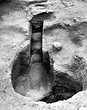
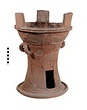
Grave (?) under wall 4. Infant burial(?); a kados, P 16747, lying sideways with a tall cylindrical stand, P 16748, set over it as a cover; the upper parts of the pots cut away ... Late 6th. c. B.C ... Infant burial(?); a kados, P 16747, lying sideways with a tall cylindrical stand, P 16748, set over it as a cover; the upper parts of the pots cut away. |
| Debris filling in a bronze casting pit and workshop, characterized by mold fragments but including also a few plain vases and fragments of wine jars. Third quarter of 4th. c. BC.
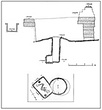
The pit was cut into the ... Ca. 350-325 B.C ... Debris filling in a bronze casting pit and workshop, characterized by mold fragments but including also a few plain vases and fragments of wine jars. ... The pit was cut into the soft bedrock to a depth of -1.43m and is 1.70m wide at its broadest extremity. The ground plan is that of a slightly lop-sided keyhole. |
Cistern chamber in the area of the southeast Temple, the mouth cut back in antiquity ... Late 4th - early 3rd c. B.C. |
Debris filling in a pit cut in bedrock at W side of House H, Room 10 ... Ca. 425-400 B.C ... Debris filling in a pit cut in bedrock at W side of House H, Room 10. |
| Cistern in the valley between the Areopagus and the Hill of the Nymphs. Simple, flask-shaped chamber withdraw-shaft; no tunnels. Mouth cut away in Byzantine times. Lower filling, 3rd c. B.C. Coins:
25 ... 25-30 April 1947 |
| Mycenaean tomb: Myc. III A:1-2.
SAI
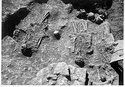
Small rectangular chamber, 2.30m wide by 1.80m deep,, entered from the east through a dromos 1.10m wide which contracted to a doorway 0.92m. wide. the doorway preserved ... 2nd half of 14th c ... Mycenaean tomb: Myc. III A:1-2.
SAI
Small rectangular chamber, 2.30m wide by 1.80m deep,, entered from the east through a dromos 1.10m wide which contracted to a doorway 0.92m. wide. the doorway preserved its rough stone blocking wall to a height of 0.70m to 0.80m., and the dromos the firm red earth with which it had been packed to a height of 1.30m.
Only the lower 0.50m of the chamber had been hewn from bedrock, the upper part being cut from very compact gravelly earth. ... Several earlier interments had been swept aside; some bones were found in the corners of the chamber. others in a small pit (0.55x0.30x0.23 deep)near the southeast corner |
| Side-chamber at the bottom of a circular shaft. AA 27; ST 103 from shaft above burial. PD 427 ... Neolithic |
| A cave-in not long after the digging of this shaft destroyed its possible usefulness as a well and thereafter it was used as a dump. Two principle periods of such use were noted, and within these several ... Ca. 575-480 B.C. |
|
|