|
|
Klepsydra: Filling in overflow channel = Channel A, North of Paved Bldg. (now T 26:7) Asterisk: T 26-27:1* ... Klepsydra: Filling in overflow channel = Channel A, North of Paved Bldg. |
| Filling in eastern channel at W. end of casting pit A 16:1. Early Roman (1st c. A.D.) but with some later disturbances (3rd. and 4th. c. A.D. and Byz.). P 25747 (VG thinks strayed from A 16:1)
Estimated ... 1st. c. A.D ... Filling in eastern channel at W. end of casting pit A 16:1. ... P 25747 (VG thinks strayed from A 16:1)
Estimated Grid |
Klepsydra: Filling in overflow channel = Channel A, North of Paved Bldg. (was T 26-27:1) Three layers, all containing a mixture of early material (LHIIIC and Protogeometric) with late Hellenistic and early ... Mid 1st. c. A.D. with later intrusions ... Klepsydra: Filling in overflow channel = Channel A, North of Paved Bldg. ... Three layers, all containing a mixture of early material (LHIIIC and Protogeometric) with late Hellenistic and early Roman, though in differing proportions. |
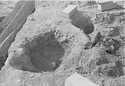
| Hole (Well) and adjoining water channel with 4th c. pottery, probably a dumped fill.
At a depth of about -5.70m we started yielding some very crude potsherds, clearly not made on the wheel (maybe Prehistoric) ... Prehistoric-Roman ... Hole (Well) and adjoining water channel with 4th c. pottery, probably a dumped fill.
At a depth of about -5.70m we started yielding some very crude potsherds, clearly not made on the wheel (maybe Prehistoric) p. 2367 ... B 1199 has been placed with A 16:1. |
Ostrakon deposit, sand fill in a shallow channel in bedrock at the bottom of the Great Drain in the valley between the Areopagus and the Hill of Nymphs.
This group of ostraka may well come from a single ... Ca. 490-480 B.C ... Ostrakon deposit, sand fill in a shallow channel in bedrock at the bottom of the Great Drain in the valley between the Areopagus and the Hill of Nymphs.
This group of ostraka may well come from a single ostrakophoria, but there is always the possibility that the water of the drain may have carried down earlier or later pieces ... 172 ostraka and a small amount of contemporary pottery, with a few later intrusions. |
Channel to West of Cistern at 63/ΞΒ. Part of Cistern System A which includes the cistern 63/ΞΒ (M 19:2), this channel to the west, and the manhole at 57-58/ΞΔ-ΞΕ. Coins:
31 May 1946 #1
3 June 1946 #1
6 ... Early 3rd c. B.C ... Channel to West of Cistern at 63/ΞΒ. Part of Cistern System A which includes the cistern 63/ΞΒ (M 19:2), this channel to the west, and the manhole at 57-58/ΞΔ-ΞΕ. |
Cistern (diameter 0.90m) with two channels; the fill of the cistern proper, below the scant upper (Byzantine) deposit, appears to have been dumped all at the same time, to 325-275 B.C. Notebook says "all ... 325-275 B.C. |
Channel J (in ΗΗ)
Cutting that probably originally held a drain. Packed with amphoras and other coarse pottery. It tapped the poros aqueduct wall just East of our explanatory trench at the East end of ... 1st c. B.C. - early 1st. A.D ... Channel J (in ΗΗ)
Cutting that probably originally held a drain. ... Then it swung sharply NW and N as though to avoid some building and moved down at great depth (1.62m)as though along a street ... MC 1045 possibly from channel. |
The cistern at 70/ΝΗ and the channel [65/ΞΑ] between chambers 70/ΝΗ and 63/ΞΒ seem to have a uniform dumped filling of first half 2nd c. A.D ... First half of 2nd c. A.D ... The cistern at 70/ΝΗ and the channel [65/ΞΑ] between chambers 70/ΝΗ and 63/ΞΒ seem to have a uniform dumped filling of first half 2nd c. |
In stone water channel and trench above. A. Walker? ... In stone water channel and trench above ... A. Walker? |
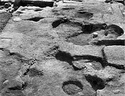
Drain channel system along the line of an ancient north-south road, the channel in part at the surface and in part tunneled and accessible by shafts. Over a considerable part of this channel the hard water ... 2nd-early 3rd c. A.D ... Drain channel system along the line of an ancient north-south road, the channel in part at the surface and in part tunneled and accessible by shafts. Over a considerable part of this channel the hard water deposit at the bottom, belonging to the period of use, is consistently of the second and early third centuries, although coins of Gallienus in the upper part of the filling show that the channel was not abandoned before the time of the Heruli. The channel actually extends over a considerable area (E-F 5-6).
|
Early cutting beside Great Drain: 103-111/Λ-ΛΓ (= "Deep cutting" Pit at 107/ΛΑ).
Abandonment filling in channel for early drain; the fragment of a red figured bell krater, P 17000, probably to be dated ... Ca. 425-395 B.C ... Abandonment filling in channel for early drain; the fragment of a red figured bell krater, P 17000, probably to be dated between 400 and 397 BC, is the latest dated object from the deposit, otherwise a consistent filling of the last quarter of the 5th. c. with some earlier material.
|
Water channel in north part of section. Coins:
20 February 1936 #2-#3
Five stamped amphora handles; Type 48 A lamp; one-third of bowls long-petal; one long-petal mold ... Second half of 3rd c.-Early third quarter of 2nd c ... Water channel in north part of section ... Coins:
20 February 1936 #2-#3
Five stamped amphora handles; Type 48 A lamp; one-third of bowls long-petal; one long-petal mold. |
| Rodney S. Young ... Destroyed urn cremation. No remains. Originally assigned as part of Tomb C 9:14 (Grave 7)
JP
"Large fragments of an urn were found in the packing of a Hellenistic water channel which cut through a LPG ... Final Mycenaean/Submycenaean ... Originally assigned as part of Tomb C 9:14 (Grave 7)
JP
"Large fragments of an urn were found in the packing of a Hellenistic water channel which cut through a LPG burial area and obliterated the urn and urn-hole of LPG grave C 9:14." ... P 6723, although surely an urn, rust-stained inside from the iron jewelry and within a meter of Grave C 9:14, is much earlier than the offerings in that grave and must have come from still another burial trench in the line of the water channel; a narrow burned strip along the edge of the channel opposite the fragments may be part of that trench.
|
| Report on sorting of pottery, August 1951, by H.S. Robinson [nb p. 3666].
Cistern discovered and dug to 1.60m., vi/10/36; dug to bottom iv/22/37-v/6/37. Diam. At mouth 0.26m.; neck begins to widen out ... 1st. c. B.C. to post-Herulian ... Well-plastered, without footholds; at 2.90-3.85m. a passage opens out to the south, curving slightly eastward, for 5.00m., at which point it is blocked by fill from another (cistern?) ... At 1.50m. appears the flow of an overflow channel connecting with the well at 105/ΝΗ. |
Cistern at 60/ΙΕ; bell-shaped cistern with a channel 1.65m high and 4.60m long, leading to a dead end against bedrock. This channel runs north with a slight curve to the east and looks as though it was ... Second half of 3rd c. B.C.-Early 2nd c. B.C ... Cistern at 60/ΙΕ; bell-shaped cistern with a channel 1.65m high and 4.60m long, leading to a dead end against bedrock. This channel runs north with a slight curve to the east and looks as though it was intended to meet a channel which started west from the cistern at 53/ΚΓ. |
Water channel in north part of Section: Channel Mouth 4. Coins:
22 February 1936 #16-#18
24 February 1936 #1-#2
Twenty stamped amphora handles; type 38 lamp; type 56 A lamp; over half of bowls long-petal ... 120-86 B.C ... Water channel in north part of Section: Channel Mouth 4 ... Coins:
22 February 1936 #16-#18
24 February 1936 #1-#2
Twenty stamped amphora handles; type 38 lamp; type 56 A lamp; over half of bowls long-petal. |
Dumped fill in a shaft which served as means of access leading to a water channel south of the Stoa of Attalos. Coins:
29 June 1933 #1 (disintegrated)
29 April 1936 #1-#3
4 May 1936 #1 ... Early 1st c. A.D ... Dumped fill in a shaft which served as means of access leading to a water channel south of the Stoa of Attalos. |
| A closely compacted group of 431 bronze coins found at ca. 52.50m., against the east brick wall. No sign of a container. Others dribbled down against the channel wall in a restricted area to as deep as ... Late Roman ... A closely compacted group of 431 bronze coins found at ca. 52.50m., against the east brick wall. No sign of a container. Others dribbled down against the channel wall in a restricted area to as deep as 52.07. Their date suggests a later deposition: the latest coins dating to the reign of Leo I, come into the 470's. |
Well in Room 1 of south aisle of Stoa. The well is lined with bricks and tile. This lining is preserved to a level of 52.733 m., which is approximately the same as the level off the late threshold of the ... 5th-6th c. A.D ... A channel had been dug through bedrock with its bottom at 49.321 m. ... Broken drain tiles were found further up in the channel. Pottery from the channel was the same as that from the well ... Pottery dated in the 5th century with a few 6th c. sherds. |
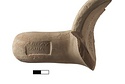
Well shaft cut through a cistern channel which was then packed with three amphorae (P 3123, P 3125, P 4201) of 1st or at latest early 2nd c. A.D. (These three amphorae could be considered with F 15:2) ... 3rd-4th c. A.D ... Well shaft cut through a cistern channel which was then packed with three amphorae (P 3123, P 3125, P 4201) of 1st or at latest early 2nd c. ... At 5.50 a group of fallen wall tiles arched over shaft which was empty to below 8.00 (at water level).
... It seems more likely that tiles were robbed in late 4th c., one 1st c. amphora of packing fell in and then a 4th c. dump was dropped in, capped by tile fragments; later a 5th c. dump on top.
|
Cistern A for 1935 (there is another Cistern A, for 1936, D-E 8-9:1) Coins:
16 May 1935 #4-#5
17 May 1935 #1-#2
18 May 1935 #1-#2
20 May 1935 #1-#2
22 May 1935 #1
23 May 1935 #2-#6
24 May 1935 #1-#7
25 ... 16-25 May 1935
6 February 1936 ... Cistern A for 1935 (there is another Cistern A, for 1936, D-E 8-9:1) ... Also, from rock-cut channel leading south from cistern (27/8/1961) S 589, S 590, SS 4316, IL 254, IL 258, IL 286, T 885, T 901, A 578, P 5947, P 6449 and coins ΠΘ-34, ΠΘ-35. |
Cistern at 63/ΛΑ (part of cistern system 63/ΛΑ-65/ΜΑ-70/ΛΣΤ, consisting of two chambers and a well). Roman upper fill with modern cesspool fill above. Channel finds: MC 517, SS 8078.
Only datable object ... 300-195 B.C ... Cistern at 63/ΛΑ (part of cistern system 63/ΛΑ-65/ΜΑ-70/ΛΣΤ, consisting of two chambers and a well). Roman upper fill with modern cesspool fill above. Channel finds: MC 517, SS 8078.
Only datable object a Rhodian stamped amphora handle (ca. 211). |
| Cistern at 53/ΚΓ and channels. The pottery in the cistern and in the two channels was a thoroughly mixed lot of broken material from 5th c. B.C. to 4th c. A.D. and all seemed the same except the bottom ... 5th c. B.C.-4th c. A.D ... The pottery in the cistern and in the two channels was a thoroughly mixed lot of broken material from 5th c. ... A.D. and all seemed the same except the bottom fill in the manhole (nb. p. 616) which was a rather consistent lot of coarse pottery, about 3rd c. ... South Channel (to manhole O 19:8)
West Channel (dead end)
Northeast Channel (blocked off) |
Well (diameter 0.91m, water level -7m) in House H, Room 10 (and pit over). Plain shaft cut in stereo; pit at mouth of well,reused as drainage pit at start of tile drain running west.
Scanty use filling ... Ca. 425-400 B.C ... Scanty use filling at bottom; above this, a broken bedrock fill and above that a dumped filling. The upper part of the well was lined with tiles in the second half of the 4th. c. for use as a collecting basin for a water system, a channel of which entered the well shaft. ... P 18400, although found in the drain channel, appears to be a good 5th c. collar rim type,and was perhaps dislodged in this same disturbance. |
| Handler ... Found in an area of disturbed fill north of a floor surface in Room 4 of the Classical Commercial Building. The floor surface (n. 3 on the west side of Room 4) was preserved at 52.503-52.544 masl., and ... 2nd half 4th c. B.C ... Found in an area of disturbed fill north of a floor surface in Room 4 of the Classical Commercial Building. ... The pyre was located in a shallow channel adjacent to the south face of Wall 4, where the floor surface was not preserved ... AS 1396.3 in Study Collections-Case No. 99C-2 box V, while a bone bag now stored in drawer 33 (animal bones) |
Within the precinct of the Hephaisteion, about 10m. north of the north stylobate of the temple.
Flask-shaped pit (W. (bottom) 3.14 x 2.73m) probably originally intended as a cistern; used for dumping ... Ca. 375-310 B.C.-Byzantine ... (bottom) 3.14 x 2.73m) probably originally intended as a cistern; used for dumping waste from a metal furnace. A substantial mass of iron slag found at the bottom along with a thick waste of bricks, charcoal and sand and a quantity of pottery. ... Container 299 represents fill from channel leading from 60/ΛΗ. |
Construction fill below floor of Brick Building.
Areas involved:
a) Western portion of Room A: packing below floor.
b) Room B: packing below floor of northern,larger room.
c) Fill over water channel in ... First quarter 2nd century, before its end ... Areas involved:
a) Western portion of Room A: packing below floor.
b) Room B: packing below floor of northern,larger room.
c) Fill over water channel in smaller, southern room B; channel discovered by builders of Brick Building,rebuilt by them and covered over.
d) Foundation trench of earlier building beneath Brick Building, filled and covered by builders of Brick Building.
e) "Apparently from below floor of building" (nb.p. 1282).
... Type 48 A lamp. No long-petal bowls ... Lot 20 "Ash, Carbon and Slag Fill, against the west face of dividing wall between Rooms A and B" of 1936 excavations including P 19790, SS 5379 and coin ΣΑ-16. |
Material from trenches:
a) 1.00-7.00m. from East End of Stoa.
b) 18.40-21.40m. from East End of Stoa.
c) 46.60-48-60m. from East End of Stoa.
d) 51.00-53.00m. from East End of Stoa.
e) 79.00-81.00m. from ... 2nd c. B.C ... Material from trenches:
a) 1.00-7.00m. from East End of Stoa.
b) 18.40-21.40m. from East End of Stoa.
c) 46.60-48-60m. from East End of Stoa.
d) 51.00-53.00m. from East End of Stoa.
e) 79.00-81.00m. from East End of Stoa.
Includes drain trench in front of back wall of Stoa (some disturbed, some undisturbed fill), soft fill above stone drain, fill from within stone drain, channel behind stylobate. |
| Shallow pit below layer I in Stoa Shop VI (Pyre)
Diameter 0.90; D. 0.15m Under shop VI of the Stoa of Attalos Pottery, ash, burning and packing of small stones in pit in stratum. The pyre was covered by ... Ca. 350 or 325 B.C. ? ... Layer II in turn covered a cobbled surface flush with a water channel. ... No contemporary structures, wells, or cisterns were preserved in this area, but it is about 10m south of the mudbrick commercial building that functioned in the second quarter of the 2nd c., and had a predecessor of unknown date. |
| Rodney S. Young ... Grave 7 in notebook (E.L. Smithson: Grave XXI: PG). Bones discarded. Disturbed and damaged cremation (originally trench-and-hole), the east end cut away, probably contained the burial urn.
JP
It consisted ... Late Protogeometric ... JP
It consisted of a rectangular trench cut through hard-packed fill and slightly into bedrock to a depth of 0.48m. the trench oriented east-west, had a preserved length of 0.70m and a width of 0.60m. The east end where the cinerary urn would have originally been located in an urn-hole, was almost completely cut away by the Hellenistic water channel that skirted the tomb to the south. evidence of heavy burning, in the form of reddened earth, was noted on the ground around the mouth, rim, floor and three sides of the trench. The preserved east end, built up from redeposited green schist bedrock streaked with reddened earth, may have been a barrier between the destroyed urn-hole and the pyre trench, constructed after the fire had subsided. |
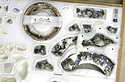
| Laura Gawlinski ... Bronze foundry north of bridge on Piraeus street, east of Great Drain.
Keyhole-shaped bronze casting pit, cut into bedrock.
2016: Continuation of the excavation of a rectangular pit with foundry debris, ... Late 6th-early 5th c. B.C.
(Late Archaic/ Early Classical) ... Pit cut into bedrock at west and north; fill continues beneath later wall (“Wall A”) at east. Appears to be cut into fill at south, but that area is disturbed by a modern water pipe from the landscaping of the Agora. ... We reached a maximum depth of 59.781m by the end of the 2016 season, but more remains to be excavated.
2017-2018: Upper level disturbed by modern water pipe at southwest and Wall A (probably Hellenistic) at east. ... Seven standing mudbricks line the bedrock wall at south, surrounding a ceramic stand, hand-formed on a cut bedrock base. |
Filling of Middle Drain (Tr. H+F in Section Ζ). Sand and gravel filling of the old course of the west branch of the Great Drain, a large (ca. 1.00m. deep and 1.30m. wide) underground channel in the area ... 150-100 B.C ... Sand and gravel filling of the old course of the west branch of the Great Drain, a large (ca. 1.00m. deep and 1.30m. wide) underground channel in the area of the Tholos. |
|
|