|
|
Fillings below the courtyard floor of the Poros Enclosure west of the Areopagus. The lowest layer, over bedrock, is of the archaic period and may have accumulated on the spot before the start of building ... First half of 5th c. B.C. |
| North of House G (RSY=Pyre 13).
Concentration of artifacts, small pieces of bone, and burnt material in stratum, no pit discerned. The pyre is cut by the trench of a wall of a Roman house to north. It ... 290-250 B.C. |
Pit (Well?) under Building A, Room 2. Coins:
9 May 1949 #1-#2
11 May 1949 #4
12 May 1949 #3 (not a coin, bronze fragment in lotted metal tins ΠΠ 295). Estimated Grid
Remains of coloring matter found with ... Hellenistic-Early Roman ... Coins:
9 May 1949 #1-#2
11 May 1949 #4
12 May 1949 #3 (not a coin, bronze fragment in lotted metal tins ΠΠ 295) ... Estimated Grid
Remains of coloring matter found with 4th c. sherds. |
Well, unfinished?
The shallow depth, small diameter, lack of water and any use fill make it possible that this was not a well, although the character of the cutting is difficult to explain otherwise. The ... Ca. 440-420 B.C. |
Cistern System #1b: Shaft/manhole and gallery at 18-19/ΞΑ-ΞΓ.
Objects divided between the two features, shaft and gallery, according to deposit notebook list, not according to remarks on cards. 22 February ... Late 1st c. B.C.-early 1st c. A.D. |
According to the excavator " a pre-herulian filling dumped in to fill the cistern some few years after the Herulian destruction". Coins:
10 June 1936 #2-#6
11 June 1936 #1-#19
12 June 1936 #23-#27 P 11936 ... A.D. 267 to mid 3rd c ... P 11936 and L 2555 from passage between cisterns at 106/ΛΓ and 107/ΚΘ but not recored as part of deposit C 14:2, see nb.p. 3559. |
Cistern System #1e: Shaft at 11/ΞΑ.
Agora XXIX: "Well (not cistern shaft, as in Agora XII) ... Communicates with water system through small hole (see C 8:1) probably fortuitously. Single fill, mostly of ... 350-300 B.C ... Agora XXIX: "Well (not cistern shaft, as in Agora XII) ... Communicates with water system through small hole (see C 8:1) probably fortuitously. |
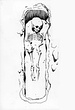
| Rodney S. Young ... Grave 8 in notebook. Bones discarded. Fragments of an iron pin found on the chest and a fragment of a Protogeometric krater base found beside the body were not inventoried.
JP
Unlined roughly rectangular ... LH III/EPG (date uncertain) |
Great Drain fills, including "packing over elliptical tiles" and "gravel fills". The central drain area covered by the sections below; other sections are with other deposits. Coins:
9 May 1947 #2-#5
16 ... 1st c. A.D. |
| Artifacts, burnt bone, ash, cinders and charcoal in pit in bedrock. The pyre lay directly under mosaic floor A. the deposit is not badly disturbed, however, and it is possible that it was laid immediately ... Early second quarter of 4th c. B.C. |
| James H. Oliver ... (E.L. Smithson: Grave IX: PG). Two children's skeletons one on top of the other. Cf. PD 329 for PD 430 for second skeleton, same deposit.
PG grave about 25m. SW of Cistern A at 46/ΜΔ.
[In some records, ... Developed Protogeometric |
| Rodney S. Young ... Grave 2 in notebook (E.L. Smithson: Grave XV: PG). Urn cremation (trench-and-hole), adult female.
JP
It consists of a roughly rectangular pit or trench cut into bedrock to a depth of 0.35m., measuring ... Late Protogeometric |
| Rodney S. Young ... Grave 19 (In some records as Grave VIII). No remains, no burned matter or traces of burning.
JP
A small cutting with a single offering. The pit may have been for a simple child/infant inhumation, with ... Early Protogeometric |
Roman well, stratified.
Finds from the earth (not recorded in a subdivision):
P 7995, P 8036, P 21834, SS 6338, IL 483, IL 486, BI 309, BI 310,
BI 314.
According to the excavator the shaft had been cleaned ... 2nd-4th c. A.D. |
| Rodney S. Young ... Grave 6 in notebook (E.L. Smithson: Grave XXII: PG). Bones discarded. Urn cremation (trench-and-hole).
JP
Roughly rectangular trench cut through hard earth into bedrock to a depth of about 0.35m, approximately ... Late Protogeometric |
House R, fill under drain tiles and fillings associated with house K in industrial area, including what was C 19:15, plus C 19:16 and
C 19:17.
a) House built as dwelling in second half of 5th.c.
b) Used ... Ca. 5th and 4th c. B.C ... House R, fill under drain tiles and fillings associated with house K in industrial area, including what was C 19:15, plus C 19:16 and
C 19:17.
a) House built as dwelling in second half of 5th.c.
b) Used as marble-workers' shop from beginning of 4th. c. to near middle of century. Rebuilt as an industrial establishment about middle of 4th. c.
c) Area built over in Hellenistic times.
... B.C. It is not always possible to distinguish between these two periods; the objects from both, mostly of the late 5th into the first half of the 4th c., have been listed together. |
Hellenistic-Early Roman fill over bedrock, along west side of Kolonos Agoraios. Consistent dumped filling; occasionally there is a late Roman fragment intruded from the filling above, but this seems not ... 26-29 February 1936
2-12 March 1936 |
"baskets" 1-5 Coins:
22 April 1937 #7
23 April 1937 #17-#18
24 April 1937 #1
coins from Dump:
28 May 1937 #31-#32 ADDENDA Top-early 4th. c. consistent with coins of Licinius and Maximinus in good condition ... post-Herulian |
Well at 32/ΣΤ ... Late 6th c. B.C. |
Coins from dump:
27 May 1937 #2-#9
28 May 1937 #3-#11 Not later than 3rd. c. A.D ... 3rd. c. A.D ... Not later than 3rd. c. |
Well 2: archaic. Diameter, top ca. 1.00; bottom ca. 0.90m.
Water level:ca -7.00m In the use filling, along with the plain water pots was a black-figured neck amphora assigned to the Edinburgh painter ... Last quarter of the 6th c. B.C. |
Cf. P 3736, from the original "packing behind poros benches". Not from the pit itself it is therefore not listed with this deposit ... 5th c. B.C. |
| Grave XV in notebook = RSY Grave 1.
Part of a burial jar with bones of 18-month-old child. Position of body not determinable. Foot of jar had been broken to insert body of child and stopped with stones ... Second half of 8th. c. B.C. |
"Not much earlier than middle fill" Coins:
12 February 1937 #5-#7 ... Fourth quarter of 2nd c. B.C. |
Great Hole at 33/Ζ = Area of early wells Some of the objects may have come from N 18:7 or from a neighboring 7th c, well, not separately cleared, but no definite association is possible ... 7th-5th c. B.C ... Some of the objects may have come from N 18:7 or from a neighboring 7th c, well, not separately cleared, but no definite association is possible. |
Investigations in the Hellenistic Metroon, various levels. Stoa Pits A, B, C, D, E, F, H and I (various layers).
Locations include:
SW corner of Primitive Bouleuterion; from contemporary filling alongside ... 8th-6th c. B.C ... Stoa Pits A, B, C, D, E, F, H and I (various layers).
... Levels include:
- 8th and 7th c. B.C.
- early 6th c. ... B.C.
- not later than 6th c. |
Well at ΜΣΤ,ΜΗ/112. Collapsing bedrock prevented us from reaching bottom. Not A. Walker but same scenario ... 7th-Mid 6th c. B.C. |
Well at 19/ΙΑ (corrected from O 13:2) Incised bowl
Graffito bowl
Water jug x2
Small amphora
Amphora x2
Canteen x2 Tins 132-138 (not found in notebook) ... 12th c. A.D. |
| Hole (Well) and adjoining water channel with 4th c. pottery, probably a dumped fill.
At a depth of about -5.70m we started yielding some very crude potsherds, clearly not made on the wheel (maybe Prehistoric) ... Prehistoric-Roman ... Hole (Well) and adjoining water channel with 4th c. pottery, probably a dumped fill.
At a depth of about -5.70m we started yielding some very crude potsherds, clearly not made on the wheel (maybe Prehistoric) p. 2367. |
| Coins:
16 June 1981 #89
17 June 1981 #94-#95, #100 (not a coin).
19 June 1981 #103-#104, #335-#336
23 June 1981 #111-#112 ... 9th-13th c. A.D. |
Rectangular shaft at northwest foot of Areopagus; dumped filling of second half of 4th c. B.C. Pit at 16/Δ-Ε recorded one time as an extension of shaft 17/Δ-Ε (see L 506 and nb.p. 395), but items from ... Ca. 325-275 B.C ... Rectangular shaft at northwest foot of Areopagus; dumped filling of second half of 4th c. B.C. Pit at 16/Δ-Ε recorded one time as an extension of shaft 17/Δ-Ε (see L 506 and nb.p. 395), but items from there are not recorded with this deposit. |
Rectangular cutting, not entirely preserved, west of underground drain. Contained good black glazed pottery, some stamped, and a little coarse ware, along with bits of bone and part of a skull ... Third quarter 5th c. B.C. |
Shaft fill, not mouth fill, of drawshaft at 42/Θ. This is part of the cistern system 44/ΙΓ - 46/ΙΑ - 42/Θ.
Thirteen stamped amphora handles; fragments of Arretine pottery; over half of bowls long-petal ... 1st c. B.C.-early 1st c. A.D. |
Well G, just south of Room D. It was finally filled in the 6th c. A.D. with some attractive sculpture. Its contents suggest that the building was not used for metal work, but was purely domestic containing ... 3rd-6th c. A.D ... It was finally filled in the 6th c. A.D. with some attractive sculpture ... Its contents suggest that the building was not used for metal work, but was purely domestic containing abundant household pottery, remnants of wood, bone, stone, fruit stones and animal bones, especially of boar and goat. |
East-West Street (63-64/ΙΣΤ, etc.)
Packing in line of ancient east-west street along Areopagus north slopes.
Lower fills, predominantly late 6th-early 5th c. B.C.
Middle fills, last quarter of the 5th ... Various levels and dates ... Lower fills, predominantly late 6th-early 5th c. B.C.
Middle fills, last quarter of the 5th c.
Upper fills, 4th to 3rd c. B.C.
These fills correspond closely to the apparent three periods of a house of which very scanty remains were observed directly to the south of the street: notebook House D ... In these fillings there are occasional later disturbances at various points, but they do not affect the dates of the fillings as indicated by the inventoried pieces. |
Investigations in the area of the Odeion: lettered Odeion Trenches not otherwise specified.
The trenches were excavated by layers; these layers could be compared across the area to determine correlation ... 1st c. B.C. |
| Roman Bath, Herulian destruction debris in A3. The high proportion of vessels for eating suggests that this was not the actual bath fill but was probably dumped in from the ruined houses higher on the ... Second half of 3rd and into 4th c. A.D. |
Cistern at 70/ΛΣΤ in the northeast slope of the Areopagus.
Part of system with two chambers and well. Homogeneous fill.
13 stamped amphora handles. Latest lamp type 46 B. N 72206 (Ω-344), picked up near ... Second half of 3rd c. - Early 2nd c. B.C. |
Dug bedrock filling in a well of unusually large diameter (1.35m.), possibly the original source of water for a factory for making terracotta figurines (water for the workshop with waterproofed floor and ... 4th. c. B.C ... Great caves and caverns below surface where soft stereo had fallen.Well fill not reached ... Scattered pottery fragments of the 4th c. B.C.; topographical considerations however indicate that the well was probably not filled in before Roman times; the context is thus irrelevant for the Classical period. |
| Although separated by a sterile rocky fill the two use fillings are apparently one continuous accumulation (GRE).
Packing around well includes SS 14261, P 25943-P 25953. These are not given a subdivision ... 350-300 B.C. to ca. 225 B.C ... These are not given a subdivision and are dated to third quarter 4th c. |
|
|