|
|
| Grave XVI in notebook = RSY Grave 3.
Bones of a young child found inside. Discarded? ... 6th. c. B.C ... Hesperia 20 (1951), p. 87, pls. 35 d and 38 c, e (Grave 3). |
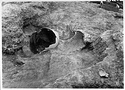
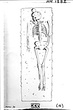
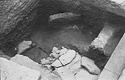
| Grave XXV in notebook = RSY Grave 4. PD 731-b ... 750-725 B.C ... Hesperia 20 (1951), pp. 87-88, fig. 6 and pl. 38 a-c (Grave 4). |
| Susan I. Rotroff ... Grave 2 (bis). Cut into by builders of I 5:2. No remains.
Possible contents in I 4-5:1 Layer C (= layer 6, lower building fill), catalogued as ΒΓ 2065 - ΒΓ 2125 ... Middle Helladic or later Bronze Age (date uncertain) |
| Phaidon Street Cistern: North Chamber
Sullan destruction debris. One of two chambers connected by tunnel.
Two latest coins date to 87/86. Gray ware lamp of first quarter of 1st c. A.D. indicates disturbance ... 2nd c. B.C ... Two latest coins date to 87/86. Gray ware lamp of first quarter of 1st c. |
| Dumped filling of late 2nd c. B.C.; Roman Group F, dumped filling of second quarter to end of 1st c. B.C. on the lower northeast slope of the Areopagus.
Diameter at bottom -3.20m Upper fill: Latest coins ... Second quarter to end of 1st c. B.C ... Dumped filling of late 2nd c. B.C.; Roman Group F, dumped filling of second quarter to end of 1st c. ... Two coins of 87/86 and several more either of 87/86 or slightly earlier. |
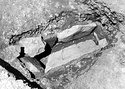
| Susan I. Rotroff ... Burial 3 beneath the floor of the Stoa Basileios. It consisted of a rectangular pit cut into bedrock to a depth of 0.44m, lined on all sides and covered with an admixture of narrow stone slabs of soft ... Final Mycenaean/Submycenaean ... Hesperia 87 (2018) pp. 226, 227 ... Hesperia 44 (1975), pp. 372-374, pl. 83,c. |
Child's burial in south wall of Marble Worker's House.
Bones examined 20 June 1975 and found to be an immature animal, not human (canid-puppy?).
Identified as pyre by SIR. Set into a shallow roughly ovoid ... Late 4th c. |
| An area about 10m2. on the lower northwest slopes of the Areopagus, southeast of the archaic fountain house. A dumped fill to the end of the 3rd quarter of the 7th c. B.C., containing many votives, overlying ... 7th c. - 625 B.C. |
The pottery of the first six meters (containers 1-3 of 117 containers total) contains a good deal of unglazed early Byzantine along with very late Roman. Below this begins a great mass of Roman pottery ... 4th-6th c. A.D. POU |
Fillings to either side of the Great Drain, in the southern part of the area west of the Areopagus; various levels, late 6th. and early 5th c. B.C. to Sullan destruction. Coins:
26 July 1946 #1-#2
30 July ... Late 6th. c. B.C.-1st. c. A.D ... Late 6th. c. B.C.-1st. c. A.D ... ΞΞ:87-102/Λ-ΜΕ |
Cistern at 9/Β (10/Β on plan), at the NW foot of the Areopagus, some 200m to the west of the Coroplast's Dump. It had evidently belonged to one of the small houses in that thickly populated residential ... Second half 4th c. B.C. |
| Mycenaean grave.
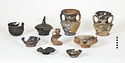
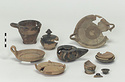
Small pit grave (0.50m by 1.35m by 0.75m deep) containing the skeleton of an infant girl. Although a simple grave with a single interment, the pit was packed with gifts. These consisted ... No later than mid-15th c ... Hesperia 21 (1952), pp. 107-108, pl. 26 c. ... Agora XIII, pp. 205-208, 274, pls. 47, 65-66, 75, 77, 79, 87 (Grave XVI). |
| Pyre(?) in House N, S.W. Room. (=House C, Room 10)
In room 10. Vessels from an earlier pyre were found dispersed in the makeup of the latest "floor" in the room, with tile fragments trodden into its surface ... First quarter of the 4th c. B.C ... First quarter of the 4th c. B.C ... ΝΝ:84-87/ΜΖ-Ν |
Drain channel system along the line of an ancient north-south road, the channel in part at the surface and in part tunneled and accessible by shafts. Over a considerable part of this channel the hard water ... 2nd-early 3rd c. A.D ... 2nd-early 3rd c. A.D ... ΛΛ:87-88/ΚΣΤ-Λ |
Middle Stoa Building Fill (with filling to S) (See also Κ: H-I-J 14-15 and Λ: K-M 13-14)
This deposit is not definitive and must be considered with the above deposits before details are entered into database; ... To ca. 180 B.C. |
|
|