|
|
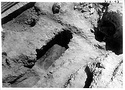
| Dorothy Burr Thompson ... Grave 14 in notebook. Cutting in bedrock. Cremation: bones in pit (E.L. Smithson: Grave XXIV: PG). Bones discarded.
[JP] Nb. says at 16-17/ΞΖ and 16/ΞΖ on cards and on deposit list.(SD) ... Early Geometric I |
Coins:
30 July 1947 #3-#11
31 July 1947 #4-#19
1 August 1947 #1-#9
4 August 1947 #1-#20
5 August 1947 #3-#20
6 August 1947 #1-#38
7 August 1947 #1-#21
8 August 1947 #1-#41
9 August 1947 #3-#6
57-59/*
66-67/* ... 28-31 July 1947
6-9 August 1947 |
(Roman Group J). The upper fill to a depth of ca. 16.00m. was of earth scooped up elsewhere and thrown in ... The latest piece noted from this fill was a TC fragment dated late 4th to 5th(?) c. BC. From ... 2nd.-3rd. c. A.D. |
| Identified as pyre by SIR.
In room E. Burnt "pocket" found while digging red earth that contained late Hellenistic pottery, including a fragment of Pergamene (discarded). No pit was discerned, but concentration ... 3rd quarter 4th c. B.C. |
Cistern at 63/ΞΒ and channel leading west from cistern to west edge of section; also manhole at 57-58/ΞΔ-ΞΕ.
Possible further connection with other cisterns, e. g. at east edge of section Υ and/or cistern ... Cistern at 63/ΞΒ and channel leading west from cistern to west edge of section; also manhole at 57-58/ΞΔ-ΞΕ.
Possible further connection with other cisterns, e. g. at east edge of section Υ and/or cistern and channel,ΔΔ 113/Α' (L 19:2) ... Use filling of 1st to early 2nd c. dump fillings of 4th and 5th to 6th c. |
| Sacrificial Pyre = Pit in floor (identified as pyre by SIR); with the characteristic small plates and saucers. "Saucer Grave" at 12/ΚΑ.
Dimensions: 2m (length)x 0.70 (width).
North of north wall of building ... First half 4th c. B.C. |
| Pocket, identified as sacrificial pyre by SIR. Possibly disturbed. Outside south wall of building. Concentration of pottery in a small pocket below a "Hellenistic" fill. There is no mention of bone or ... First quarter 4th c. B.C. |
| In room A. Concentration of artifacts and burning in stratum, no pit discerned. The pyre lay below a Late Hellenistic fill with a smooth earth surface. It is described as a black patch of earth with sherds, ... 350-250 B.C. |
Outside the market square, near the southeast corner, on the south edge of the east-west road, where it passes to the south of the Mint.
There is no doubt that the pottery from the well is "stratified" ... Early 1st to 6th c. and of 8th c. A.D. |
Channel to West of Cistern at 63/ΞΒ. Part of Cistern System A which includes the cistern 63/ΞΒ (M 19:2), this channel to the west, and the manhole at 57-58/ΞΔ-ΞΕ. Coins:
31 May 1946 #1
3 June 1946 #1
6 ... Early 3rd c. B.C. |
| Mycenaean Small Chamber tomb.
The cist measures 1,90m E to W, 0.75-0.90m N to S, max. depth -1.30m. Nothing was found in it; cleaned in modern times and used as a cesspool. Some of the SW part of it had ... Myc. IIIA, early 14th c ... IIIA, early 14th c ... ΕΕ:57/ΙΘ |
Actually 1 meter into section Δ, the well lies under a filling of primarily Hellenistic date which had been thrown in as underpinning for the support of a 2nd c. A.D. Roman tile-mosaic floor.
POU is 15.80-16.35m ... First half of 1st c. A.D ... Actually 1 meter into section Δ, the well lies under a filling of primarily Hellenistic date which had been thrown in as underpinning for the support of a 2nd c. A.D. Roman tile-mosaic floor.
... Lot 51-54 : now in one tin [tenkes'.
Lot 55-57 : not found in 2007. |
| A well on the lower slope of the Hill of the Nymphs, (diam. 1.20m -water level -7m), to 7.90m. The scanty use filling at the bottom contained water jars and pitchers as well as the inventoried objects; ... Second quarter of 6th. c. B.C ... Second quarter of 6th. c. B.C ... ΝΝ:57-58/ΞΗ-ΞΘ |
| Laura Gawlinski ... Well in courtyard of Early Building I, adjacent to wall of Room B. Tile lined; upper course in situ, lower two collapsed probably in antiquity. Letters inscribed on rims (eta, phi, omicron, theta). Medium ... First quarter of the 4th c. B.C. |
Hellenistic fill South of Middle Stoa near NW corner of Heliaea. This fill contained material later in date than that which made up the middle Stoa Building Fill.
Only the coins (and a few amphora handles ... To ca. 140 B.C ... See Hesperia 57 (1988), pp. 88-89 for a description of the dating and "The lots collected in Kleiner's Deposit III, however, do not seem to form a logical stratigraphic unit ... " ... Descriptions on coin envelopes:
Hell fills of middle stoa and s of drain c (lowest);
Hell fill over intermediate strosis + cutting intermed. strosis 22/ΛΒ;
20/ΛΔ Hell fill.
|
Michael Laughy ... West and adjacent to Modern Wall 5, we excavated 12th-13th c. A.D. fill, in some places a half meter deep or more. The fill was remarkably uniform in content throughout. Typical pottery included: fine ... 12th-13th c. A.D ... West and adjacent to Modern Wall 5, we excavated 12th-13th c. A.D. fill, in some places a half meter deep or more. ... At the time of this summary, the legible coins are Frankish, and date to the early 13th c. A.D.
Coins: ΒΘ-96; ΒΘ-98 -128; ΒΘ-135 -145
Pottery lots: T 141, T 143
Notebook: ΒΘ VIII
Baskets: 43, 57; pp. 1557, 1587
X-Section: pp. 1460, 1500
Grid: K/6,9-3/5,9
Elevation: 54.544-54.111m. |
Middle Stoa Building Fill (with filling to S) (See also Κ: H-I-J 14-15 and Λ: K-M 13-14)
This deposit is not definitive and must be considered with the above deposits before details are entered into database; ... To ca. 180 B.C. |
|
|