|
|
| Rodney S. Young ... Grave 9 (E.L. Smithson: Grave XVIII: PG). Bones discarded.
JP
Roughly circular pit, about 0.59m in diameter, cut into soft bedrock to a depth of 0.42m. Tomb encountered only about 0.12-0.15m below the ... Protogeometric |
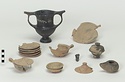
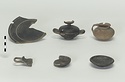
| Artifacts, burnt bone, ash, cinders and charcoal in pit in bedrock. The pyre lay directly under mosaic floor A. the deposit is not badly disturbed, however, and it is possible that it was laid immediately ... Early second quarter of 4th c. B.C. |
Chamber cistern at 95/Κ and Cistern shaft at 95/ΚΕ plus the passage between. System heavily disturbed throughout in Turkish times except for a small amount of red fill on floor of shaft. Coins:
4 May 1936 ... Hellenistic |
| North of House G (RSY=Pyre 13).
Concentration of artifacts, small pieces of bone, and burnt material in stratum, no pit discerned. The pyre is cut by the trench of a wall of a Roman house to north. It ... 290-250 B.C. |
RSY Grave 49. Outside Archaic Cemetery ... 550-525 B.C ... Hesperia 20 (1951), p. 108, pls. 47 c, 48 a (Grave 49). |
| Pit in Layer 9, lined on the sides and bottom with small stones ... Late 5th c. B.C. |
A small concentration of pottery in lowest 1.80m., possibly a use fill. Three fills above, with little pottery, ranging from Hellenistic to late Roman in date. Coins:
26 February 1934 #4-#6
27 February ... 325-200 B.C. |
| Pyre in House C, Room 12 (RSY=Pyre 9) in the industrial area west of the Areopagus.
Notebook refers to House N.
Beside west wall of room 12. Pottery, burnt bone, and cinders in a roughly round pit; disturbed ... Ca. 250 B.C ... Hesperia Suppl. 47 (2013), no. 47, p. 159, 160, figs. 78, 92, 93 ... Hesperia 20 (1951), pp. 125-126, pl. 52 c (Pyre 9). |
| Grave (?). Identified as pyre by SIR.
Pyre pots dispersed in fill over a pebble floor, with pottery ranging from the 5th c. B.C. to 3rd c. A.D. (lot ΑΑ 168), and lying directly below modern fill. No burning ... 400-350 B.C. |
| Pyre in House C, Room 8 (RSY=Pyre 6).
Near east corner of room 8. Artifacts, burnt bone, burnt sticks, and large cinders in a shallow pit dug into surface of layer 3, and covered by layer 2. Some cinders ... 350-325 B.C.-end of 4th c. B.C ... Hesperia Suppl. 47 (2013), no. 43, p. 155, figs. 78, 85, 86 ... Hesperia 20 (1951), pp. 120-121, pl. 51 c (Pyre 6). |
Containers 43-47. Coins:
22 April 1939 #1-#2
25 April 1939 #1
15 May 1939 #1 ... 3rd c. A.D. |
See I 870, a piece of which was found in disturbed red fill in Β' southeast of Tholos.
Although apparently from the same context as P 5339 (tins 24-26, undisturbed fill), P 5336-P 5338 are recorded from ... 27 February-8 April 1935 |
| Mike Laughy ... This pyre was found within an otherwise mostly sterile fill directly under a white floor surface in the southern section of Area IV. It was located ca. 0.50m. east of a similar deposit, Pyre J 2:25. The ... 4th c. B.C. |
Deposit of jewelry in hypocaust area (92/ΙΗ) of Bath to East of Poros Building. Coins:
8 April 1948 #12-#47 ... 2nd-3rd c A.D. |
Deposit alongside Greek House I, perhaps giving the construction date of the second phase. Deposit list title it as : outside of east wall of Roman House H ... Last quarter of the 4th c. B.C. |
| Laura Gawlinski ... Circular pit uncovered in Early Building II, south of Room E latrine, adjacent to the preserved latrine floor surface. Continues beneath the latrine surface and the western scarp (unexcavated). Fill relatively ... Late 5th c. B.C. |
| A well at the northeast corner of Classical Building, behind back wall. Dumped fill appears to have occurred as a single event as there are joining sherds throughout.
POU date ca. first half 5th c. B.C.; ... 5th c. B.C. |
| Marcie Handler ... It was situated in the NW corner of Room 3 in the Classical Commercial Building, just S of Wall 11, the cross-wall that divides Room 3 from Room 4 to the north. The pyre pots were found surrounded by ... Late 4th c. B.C. |
Diameter 0.80m. Water level -2m. Tiled well; height of tiles 0.67m. well in court (Room 3) of House N.
Late Hellenistic destruction fill (Pergamene etc) to -7m;
Sand without a well deposit (lamp Type ... 1st c. B.C. to 1st c. A.D. |
Greek House J, under room 8 of Roman House H.
Typical though very fragmentary pyre pottery lay dispersed in a stratum over bedrock with pottery ranging from the 5th to the mid-3rd c.
In same general area ... Early 4th c. B.C.? |
| Pyre in north central room of house, measuring 0.50m east-west by 0.35m north-south. Pottery, bone, and burnt material in pit dug into layer IIb (crushed bedrock floor: lot Ω 464, 4th c.) and covered by ... 350-325 B.C. |
| Disturbed pyre in NE stoa area.
In western room of westernmost shop building. A patch of ash i or at the level of layer 2 (lot Ι 189d), partially destroyed by modern wall. Pottery from layer 2 dates ... 400-350? |
West Terrace, South End, Layers IV and V. Heavy dumped filling associated with terrace walls at the extreme south end of the excavations in the Areopagus industrial area. The proportion of figured and ... Ca. 420-390 B.C. |
| Pocket with burning at 60/ΚΗ. "Is this perhaps a disturbed pyre burial." [Nbp. 2928].
Identified as pyre by SIR.
Near north end of corridor, beside its west wall. Concentration of artifacts, tiny scraps ... 4th c. B.C. |
| Identified as pyre by SIR.
In room E. Burnt "pocket" found while digging red earth that contained late Hellenistic pottery, including a fragment of Pergamene (discarded). No pit was discerned, but concentration ... 3rd quarter 4th c. B.C. |
Classical commercial building, room 3, against south wall. Small fragments of pottery dispersed in fill overlying two floor levels (at 51.897 and 51.941 masl). Five objects of pyre type: ribbon-handled ... 4th c. B.C. |
| Identified as Pyre by SIR.
Debris filling of the middle of the 4th c. B.C. including the remains of a sacrificial pyre.
Objects dispersed in red-clay fill uncovered in removal of modern staircase. A broken ... 4th c. B.C. disturbed |
| Handler ... Found in an area of disturbed fill north of a floor surface in Room 4 of the Classical Commercial Building. The floor surface (n. 3 on the west side of Room 4) was preserved at 52.503-52.544 masl., and ... 2nd half 4th c. B.C. |
| Marcie Handler ... The Pyre was revealed in a layer of 4th c. fill in the north end of Room 6, just south of Wall 8. Room 6 is defined by the street wall (Wall A) on the west, Wall 7 on the east, Wall 9 on the south (preserved ... 4th c. B.C. |
| Pyre 1 in Central House, Room XI, strosis 3. Sacrificial pyre with characteristic small vases amid carbonized twigs and bone.
Near north side of courtyard. This pit was cut slightly into strosis 3 (lot ... 1st quarter 4th c. B.C ... 1st quarter 4th c. B.C ... Φ:47/Κ |
| Small pit (in Layer I) = Grave ("Pyre") Identified as pyre by SIR.
Pottery and burning ("pit filled with black") in pit slightly west of Panathenaic Road, dug into layer I (lot AA 180, much earlier 6th ... 275-250 B.C. |
| The remains of a pyre disturbed by the construction of Wall 106. The compact, light brown soil contained some ash and bone and 5 nearly complete pots or saucers ... First half 3rd. c. B.C. |
Hellenistic cistern, part of the same system as 94/ΝΣΤ (D 4:1) and connected with it by a passage. Later cleaned out for reuse and filled with destruction debris of the late 4th c. A.D. Coins:
23 March ... Second half 4th c. A.D. |
| "Perhaps a cremation burial ... " nbp. 811. "Sacrificial pyre, disturbed," GRE, deposit nb.
In room on east side of building. Concentration of artifacts, fragments of bone, and abundant cinders in stratum, ... Early 3rd c. B.C.-Ca. 250 B.C. |
| Disturbed Pyre at 59/ΚΗ (ΚΖ), in the area of the Poros Building west of the Areopagus.
Against east wall of room 5 west. concentration of artifacts, ash, carbon and a few bones in stratum, no pit discerned ... 3rd c. B.C. |
| Located in Middle Stoa, west, south aisle, beneath pressure pipe (cf. A 4900). The siting of the well is remarkable in its proximity to Well I 13:3, also Geometric in date, which was found in 1968 only ... Second half of 8th c B.C. |
| Sacrificial Pyre II, Classical Building II.
Found right beneath the stuccoed channel built for sluicing in the 1st c. A.D., and must have been partly disturbed when the channel was constructed. It may ... Ca. 250 B.C. |
| Sacrificial pyre, disturbed; a small pyxis (P 14864) is close to that from B 18:4. First half of 4th. c. B.C., perhaps first quarter.
West of House C. Pottery and cinders in pit in stratum. The pyre was ... First half 4th. c. B.C ... First half of 4th. c. B.C., perhaps first quarter.
West of House C. Pottery and cinders in pit in stratum. ... Published together with A 18:9 in Hesperia 47. |
| Pyre 2 in Central House, Room X, under strosis 9. Signs of burning, carbonized food, animal bone.
In room south of courtyard. concentration of artifacts, bone, and charred material in floor makeup, no ... 290-275 B.C. |
| Pocket, identified as sacrificial pyre by SIR. Possibly disturbed. Outside south wall of building. Concentration of pottery in a small pocket below a "Hellenistic" fill. There is no mention of bone or ... First quarter 4th c. B.C. |
|
|