|
|
| RSY Grave 51.
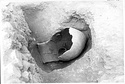
The grave lay on the slope of the Areopagus in Roman house O, just east of the line where the hillside is scarped for the foundation of the west wall of the house.
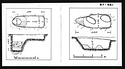
Cutting:the pit cut in ... Archaic period/6th or 7th c ... Hesperia 20 (1951), p. 109, pl. 48 c, d (Grave 51), plan pl. 33. |
| Rodney S. Young ... Grave 8 in notebook. Bones discarded. Fragments of an iron pin found on the chest and a fragment of a Protogeometric krater base found beside the body were not inventoried.
JP
Unlined roughly rectangular ... LH III/EPG (date uncertain) |
Great Hole at 33/Ζ = Area of early wells Some of the objects may have come from N 18:7 or from a neighboring 7th c, well, not separately cleared, but no definite association is possible ... 7th-5th c. B.C ... Great Hole at 33/Ζ = Area of early wells ... Some of the objects may have come from N 18:7 or from a neighboring 7th c, well, not separately cleared, but no definite association is possible. |
Red fill with burning over south part of Heliaea. Post Herulian Metal- Worker's establishment. Coins:
20 May 1953 #1-#2
4 May 1953 #1 P 30199 (Κ 4282), B 1544-1546 (Κ 4281, Κ4283-4284) catalogued on May ... Late 3rd. c. A.D. |
South Stoa II Construction Fill.
About 85 stamped amphora handles, many with parallels in building fills of Middle Stoa and Stoa of Attalos. Fragments of long-petal bowls confirm date after mid-2nd c ... To ca. 140 B.C ... Fragments of long-petal bowls confirm date after mid-2nd c. Types 25 A', 33 A, 35 B, and 44 A lamps. |
Kernos Pit #2 at 33/ΛΑ. P 30175-P 30186 (ΙΙ 635-ΙΙ 646) added on 7 May 1973 ... Early 4th c. B.C ... Early 4th c. B.C ... ΙΙ:33/ΛΑ |
| Pocket with burning at 60/ΚΗ. "Is this perhaps a disturbed pyre burial." [Nbp. 2928].
Identified as pyre by SIR.
Near north end of corridor, beside its west wall. Concentration of artifacts, tiny scraps ... 4th c. B.C. |
Kernos Deposit (?): below floor of Building A, over and in cutting at 33/ΚΗ P 30162-P 30172 added on 4 May 1973 ... 4th c. B.C ... 4th c. B.C ... ΙΙ:33/ΚΗ |
Filling in a cistern chamber in the area west of the Areopagus. Main dumped fill of 2nd. c. B.C., with small amount of later material in uppermost 1.00m. A connecting passage contained some material of ... 2nd. c. B.C ... Main dumped fill of 2nd. c. B.C., with small amount of later material in uppermost 1.00m. A connecting passage contained some material of the 4th. c. B.C ... 17 stamped amphora handles; Types 33 and 34 variant lamps; possible fragment of long-petal bowl (must be intrusive); later lamps (also intrusive); one mold. |
South Tunnel: Bone Factory. Starts at 4-6/Μ and runs south to well. Coin
14 March 1938 #33 Lot ΑΑ 19, does it belong here? ... Second half of 2nd c. A.D. |
Also noted as 32-33/Μ. The N wall collapsed. A very shallow deposit of ancient fill over its stuccoed floor. Coins:
10 May 1939 #3-#4 ... Hellenistic, 4th-early 3rd, Roman, 4th c. A.D. |
Associated with the Tholos.
Originally a well but after it had been in use for a short time the shaft was partially filled in and the upper part widened to form a large cistern.
The pottery falls into ... 335-250 B.C. |
| 5th-4th c. B.C ... 5th-4th c. B.C ... ΚΚ:31-33/ΝΕ-ΝΖ |
| Herulian Debris in a house on the lower slopes of the Hill of the Nymphs: House P = South House; Room 2 = Dining Room; Room 3 = Kitchen; Room 18; Room 23; Room 24. Coins:
9 August 1947 #1-#37, #47-#49 ... Mid 3rd c. A.D. |
Cistern at 53/ΝΕ, bottle-shaped, stucco-lined, in the east aisle of the peristyle of Roman House H (courtyard of Greek House G, just west of andron).
Lower diameter 2.73m.
Homogenous fill all apparently ... Into early 2nd century B.C. |
Great Drain: fillings in south part of section; Martyrs I, II and III, all layers (essentially no difference in the layers).
Pottery sorted and recorded by H.A. Thompson 12 may 1950: "Having gone through ... Second half of 2nd c. B.C.-Early 1st c. B.C ... Twenty-five stamped amphora handles; latest of 79 coins date in last quarter of 2nd c.; pottery closely similar to that in Thompson's Group E; two molds, one for long-petal bowl ... Coins:
7 June 1939 #1-#13
8 June 1939 #1-#19
9 June 1939 #1-#19
10 June 1939 #1-#33
12 June 1939 #1-#22 |
| Handler ... Found in an area of disturbed fill north of a floor surface in Room 4 of the Classical Commercial Building. The floor surface (n. 3 on the west side of Room 4) was preserved at 52.503-52.544 masl., and ... 2nd half 4th c. B.C ... The floor surface (n. 3 on the west side of Room 4) was preserved at 52.503-52.544 masl., and was excavated in Lot ΒΖ 1758 (2nd half of the 4th c. B.C.). The pyre was located in a shallow channel adjacent to the south face of Wall 4, where the floor surface was not preserved ... AS 1396.3 in Study Collections-Case No. 99C-2 box V, while a bone bag now stored in drawer 33 (animal bones) |
Accumulated fillings in a system of underground drains at west end of section ΔΔ with northward continuation into and across Section Υ.
The filling in the "underground passages" in section ΔΔ appears to ... 3rd c. B.C.
2nd c A.D ... The filling in the "underground passages" in section ΔΔ appears to be not later than 3rd c. B.C.; but drain channels, pits and cuttings, etc. in Υ are partly Early Roman, some mixed to Late Roman or later.
... Section Υ: pit at 31-32/ΜΘ-Ν, 31-32/ΜΣΤ-ΜΖ, 36-38/ΞΔ, 33/ΝΒ, 31-32/ΜΓ-ΜΣΤ, 31/ΜΑ-ΜΓ
two fragments of semi-glazed bowls with everted rim (late 2nd c.?) ... More extensive disturbance in east branch indicated by fragments of dipper, 2nd c. plate, at least five moldmade bowls, a Roman lamp. |
| Mike Laughy ... This pyre was found within an otherwise mostly sterile fill directly under a white floor surface in the southern section of Area IV. It was located ca. 0.50m. east of a similar deposit, Pyre J 2:25. The ... 4th c. B.C. |
Accumulated debris on the west side of the market square.
Related layers added 1999/2000 (JWH), e.g. "Gravelly layer above burning", "Clearing Classical floor", "Lowest level above bedrock", "Below burning", ... First half of 5th c. A.D. |
|
|