|
|
Ostrakon deposit, sand fill in a shallow channel in bedrock at the bottom of the Great Drain in the valley between the Areopagus and the Hill of Nymphs.
This group of ostraka may well come from a single ... Ca. 490-480 B.C. |
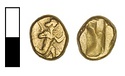
| Persian Empire ... Χρυσός Δαρεικός: Περσία 5ος αιώνας π.Χ. Coin no. 1. Casts. Late Roman fill; red. King running r., carrying spear and bow. Oblong incuse. C 254, 91-2-16 ... 480's - mid-4th c. B.C ... C 254, 91-2-16 |
Flattened double conical shape.
Two star-shaped stampes above and two below. Unglazed.
Attic clay. Protoattic Pit, Geometric sherds. Leica, 7-529 ... 26 March 1936 |
Gray Minyan ... Middle Helladic |
| Poros Building; East Wall; Area C 3 ... ΟΟ-9 1664, 1665 Section ΟΟ 254 ... 14 April 1949 |
Wright, James C ... American School of Classical Studies at Athens ... Hesperia 46.3 3 245-254 10.2307_148042 ... 1977 |
| Other. Well. Hesperia, XX, 1951, pp. 50-51, pl. 25 a. Type 19 Variants; Lamps with Sharp Angle between Body and Rim; Variant Features. Type 21 C; Curved Rims; Long Wide Nozzles. Type 23 A; Flat Rims; Broad ... Agora 4 244 Q 8:1 R 12:1 P 8:5 R 13:1 P 10:1 R 13:2 P-R 6-12 R 13:3 Q 13:1 R 13:4 R 18:2 Q 18:1 R 21:2 R 8:2 R 9:1 S 19:3 R 10:1 S 21:1 R 11:1 S 21:2 ... 3rd-4th quarter of 5th B.C. |
Fragment from near center of Late Roman C plate. Stamped with palm leaf and two sets of concentric circles on one side, one on the other.
Light red clay; thin red wash. From sherds, B 131. Leica, 2-293 ... 28 April 1932 |
|
|
.jpg.icon.jpg)
.png.icon.jpg)