|
|
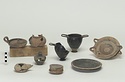
"Oinophorus Well".Tiled well in House H (diameter 0.80m, water level -4.70m). Height of tiles 0.64m Heavy well deposit; lamps,, type XXVII; many basket-handled water jars; oinophoros with labors of Herakles ... Use filling of early 2nd-mid.-3rd c. A.D ... C 20:1 ... C 20:1 |
Coins:
29 May 1947 #1
30 May 1947 #7-#9
31 May 1947 #1-#8
2 June 1947 #1-#3 ... Early 2nd c.-mid-3rd c ... C 20:1.3 ... C 20:1.3 |
Cistern with mixed dumped filling uniform throughout cistern and two short blind channels. Coins:
16 May 1939 #6-#7
17 May 1939 #1 ... 6th-1st c. B.C ... C 20:3 ... C 20:3 |
Coins:
31 May 1947 #1-#4 ... Post-Herulean, end 3rd c ... C 20:1.2 ... C 20:1.2 |
| In area West of the Areopagus. Fills with many figurines and molds, possibly from a terracotta factory.
Twelve stamped amphora handles; no long-petal bowls; Type 54 A lamp Coins:
31 May 1939 #11
1 June ... Mostly 200-150 B.C ... C 20:2 ... C 20:2 |
Late Roman ... C 20:1.1 ... C 20:1.1 |
Now C 20:2 Asterisk: B 20:6* ... Now C 20:2 ... Asterisk: B 20:6* |
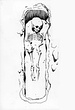
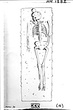
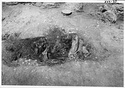
| RSY Grave 51.
The grave lay on the slope of the Areopagus in Roman house O, just east of the line where the hillside is scarped for the foundation of the west wall of the house.
Cutting:the pit cut in ... Archaic period/6th or 7th c ... Hesperia 20 (1951), p. 109, pl. 48 c, d (Grave 51), plan pl. 33. |
Small deposit in bedrock. Coins:
20 April 1936 #2-#3 ... 4th c. B.C. to early 3rd c. B.C. |
Cistern System #1f: Shaft at 1/ΝΘ = Well A. Scanty dumped filling. Coins:
19 February 1936 #2-#3
20 February 1936 #16-#20
21 February 1936 #5-#7
22 February 1936 #1 ... Mid-4th to 3rd c. B.C. |
Well M: EG, under the south court of the Poros Building.
Hesperia 20 (1951), p. 144 (noted) ... Middle Geometric |
Coins:
30 July 1947 #3-#11
31 July 1947 #4-#19
1 August 1947 #1-#9
4 August 1947 #1-#20
5 August 1947 #3-#20
6 August 1947 #1-#38
7 August 1947 #1-#21
8 August 1947 #1-#41
9 August 1947 #3-#6
57-59/*
66-67/* ... 28-31 July 1947
6-9 August 1947 |
Filling associated with construction of Poros Building. A small amount of fragmentary pottery found in the clay filling of the original floor; perhaps deposited as late as ca. 425-400 B.C. Cf. 18:4 and ... Ca. 475-450 B.C. or later. |
Patch of early fill, disturbed. 20/9/1962: Tin 145 is checked and is chiefly late archaic, but some of the coarse ware is late 5th with 4th c. B.C., and a few bits are 4th c. A.D ... Late 6th.-early 5th c. B.C ... 20/9/1962: Tin 145 is checked and is chiefly late archaic, but some of the coarse ware is late 5th with 4th c. B.C., and a few bits are 4th c. A.D. |
Well (diameter 0.98m) in House H, Room 13.
Two dumped fills apparently of the same date, but separated by a clay deposit of over 2.00m.
Cf. Hesperia 20 (1951), p. 253. (noted) Subdivisions:
.1=Upper ... Ca. 425-400 B.C. |
Well, unfinished?
The shallow depth, small diameter, lack of water and any use fill make it possible that this was not a well, although the character of the cutting is difficult to explain otherwise. The ... Ca. 440-420 B.C. |
Well in house R of industrial area west of the Areopagus. This well, originally tiled, was abandoned and filled at the time of the conversion of the house into a stone-cutters' workshop.
Tiled well but ... Ca. 425-400 B.C. |
Fillings below the courtyard floor of the Poros Enclosure west of the Areopagus. The lowest layer, over bedrock, is of the archaic period and may have accumulated on the spot before the start of building ... First half of 5th c. B.C. |
POU 3.50-10.30m. dumped filling of 5th or 6th century. Coins:
10 May 1949 #1
16 May 1949 #1
17 May 1949 #1-#2
19 May 1949 #1-#2
20 May 1949 #1-#12
21 May 1949 #1-#4 from dump
23 May 1949 #1-#3 from dump ... 3rd-5th c. A.D. |
Great Drain sand fill under Roman bath including small area at north end under tiles that was excavated separately.
See also A-B 19-20:1 for additional Great Drain sand fill at ca. 70-113/* Subdivisions: ... 30 July-11 August 1947 |
House R, fill under drain tiles and fillings associated with house K in industrial area, including what was C 19:15, plus C 19:16 and
C 19:17.
a) House built as dwelling in second half of 5th.c.
b) Used ... Ca. 5th and 4th c. B.C. |
Ostrakon deposit, sand fill in a shallow channel in bedrock at the bottom of the Great Drain in the valley between the Areopagus and the Hill of Nymphs.
This group of ostraka may well come from a single ... Ca. 490-480 B.C. |
| Located in House H, Room 13 on the lower northwest slope of the Areopagus ... Late 2nd c. B.C. |
| North of House G (RSY=Pyre 13).
Concentration of artifacts, small pieces of bone, and burnt material in stratum, no pit discerned. The pyre is cut by the trench of a wall of a Roman house to north. It ... 290-250 B.C. |
| James H. Oliver ... (E.L. Smithson: Grave IX: PG). Two children's skeletons one on top of the other. Cf. PD 329 for PD 430 for second skeleton, same deposit.
PG grave about 25m. SW of Cistern A at 46/ΜΔ.
[In some records, ... Developed Protogeometric |
| Rodney S. Young ... Grave 20 (E.L. Smithson: Grave X: PG). Bones discarded. Pit tomb, inhumation (on bier or in coffin?), perhaps of a child. Little ash and carbon in the filling, but the grave offerings were unburned.
JP ... Developed Protogeometric ... Grave 20 (E.L. Smithson: Grave X: PG). ... The se pots, all unburned and clustered together, would have been placed in the area immediately above the feet of the deceased.
c) in the lowest 0.30m, very damp earth with very little ash, much heavy black matter "of a different character", from that in the layer above.
|
Cleaning over bedrock along west side of Kolonos Agoraios. Context Protogeometric-Geometric disturbed. Objects from ΠΘ 24-28/ΝΗ-ΞΔ are added because P 8141 is published in Hesp. Suppl. 20, p. 153 as this ... To 2nd. c. B.C. |
Hellenistic-Early Roman fill over bedrock, along west side of Kolonos Agoraios. Consistent dumped filling; occasionally there is a late Roman fragment intruded from the filling above, but this seems not ... 26-29 February 1936
2-12 March 1936 |
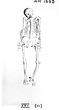
| Grave XXI in notebook = RSY Grave 11. Pottery discarded; late Roman, mostly coarse. PD 731-e ... Ca. 530 B.C ... Hesperia 20 (1951), pp. 92-93, fig. 9 and pl. 41b-c (Grave 11). |
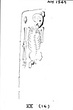
| Grave XX in notebook = RSY Grave 16. PD 731-i ... Late 6th. c. B.C ... Hesperia 20 (1951), pp. 97-98, fig. 13 and pl. 44 c-d (Grave 16). |
Well dug through cistern at 64/Γ. Seems to have been stratified; four fills recorded but here treated as one as divisions are rather "arbitrary".
Agora V, p. 126: Constructed in late 1st c.; use filling ... 3rd c. A.D. POU (before 267 A.D.) |
| Grave XXV in notebook = RSY Grave 4. PD 731-b ... 750-725 B.C ... Hesperia 20 (1951), pp. 87-88, fig. 6 and pl. 38 a-c (Grave 4). |
| Sacrificial Pit I in notebook = RSY Grave 20 ... Ca. 510-490 B.C ... Hesperia 20 (1951), pp. 101-102, pl. 46 c-d (Grave 20). |
Use filling of first half of 1st c.; dumped filling of late 1st c.(?). This well, near its mouth, cuts off the end of the upper passage of the cistern at 53/Ε. Subdivisions:
.1=Dumped filling
.2=POU ... First half of 1st c. A.D. POU |
Well at 74/Ι, on the lower north slope of the Areopagus.
Use fill from early 1st to 3rd c. A.D.
Dump fill from 4th c. A.D. Coins
9 April 1938 #2
9 May 1938 #1 Container 20 (lost) p. 1529 ... 1st c. to 3d c. A.D ... Use fill from early 1st to 3rd c. A.D.
Dump fill from 4th c. ... Container 20 (lost) p. 1529. |
Top fill to 1.00m. = dump of late Hellenistic ware mixed with some Roman of 2nd c. to early 3rd. c. Intermediate fill 1.20-2.00m. = dump with tiles and stucco, almost no sherds. Coins:
6 February 1937 ... 2nd-3rd c. A.D. |
Well at 75/Ε. Dumped debris of Herulian destruction, including much material from the first half of the 3rd c ... 3rd c. A.D. |
Scanty debris filling in a pit. The wishbone-handled bowl (P 16753) is of the middle of the third quarter of the 5th. c. century, as are also two red figured fragments, P 25820 and P 25821; the deposit ... Ca. 450-400 B.C ... The wishbone-handled bowl (P 16753) is of the middle of the third quarter of the 5th. c. century, as are also two red figured fragments, P 25820 and P 25821; the deposit as a whole is somewhat later. Last quarter of the 5th. c. B.C ... Merged with A 20:8. |
Filling in a cistern chamber in the area west of the Areopagus. Main dumped fill of 2nd. c. B.C., with small amount of later material in uppermost 1.00m. A connecting passage contained some material of ... 2nd. c. B.C. |
| Pyre in north central room of house, measuring 0.50m east-west by 0.35m north-south. Pottery, bone, and burnt material in pit dug into layer IIb (crushed bedrock floor: lot Ω 464, 4th c.) and covered by ... 350-325 B.C. |
|
|