|
|
Coins:
17 May 1937 #1 ... Second half 4th. c ... Second half 4th. c ... ΠΘ:106/ΛΓ |
Late 3rd-first half 4th c ... Stratified Well at 106/ΛΓ Late 3rd c. to First Half of 4th c. |
According to the excavator " a pre-herulian filling dumped in to fill the cistern some few years after the Herulian destruction". Coins:
10 June 1936 #2-#6
11 June 1936 #1-#19
12 June 1936 #23-#27 P 11936 ... A.D. 267 to mid 3rd c ... P 11936 and L 2555 from passage between cisterns at 106/ΛΓ and 107/ΚΘ but not recored as part of deposit C 14:2, see nb.p. 3559. |
Cistern through which well G 14:4 was dug. Filling in cistern, early Byzantine, but with various objects resembling those from the upper dumped filling in the well, below the cistern floor (5th c. A.D.) ... Early Byzantine |
Coins:
28 May 1937 #30
29 May 1937 #1
31 May 1937 #1-#3 ... 2nd c ... 2nd c ... ΠΘ:106/ΛΓ |
Well in the bottom of chamber cistern at 106/ΛΓ, stratified. A soft spot in the bedrock at the west side of the well caved in and was packed with typical coarse Roman first century amphoras; the well was ... A.D. 200-150 |
Dumped fill in mouth of well. Coins:
16 May 1937 #1 ... Early 5th c ... Early 5th c ... ΠΘ:106/ΛΓ |
Lower filling mostly of second half of 4th c. B. C. and earlier, but perhaps dumped in 3rd c. B.C. Upper filling mixed to Roman (4th c. A.D.). Pottery in container (9-22-58) is mostly second half of 4th ... Ca. 375-325 B.C. with late-3rd-century disturbance |
Exploratory excavation trench between east front of Hellenistic Metroon and Great Drain.
Cf. Hesperia Suppl. 4 (1941), p. 106.
Cf. also Metroon Drain Cut I 9:1 and F-G 12:1 and H 12:9 ... 8th-6th c. B.C. |
| Pyre 1 in Central House, Room XI, strosis 3. Sacrificial pyre with characteristic small vases amid carbonized twigs and bone.
Near north side of courtyard. This pit was cut slightly into strosis 3 (lot ... 1st quarter 4th c. B.C. |
| The remains of a pyre disturbed by the construction of Wall 106. The compact, light brown soil contained some ash and bone and 5 nearly complete pots or saucers ... First half 3rd. c. B.C. |
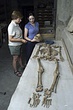
| David Scahill ... Burial in Geometric well (J 3:8), in Classical Building II, Room I, next to south ashlar wall. "No grave goods!"
ADDENDA: J. Papadopoulos later associated P 34449 and P 34450 to that grave. (Cf. Agora ... Geometric |
| Eugene Vanderpool ... Mycenaean Chamber Tomb.
Although badly disturbed at various times in antiquity, it was clearly a chamber tomb with the chamber little more than a cubby-hole at the end of a steep dromos, entered at the ... Myc. III A-B ... Hesperia 21 (1952), pp. 106-107, pl. 25 b, c. |
| Mycenaean Chamber Tomb with niches.
One of the few tombs found in the Agora that has an almost architectural regularity with squares chamber (1.75m wide by 2.10m deep) and axially centered dromos (4m long ... Myc. III A 1:2 ... Hesperia 21 (1952), pp. 105-106, fig. 4, pl. 25 b, c. |
Cistern on the lower Acropolis slopes, west of Panathenaic Way; dumped filling of 1st century B.C.
Bottom diameter 3.90m. Cistern with connecting draw-shaft and a dead end tunnel dates from Late Hellenistic ... 1st century B.C. |
Various layers and dates, primarily from Tholos Tr. L (area of early road drain), Q (area of road) and V (area of road).
Also Room G of Trench V listed with G-H 11-12 probably has road layers (no finds, ... 8th c.-ca. 480 B.C. |
Green and sandy fill in foundation. Coins:
15 May 1936 #1-#5 ... 4th c. B.C ... 4th c. B.C ... Γ:104-106/ΛΔ-ΛΣΤ |
| Bronze-casting pit and furnace against S apse of Church (106/ΛΕ). Late Roman sherds of the 4th and the 6th c. A.D. were found with fragments of moulds from bronze casting. The west end was destroyed by ... 5th-6th c. A.D ... Bronze-casting pit and furnace against S apse of Church (106/ΛΕ). Late Roman sherds of the 4th and the 6th c. |
Pottery discarded ... Mixed to Roman, 3rd c. A.D ... Mixed to Roman, 3rd c. A.D ... Γ:104-106/ΛΔ-ΛΣΤ |
Cistern at 53/ΝΕ, bottle-shaped, stucco-lined, in the east aisle of the peristyle of Roman House H (courtyard of Greek House G, just west of andron).
Lower diameter 2.73m.
Homogenous fill all apparently ... Into early 2nd century B.C. |
|
|