|
|
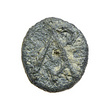
| Obverse : ligature of A (alpha) and P (rho) in relief.Λ
Reverse : plain. On bedrock, floor of Byzantine pithos. Leica ... 23 March 1935 ... On bedrock, floor of Byzantine pithos. |
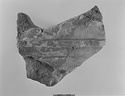
Inscribed fragment.
Broken all around.
Only smooth front and rough picked back preserved.
Hymettian marble. Found in wall of Byzantine pithos. Leica ... 3 June 1970 ... Found in wall of Byzantine pithos. |
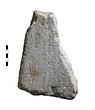
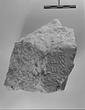
Inscribed fragment.
Broken above, below, and to right.
Rough back, worn, and possibly left side preserved.
Hymettian marble. Found in wall of Byzantine pithos, east of the altar of Ares. Leica ... 6 April 1951 ... Found in wall of Byzantine pithos, east of the altar of Ares. |
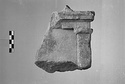
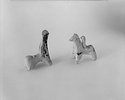
Large eyed animal.
Broken all around.
Brown clay, traces of red and white paint.
ADDENDA Perhaps for a rabbit; cf. T 232, from the same mould. Roman fill beside Byzantine pithos. 4877 Leica ... 20 April 1954 ... Roman fill beside Byzantine pithos. |
Inscribed fragment of columnar grave monument.
Top part preserved.
Three lines of the inscription preserved.
Hymettian marble. Found built into wall of Byzantine pithos, south of Pier 9 of the Stoa of ... 17 February 1949 ... Found built into wall of Byzantine pithos, south of Pier 9 of the Stoa of Attalos. |
Inscribed fragment of columnar grave monument.
Inscribed face only preserved.
Two lines of the inscription preserved.
Hymettian marble. Found in a Byzantine pithos over the north foundation of the Hellenistic ... 28 April 1936 ... Found in a Byzantine pithos over the north foundation of the Hellenistic Building, on Kolonos Agoraios. |
| Inscribed fragment.
Broken to right, below and behind.
Crowning pediment and left side preserved.
Hymettian marble. Found in Byzantine context beside Byzantine pithos, at the west edge of the altar of ... 3 June 1950 ... Found in Byzantine context beside Byzantine pithos, at the west edge of the altar of Ares. |
Inscribed fragment.
Front and back faces preserved; back dressed smooth.
Three lines of the inscription preserved.
The marble has a pinkish cast, with gray veins.
Pentelic (?) marble. Found in a Byzantine ... 1 June 1936 ... Found in a Byzantine pithos, on the south slope of Kolonos Agoraios. |
| Inscribed fragment.
Broken all around, battered and worn but surface generally quite fresh.
Parts of fifteen lines of the inscription preserved and one column of the lists of cities and payments.
Pentelic ... 8 June 1972 ... Found in Byzantine Pithos. |
Inscribed fragments.
Two joining fragments from the upper part of a tall grave stele.
Broken all around. Back worn smooth.
Moulding at top of stele preserved, but palmette above it missing. Two disk rosettes ... 19 August 1959 ... Found built into Byzantine pithos, at northwest corner of the Archaic temple. |
| Inscribed fragment.
Upper right corner of a votivbe relief with pilaster and entablature.
On the architrave the end of a dedicatory inscription to Zeus Meilichios.
Pentelic marble. Found in Byzantine pithos, ... 13 April 1953 ... Found in Byzantine pithos, in the west end of the South Stoa II. |
Broad handle.
Russet clay light grey at core.
Thasian or early Knidian(?). Par: Ker.VG 434*
Not Thasian (Chavdar Tzochev, March 2010). Pithos cutting; Byzantine context. ΑΡΙ Leica ... 3 June 1936 ... Pithos cutting; Byzantine context. |
| Nose and lower legs broken off. Trace of rider or girth on back.
Fragmentary.
Buff clay with black glaze remaining over much of body.
Cf. Hesperia 2 (1933), pp. 617-620. Just outside break in north wall ... 2 August 1967 ... From protoattic fill inside, disturbed by Byzantine pithos 2. |
| Inscribed stele fragment.
Broken at the bottom. The sides preserved, and the back, the latter rough picked. At the top a bit of the fascia remains. Tapers toward the top.
Decree passed by Orgeones; mentions ... Early 3rd. century B.C ... Built into a Byzantine pithos, on the north slope of the Areopagus. |
| Inscribed fragment.
Top and bottom, roughly dressed preserved, and smooth dressed back; broken at left; right side chipped along face but original edge probably preserved at back.
Shallow frame, within ... 5 May 1939 ... Found in Byzantine pithos in the industrial area, southwest of the Market Square. |
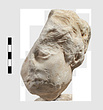
| Broken off at neck. Forehead and front part of hair missing, back of neck and back hair also broken off. Features badly chipped and rubbed.
Life-size head, with slightly parted lips, broad nose and eyes ... 1st c. B.C. (?) ... Byzantine pithos in Room XVI, with mixed fill. |
| Inscribed fragment.
Inscribed face, left side and back preserved.
Three lines of the inscription preserved.
Pentelic marble. Finished Found in Byzantine context in a pithos on the north slope of the Acropolis, ... 5th. century B.C ... Found in Byzantine context in a pithos on the north slope of the Acropolis, east of the late Roman Fortification. |
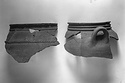
| From the rim and shoulder of a large pithos with flat projecting rim. Around the shoulder two piecrust ridges connected at intervals by vertical piecrust ridges. Two rows of incised zigzags between the ... 22 March 1937 |
Seven joining pieces of rim and handle. Rim flat on top, two angular ridges around its side. Horizontal loop handle on bulging side wall. Incised wavy lines below rim.
Coarse red clay; gray at core ... 27 April 1937 |
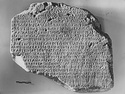
Inscribed fragment.
Broken top, bottom and left.
The back preserved, rough picked, and the right side with a bevelled edge along the inscribed face.
Nine lines of the inscription preserved, with thirty-eight ... 1 April 1948 ... Found built into late Byzantine concrete pithos, southwest of the Market Square. |
Fragment of rim only of a very large pithos or stamnos, having a slight overhang on the outside, below which are several horizontal grooves.
Letters on the broad top of rim:
Very coarse yellowish-buff ... 13 March 1937 |
Single fragment preserves lower part of a handle and the immediately adjacent part of the body of a large coarse pot. In a rectangular stamp at the base of the handle are two spirals.
Micaceous clay with ... September 1932 |
| Broken below at neck. Right side from top to mid cheek missing. Nose, mouth, and chin much chipped and bruised. Drill hole at back to separate it from background.
Female head, half life-size, left, seen ... 23 April 1951 ... From marble lining of Byzantine (?) pithos. |
| Small pieces of rim missing. Small base ring; flat floor; upturned lip. Floral decoration in blue and black on floor.
Gritty white clay. Colorless glaze. Finished Pithos. Leica ... 16 April 1938 |
Intact.
A cone-shaped stone with a small knob at end.
On flat circular bottom is crudely engraved a bird (?).
Light green stone, soapy texture; opaque.
Byzantine. Pithos with coins nos. 15-17 for the ... 16 March 1937 ... Light green stone, soapy texture; opaque.
Byzantine ... Pithos with coins nos. 15-17 for the day and fine 12th. century (?) |
| Inscribed fragment of Herm of Zeno.
Fragment from the sloping upper part of a portrait herm; left side and inscribed face only preserved.
Herm of Zeno, son of Mnaseas, the Stoic philosopher.
One line of ... 2nd. century A.D ... Found built into the wall of the pithos 21 of the Byzantine period, outside the Market Square to the southwest. |
| Handle and upper shaft and upper lamp missing, and many chips from base and lower lamp.
Broad base, slightly upturned at edges. A double lamp on a standard; stump of long vertical handle.
Traces of light ... 9 March 1937 |
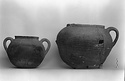
Chips missing from wall and mouth. Round bottom; fairly high shoulder; squat neck and small mouth with rounded lip. Heavy high-swung handles.
Coarse red clay with white grits, very thick. Pithos. Leica ... 16 February 1938 |
| Head, set in socket, missing; socket fully preserved. Feet and lower part of drapery broken off, also upper part of right arm and most of the fingers of the right hand. Left forearm and hand largely missing ... 16 March 1937 ... Just west of Great Drain; partially cut by Byzantine pithos. With coin # 23 of 17 March 1937. |
Chip missing from lip. Round bottom with a small button at base; body like inverted pear; high flat handles, flaring mouth with heavy lip. Two heavy wheel grooves around body at bottom.
Coarse red clay; ... 18 February 1938 |
Low ring foot; center of floor and part of wall preserved. Rabbit, right, body incised, head and ears sgraffito, legs and paws part incised, part sgraffito. Very long ears. Bit of enclosing circle, incised, ... 11 May 1939 |
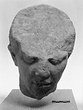
| Right side of head, broken off at right of nose and diagonally across bottom with break running from chin to base of skull. Face very badly battered.
Life-sized male head, heavily bearded, with short hair, ... 10 May 1965 ... Trench zeta; in pithos with Byzantine fill. |
Two joining fragments, preserving about one-half of base and center of plate. Low ring foot. Medium coarse red clay; outside white slipped; inside, in center, surrounded by a sgraffito band of linear ornament, ... 26 May 1937 |
| Upper three-fourths of sides preserved; most of rim and one handle. Bottom missing. Squat pot with broad shoulders, no neck, and a low vertical rim around opening. Two band handles, vertical. Wheel grooves ... 16 March 1937 |
About one-half preserved. Mended from many pieces. Flaring ring foot. Flaring straight-walled body turns to vertical upper body below a flattened out-turned rim. Interior rim glazed. Alternating bands ... 28 July 1980 |
Almost half preserved. Restored in plaster. Rather high ring foot. Three zones of ornament consisting of vertical lines, incised and sgraffito, the middle one interrupted four times(?) by a medallion of ... 17 March 1937 |
A small bowl with flaring sides and ring foot. In the center, a medallion with a simple design of incised lines. Around the sides, two bands, one narrow, one wider, of vertical incised lines.
Light red ... 16 March 1937 |
| One corner and part of one end broken away; otherwise complete. On one face two long concave cuttings, one wide and shaped rather like a rain tile, the other narrow and rather like a cover tile. Anathyrosis ... 17 July 1946 ... Found in line of a Byzantine wall here destroyed; standing almost upright on one of its narrow edges, it leans slightly to S.E. against a Turkish pithos; it would seem to have reached its present position in Turkish period, but may have formed part of Byzantine wall. |
Low bowl with slightly incurving sides. Restored in plaster. Ring foot. In center of interior only, an incised design, much of which is missing; perhaps a Maltese cross, crosshatched with loops over top ... 16 March 1937 |
| Brittle white clay; light green glaze darker in places; fired yellowish-brown where lines or dots have been incised. A triple affair, the outer part of which has an elaborate cut out pattern; its lowest ... 5 February 1934 |
|
|