|
|
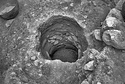
Mudbrick Pithos at N/8-6/3.
Constructed in conical shape of mudbricks, including the floor. Top cut by modern basement wall. Diameter at floor 1.45m Coin
30 May 1930 #113 ... Byzantine ... Byzantine Mudbrick Pithos |
Original bottom of pithos was damaged (probably by ground water) and a second, higher bottom consisting of squarish terracotta tiles laid. Fill above second, higher floor was unusually rich in pottery ... Byzantine ... Byzantine Built Pithos |
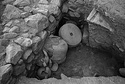
Pithos at NE corner of Byzantine Building. Coins:
20 May 1938 #1, #3 ... Late 11th-Early 12th c. A.D ... Pithos at NE corner of Byzantine Building. |
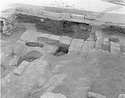
| "Room D" is the triangular area at L/15,16-2/10,12, NW of Wall 1, in E corner of basement of No.3. Hastings Street, bounded by the NE and SE walls of basement).
Bell-shaped vessel built of horizontally-laid ... 10th-11th c. A.D ... Pithos or Bothros in Byzantine "Room D". |
P.H. 1.98m; greatest diameter 1.70; wall thickness 0.20. The walls are of rubble set in clay, and the bottom is flat. Pottery was coarse Byzantine sherds but discarded except for one graffito ... 25 May 1956 |
Pithos in Turkish Pathway Coins
26 May 1937 #2-#7 ... Byzantine |
Joins occur between this pit and the cistern in section ΛΛ (87/ΛΕ)
(E 5:3). Coins:
16 May 1936 #6 ... Byzantine |
| Johanna Hobratschk ... South end of Byzantine Room J, adjacent to Pithos B and under St. Philip's st scarp. Built lining at the E and N side, roughly constructed of some large square blocks and slabs, smaller field stones of ... 21 July-3 August 2006
2011
28 June 2012-16 July 2012 ... South end of Byzantine Room J, adjacent to Pithos B and under St. |
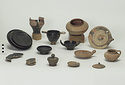
| James Artz Pirisino Daniele Kylindreas Miltiades ... Excavation in Room 3 of ΒΘ West revealed 5 ceramic vessels in a row against the eastern face of Wall 12. 3 complete vessels (ΒΘ 122, 124, and 125) were catalogued, along with the base of a plain glazed ... 9th-11th c. A.D ... The fragmentary remains of a ceramic pithos (ΒΘ 178) were revealed after the removal of a reused threshold block above the pithos. ... An illegible coin (ΒΘ-239) was found in the fill within the pithos (ΒΘ 178).
The fill within the pithos was removed separately (ΒΘ Lot 528), and after consultation with Dr. Joanita Vroom and the Agora staff, all fill from the pithos was saved, but not given an Agora Sample number. |
Early Roman pit at P/3-6/6,7
Layer 4a in Room 6 of Greek House δ, area P/2,3-6/6,8.
Pit in NW corner of Room 6 bounded by walls of Room to North and West, cut into preexisting layers to east, cutoff by ... 17 May 1971 ... Pit in NW corner of Room 6 bounded by walls of Room to North and West, cut into preexisting layers to east, cutoff by Byzantine pithos to South. |
| Well South of Soft Yellow Poros Foundation. Dumped filling of a collapsed well, that, due to hazardous conditions, could not be cleared below- 2.50m. The well was partly cut on the east side by a Byzantine ... Protogeometric-Early Geometric II, ca. 850 B.C ... The well was partly cut on the east side by a Byzantine storage pithos, and on the south side it was disturbed by another, tile-lined, well of the Roman period (U 19:4), which had been used for water and then as a cesspool inn the early 20th century.
|
| Sacrificial Pyre I, Classical Building II.
The pyre was set through the original floor level of the northern room of the Classical Building and apparently is the remainder of a ritual conducted when the ... Ca. 375-350 B.C ... The pyre was preserved in a thin strip of undisturbed fill between Pithos III and a Byzantine pit. |
|
|