|
|
South Stoa II Construction Fill.
About 85 stamped amphora handles, many with parallels in building fills of Middle Stoa and Stoa of Attalos. Fragments of long-petal bowls confirm date after mid-2nd c ... To ca. 140 B.C ... Fragments of long-petal bowls confirm date after mid-2nd c. ... Most of bowls figured; one mold. |
Water channel in north part of section, giving access to water system. Channel Mouth 1. Six stamped amphora handles; two-thirds of bowls long-petal ... Late 2nd century-Early 1st c. B.C ... Six stamped amphora handles; two-thirds of bowls long-petal. |
A well behind the Stoa of Zeus. Noted as the finding place of the bronze head of Nike, B 30.
Two Rhodian stamped amphora handles. Fragments of only two bowls ... 260-210 B.C ... Fragments of only two bowls. |
Water channel in north part of section. Coins:
20 February 1936 #2-#3
Five stamped amphora handles; Type 48 A lamp; one-third of bowls long-petal; one long-petal mold ... Second half of 3rd c.-Early third quarter of 2nd c ... Coins:
20 February 1936 #2-#3
Five stamped amphora handles; Type 48 A lamp; one-third of bowls long-petal; one long-petal mold. |
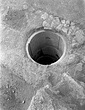
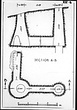
Cistern at 53/ΝΕ, bottle-shaped, stucco-lined, in the east aisle of the peristyle of Roman House H (courtyard of Greek House G, just west of andron).
Lower diameter 2.73m.
Homogenous fill all apparently ... Into early 2nd century B.C ... Particularly fine series of Megarian bowls. Pottery similar to H.A.T.' ... No long petal-Megarian bowls from within cistern. |
Cistern System #3: West Chamber at 69/ΛΣΤ, joined by a crooked passage to 69/Λ. Under the southwest corner of the Hellenistic Building to the north of the Temple of Hephaistos. Upper fill of early 1st ... 175-125 B.C ... E 6:2 (upper fill): Three Knidian amphora handles; type 51 C lamp; long-petal bowls.
E 6:1 and E 6:2 (lower fill): Joins between objects in both chambers and tunnel between them indicate fill the same. Twenty stamped amphora handles; long petal bowls; figured bowls with thick walls and small indistinct figures must date in second quarter of 2nd c. |
Water channel in north part of Section: Channel Mouth 4. Coins:
22 February 1936 #16-#18
24 February 1936 #1-#2
Twenty stamped amphora handles; type 38 lamp; type 56 A lamp; over half of bowls long-petal ... 120-86 B.C ... Coins:
22 February 1936 #16-#18
24 February 1936 #1-#2
Twenty stamped amphora handles; type 38 lamp; type 56 A lamp; over half of bowls long-petal. |
Built against the south wall of the annex to the Poros Building
west of the Areopagus. At the west the upper layer of marble chips carried against it, the lowest were cut by it.
Part of same system as ... 225-100 B.C ... [Nbp. 3001]
Upper fill: two stamped amphora handles; one-third of bowls long petal.
Lower fill: Bronze coin from Histiaia (?); no long-petal bowls; bowls of M Monogram Class; pottery probably a contemporary household dump. |
Cistern and drawshaft connected by tunnel; used in modern times as cesspool. No stratigraphy noted, but pottery from first five boxes excavated is later than that from boxes 6-18.
11 stamped amphora handles ... Hellenistic and Late Hellenistic ... No stratigraphy noted, but pottery from first five boxes excavated is later than that from boxes 6-18.
11 stamped amphora handles. Bowls are from worn molds, of poor workmanship, probably dating in second quarter of 2nd c. ... Upper part of fill contained fragments of long-petal bowls, "Pergamene" plate, Roman lamp, suggesting cistern remained open into third quarter of 2nd century and beyond. |
| Phaidon Street Cistern: South Chamber.
Connected by tunnel to O 17:5.
Knidian stamped amphora handle; fragments of five long-petal bowls, one made in worn mold. Type 35 A lamp. Coins
9 August 1957 #1-#3 ... Late 2nd c. B.C ... Knidian stamped amphora handle; fragments of five long-petal bowls, one made in worn mold. |
| Tiled Well at S edge of E-W Road, 73/ΜΗ. Contemporary upper and lower fills separated by layer of sterile mud.
Latest coin dates ca. 200. Koan amphora handle with stamped handle dates slightly after 200 ... 210-160 ... A.D. indicates contamination. Bowls of coarse workmanship , unlike those of early 2nd c. contexts; none from fresh molds, some from very worn molds. No long-petal bowls. This suggests date in second quarter of 2nd c. |
Shaft fill, not mouth fill, of drawshaft at 42/Θ. This is part of the cistern system 44/ΙΓ - 46/ΙΑ - 42/Θ.
Thirteen stamped amphora handles; fragments of Arretine pottery; over half of bowls long-petal ... 1st c. B.C.-early 1st c. A.D ... Thirteen stamped amphora handles; fragments of Arretine pottery; over half of bowls long-petal. |
| Phaidon Street Cistern: North Chamber
Sullan destruction debris. One of two chambers connected by tunnel.
Two latest coins date to 87/86. Gray ware lamp of first quarter of 1st c. A.D. indicates disturbance ... 2nd c. B.C ... Half of bowls long-petal. |
Tiled well near the SW corner of the market square between the Southwest Fountain House and the Great Drain, three fills noted: lower fill of earth and stones with a few fragments only of coarse pottery ... 4th-2nd c. B.C.
100-70 B.C ... Most of bowls long-petal.
Middle fill: No coins or datable stamped amphora handles. ... Long-petal bowls found at all depths, suggesting fill was dumped rather that accumulated over a period of time. Most of bowls long-petal. |
At 67/ΙΗ, at the northeast slope of the Areopagus.
Cistern with drawshaft, 4.60m deep. The drawshaft had been cleared to bottom in the eighteenth or nineteenth century, and some of the fill in the main ... Most second half of 3rd c. B.C ... Large numbers of bowls (49). No long-petal bowls. |
| Stucco-lined bottle-shaped cistern, with tunnel and subsidiary manhole, in SW Baths, Room Α 10. Homogeneous dumped fill, mostly of mold-made bowls and and molds for terracotta figurines. Sixteen stamped ... 225-190 B.C ... Homogeneous dumped fill, mostly of mold-made bowls and and molds for terracotta figurines. ... Large number of bowls (ca. 40) resemble those in M 21:1 and P 21:4. |
Chamber of water system with one blind tunnel and two cisterns connected by tunnel. Pottery consistent throughout, late Hellenistic. Late 2nd c. B.C.
Ten stamped amphora handles. Most of bowls long-petal ... 100-75 B.C ... Most of bowls long-petal. |
| Cistern at 75/ΜΓ connected with cistern N 18:3 by tunnel.
Only coin is Bioiotian dating between 220 and 197. Only indications of date are 1st c. lamps, two long-petal bowls, and fragments of early Roman ... 1st. c. B.C ... Only indications of date are 1st c. lamps, two long-petal bowls, and fragments of early Roman brittle ware. |
Evidence of stratification into five layers, although joins between the layers. Layer VI added when the construction of the Roman building above required it. No subdivisions assigned.
Flask-shaped cistern ... Early 3rd-late 2nd c. B.C ... Moldmade bowls with thick walls and small indistinct figures similar to those on bowls in G 5:3 and some examples in Thompson's Group C. No long-petal bowls. |
| Komos Cistern at 66/Κ, on the north slope of the Areopagus. Homogeneous fill.
Thirty-four stamped amphora handles. Eight Histiaian tetrobols, dating 170-160 at the earliest, found near top, possibly an ... Last quarter of 3rd c. B.C.-Early 2nd century B.C ... Largest group of moldmade relief ware, consisting of fragments of 183 bowls, one moldmade jug and nine molds. At least 119 bowls are products of Workshop of Bion; only 15 made by Workshop A. Great similarity among bowls, many with same stamps. |
Located in front of west end of Stepped Retaining Wall, Heliaia. Filled in and covered in last stages of grading of area after construction of Middle Stoa.
Pottery from settling basin nondescript. Single ... 175-150 B.C ... Single bowl is unusual type which may be early form of long-petal, but also resembles imbricate bowls of ca. 200. |
Grid notation in error as 99/ΚΑ sometimes.
A well (diameter 1.20m; diameter inside tiles at bottom 0.85m) in the industrial area west of the Areopagus, at the bottom of the valley, about 10.00m. east of ... 3rd. c. B.C ... Coins:
1 June 1946 #10
Upper fill contained moldmade bowls; seven stamped amphora handles; latest lamp type 43C; fragments of about 20 bowls. |
Well at 66/ΛΖ. Homogeneous fill.
14 stamped amphora handles. Rhodian and Knidian handles find parallels in Middle Stoa building fill. Type 27 D lamp agrees with this date. Fragments of 50 bowls and one ... 225-175 B.C ... Fragments of 50 bowls and one mold. |
Cistern shaft southeast foot of Kolonos Agoraios. Unstratified fill.
Ten stamped amphora handles; Type 34A lamp; many fragments of long-petal b suggesting material deposited ca. 140 or later. Cf. Pireus ... Ca. 200-125 B.C ... Pireus cistern for occurrence of long-petal bowls with amphora handles of early second quarter of 2nd c. owls, |
Stoa Construction Fills (n.b. for all Stoa and pre-Stoa fills later than construction filling of Square Peristyle see P-R 6-12)
Over 100 stamped amphora handles in fill. No long-petal bowls, but one fragment ... Before ca. 150 B.C ... No long-petal bowls, but one fragment in fill over floor of Square Peristyle, directly under fill of Stoa of Attalos and possibly intrude from it. |
Cistern connected by tunnel to another chamber filled in Byzantine period. Small Hellenistic deposit on floor. somewhat contaminated by Byzantine fill above
No stamped amphora handles later than 3rd c.; ... 250-190 B.C ... ; latest lamp type 45C; fragments of many bowls (ca. 40), similar to those in M 21:1 and P 21:4. |
Unfinished well, all one fill; solid bedrock at a depth of -2.47m.
It contained masses of broken rooftiles and probably was used as a refuse pit after the sack of Athens by Sulla.
Twenty-three stamped ... Early 1st c. B.C ... Twenty-three stamped amphora handles; "Pergamene" ware; "Samian" ware and Pompeian-red ware must be intrusive; two-thirds of bowls long-petal. |
| Second century B.C. fill with early 13th c. A.D. fill in mouth.
The Byzantine objects from the mouth are P 13713-P 13718, L 3585.
Lower fill contained bones of many infants and dogs.
The bones from this ... Mid-2nd c. B.C ... Most of figured bowls are of M Monogram Class. No long-petal bowls. |
Cistern with two tunnels, the one entering its neck cut off by an early Roman well, the other, at the bottom not excavated.
Chamber conical in shape, with a depressed draw basin in the center of the floor ... Early Roman-3rd c. B.C ... Two molds, stamp for manufacture of molds, and clay stacking ring suggest fill is dump from potter's establishment. all molds and fragments of bowls produced by Workshop of Bion. Cistern M 21:1, 20 meters to southwest, also contained molds and large quantity of bowls, mostly products of Workshop of Bion. ... Fragments of two bowls; one stacking ring (possibly from middle fill). |
| Pithos ay the bottom of the north slope of the Areopagus with single fill; Part of Hellenistic Group D.
One stamped amphora handle dates slightly after 146. Latest coin dates in first two decades of 2nd ... 160-130 B.C ... Latest coin dates in first two decades of 2nd c. many long-petal bowls indicate date somewhat after ca. 145 for closing of deposit. |
| In area West of the Areopagus. Fills with many figurines and molds, possibly from a terracotta factory.
Twelve stamped amphora handles; no long-petal bowls; Type 54 A lamp Coins:
31 May 1939 #11
1 June ... Mostly 200-150 B.C ... Twelve stamped amphora handles; no long-petal bowls; Type 54 A lamp |
North of Eleusinion: Loose fill in pit outside Roman Building. 14 inventoried items, 22 objects, 325 sherds.
Objects : terracottas; handmade object; large figurine; lamps.
Early ware : Gray Minyan; Mycenaean; ... 6th c. B.C. and earlier ... Archaic ware : black figure; oinochoe; cup; lekythos; louterion; miniature; black glaze amphora; lebes/louterion; krater; oinochoe; olpe; skyphos; cups; stemless; cup-skyphos; one handler; bowls; stemmed dishes; aryballos; amphoriskos; lekanis; pyxis; thymiaterion; ray-based vessels.
|
Fill in abandoned cistern, lower terrace adjacent yo the Eleusinion on the north.
Uncatalogued material: 189 sherds, 4 objects. Many kernoi fragments.
Objects : loom weights; lamp.
Early ware : Gray Minyan; ... Mid. 4th c. B.C ... Archaic-Classical : black figure; black glaze; amphora; cup; krater; oinochoe; skyphos; cup-kantharos; bolsal; stemmed dishes; echinos bowls; fish plates; plates; lekanis; pyxis; thurible; miniature kothon; unglazed; plemochoai.
|
Filling of Middle Drain (Tr. H+F in Section Ζ). Sand and gravel filling of the old course of the west branch of the Great Drain, a large (ca. 1.00m. deep and 1.30m. wide) underground channel in the area ... 150-100 B.C ... Figured bowls have thick walls, small stamps, and were produced in worn molds of coarse workmanship. Half of bowls long-petal. One long-petal mold. |
Well at 67/ΛΓ on the northeast slope of the Areopagus. Connected with the same cistern system as O 20:2.
Dug as several fills but probably a continuous accumulation Coin
28 May 1938 #1 (?) Illegible N ... 300-250 B.C ... Drinking cups advanced over those in level I, but absence of mold-made bowls suggests material no later than ca. 225. |
| Cistern at 77/Μ on lower north slopes of the Areopagus. Bottom diameter of 2m connected by tunnel to cistern M-N 18:1.
Only stamped amphora handle dates slightly after 240. Latest coin dates about 200 ... 3rd c. B.C.-196/190 B.C ... Bowls and plates share stamps with vessels from N 21:4, E 14:1, F 17:4, G 14:2. |
Well near southwest corner of market square; successive use fillings, and dumped filling.
Lower use filling, second half of 4th century B.C.
Main use filling, second quarter of 2nd century B.C. to shortly ... 10 April-31 May 1935 ... Seventy-four stamped amphora handles; over half of bowls long-petal. |
| Cistern in the valley between the Areopagus and the Hill of the Nymphs. Simple, flask-shaped chamber withdraw-shaft; no tunnels. Mouth cut away in Byzantine times. Lower filling, 3rd c. B.C. Coins:
25 ... 25-30 April 1947 ... Fragments of six bowls. |
Cistern at 72/ΛΘ. Under NW corner of Roman House H. Stucco-lined, bottle-shaped cistern, poor condition. Diameter at bottom -2m.
Two tunnels, one leading east, one west, ca. 1.65m high and 0.80m across ... 150-110 B.C. with a few earlier pieces ... Pottery finds parallels in Thompson's Group D. one-third of bowls long-petal. |
Dumped fillings thrown in during second quarter of 1st c. B.C. containing mostly debris resulting from Sulla's sack in 86 B.C.
Agora XXIX, p. 464: Four fills distinguished during excavations ... but seemingly ... Late 2nd c. and early 1st c. B.C. POU; 110-75 B.C ... Two thirds of bowls long-petal. |
|
|