|
|
Bothros at 18/ΙΒ (= 18/ΙΓ) ... Middle Byzantine ... Bothros |
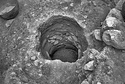
Turkish bothros/unlined pit at P/1-6/5 (now Ο/20-6/4).
Fill: soft, moist greenish-yellow clay with distinctive/definitive odor. No containers. Grid correction: from P/1-6/5 to Ο/20-6/4 ... 17 April 1970 ... Turkish Bothros |
"Bothros Well" at 71/ΞΣΤ ... 1700 - 1750 A.D ... "Bothros Well" at 71/ΞΣΤ |
Pocket in wall of Turkish bothros. The uninventoried material includes along with earlier pieces, the fragment of a bolsal very close to those from the well R 13:4 ... 450-425 B.C ... Pocket in Bothros |
A rubbish pit at the foot of the northwest slope of the Areopagus. Black figured, plain glazed vases and several lamps. A pair of lekythoi recall both in make and in style the products of the Haimon Painter ... Ca. 480-475 B.C ... Bothros of Agonippos |
The grid area is covered by 'modern bothros' nbp. 375 ... 1 June 1932 ... The grid area is covered by 'modern bothros' nbp. 375. |
Mycenaean Pit (Bothros?) opposite Pier 17.
Diameter at top 1.30m Estimated Grid ... Mycenaean IIIA:2-B ... Mycenaean Pit (Bothros?) opposite Pier 17.
|
Tile lined bothros with field stone collar. Coins:
19 June 1992 #818-#819 ... 12th-13th c. A.D ... Tile lined bothros with field stone collar. |
| "Room D" is the triangular area at L/15,16-2/10,12, NW of Wall 1, in E corner of basement of No.3. Hastings Street, bounded by the NE and SE walls of basement).
Bell-shaped vessel built of horizontally-laid ... 10th-11th c. A.D ... Pithos or Bothros in Byzantine "Room D". |
Lower fill may be original. Part of North side cut away by modern bothros wall. Fragments of Pilgrim Jug of Grey Ware, related to Turkish Grey Ware? ... 12th or 13th c. A.D ... Part of North side cut away by modern bothros wall. |
Double Well by Entrance to Square Building (Well B)
Wall A (R 9:2) was Late Geometric or transitional well, into one-half of which a bothros had been sunk in Turkish times (16th c. A.D.)-R 9:3.
This bothros ... ca. 17th century A.D ... Double Well by Entrance to Square Building (Well B)
Wall A (R 9:2) was Late Geometric or transitional well, into one-half of which a bothros had been sunk in Turkish times (16th c. ... -R 9:3.
This bothros was lined on the side of the Geometric well by a wall made of rough stones and pink cement, supported by three small round wooden beams. |
|
|