|
|
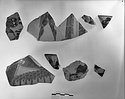
Wall fragment from bottom of figured decoration. Max. dim. 0.095.
Chimaera (chest, shoulder, most of forelegs, start of belly) to left. Below, stopped-maeander pattern with checkerboard-squares. Preliminary ... Probably early 4th century ... The subject is Bellerophon and the Chimaera, a rather rare theme in Attic red figure (see 443). Given the large scale of the Chimaera on 445 in relation to that of the ornamental band, there may not have been other figures present besides Bellerophon on Pegasos, although this would be unusual. |
| From wall of a large closed pot. Head of serpent seen against body and wings of a large animal. Red for the foreparts and for most of the feathers of the wings, for the underside of the body of the animal ... 21 July 1959 ... Red for the foreparts and for most of the feathers of the wings, for the underside of the body of the animal and for the eye of the snake. Bellerophon on the Chimaera? |
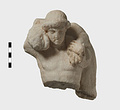
| Broken off just above the waist, nose and hair chipped, parts of both arms missing.
Nude youth with hair done in archaic style, carrying over his shoulder a lion. He holds the left forepaw in his left ... Roman period ... ADDENDA Published (Agora XI) as Bellerophon lifting the dead Chimera. |
Wall fragment from near rim. Reserved band on inside. Max. dim. 0.064.
Bellerophon (head, start of right arm) to right, wearing a cloak. Of Pegasos, just a bit of his wings remains. White: wings. Dilute ... Early 4th century B.C ... Max. dim. 0.064.
Bellerophon (head, start of right arm) to right, wearing a cloak. |
Wall fragment with start of rim. Narrow reserved band on inside near top. Max. dim. 0.044.
Wreathed head of man emerging from between a pair of wings. Preliminary sketch. Relief contour: profile. White ... Third quarter of the 5th century B.C ... The identity of the figure is puzzling because the presence of the beard rules out the usual characters who appear in a winged context, namely Triptolemos and Hyacinth, also Bellerophon and, occasionally, Apollo (for the latter, see the namepiece of the Painter of Vienna 202, in which the god rides a griffin: ARV2 1523, 1; Addenda 385). |
|
|