|
|
| The Odeum ... Homer A. Thompson ... A rectangular building with poros foundations was excavated in the central part of the eastern area of the excavation. The southwest corner, lying in Section Μ, was excavated in 1934 and the rest of the ... 2 Apr-27 Jun 1935 ... Excavation revealed a marble orchestra floor, bedrock cuttings for the lower seats of the cavea and the bedrock foundations for a stage. |
| Sections ΝΝ - ΞΞ Excavation Summary 1946 ... Rodney S. Young ... The objective of this year's excavation was to clear the southern part of the section to bedrock. Features earlier investigated (the 6th century cemetery, the Hellenistic-Early Roman terrace and one large ... 31 May-14 Aug 1946 ... The objective of this year's excavation was to clear the southern part of the section to bedrock. Features earlier investigated (the 6th century cemetery, the Hellenistic-Early Roman terrace and one large Roman tank), as well as some discovered this season (a second Roman water tank, a great built shaft, a part of the Great Drain and early house walls), were removed. |
| Preliminary Report on the 2000 Excavation Season ... John McK. Camp II ... Excavations were carried out in three sections, two to the northwest, (ΒΖ and ΒΕ) and one to the southeast of the Agora square (ΕΛ).
In Section ΒΖ the investigation of the remains of the 11th century settlement ... 6 Jun-28 Jul 2000 ... In Section ΕΛ, in the area of Eleusinion, bedrock was cleared in several trenches to determine where it would be safe to found wooden walkways. The bedrock lies high in this area and the fills were shallow. |
| Section Ψ
Supplementary Exploration: July-August 1959 ... Eugene Vanderpool ... Excavations in Section Ψ did not go to the bottom throughout the area; considerable masses of early fill were left. Instead, late disturbances and test cuts down to bedrock revealed enough of both stratification ... 29 Jul-20 Aug 1959 ... Instead, late disturbances and test cuts down to bedrock revealed enough of both stratification and structural remains to estimate that nothing of great consequence escaped the attention of the excavators.
|
| Sections Ε, Ν, Η 1952 ... Homer A. Thompson ... Mycenaean graves were excavated in section Ε.
Section Ν was disturbed by late pits, bothroi and walls. Excavation was carried out through Roman levels. The area seemed to have been leveled out and raised ... 4 Mar-31 May 1952 ... Earlier fills were found only in wells and pits cut down into bedrock. A Mycenaen tomb was excavated.
|
| Section Ω 1938 ... M. Crosby ... Section Ω lies in the east end of the north slope of the Areopagus, well to the southeast of the market square proper. Excavation showed, as expected, that the area was a residential district throughout ... 16 Jan-17 Jun 1938 ... Part of the area was covered by a mass of destruction debris from the 7th or 8th century A.D., and it was probably not built up in Byzantine times; the Turkish and modern houses rested directly on the late Roman fill at the north and southeast, on Classical and Hellenistic in the center, and on bedrock in the southwest. |
| Preliminary Report on the 2002 Excavation Season ... John McK. Camp II ... Excavations continued in the northwest corner of the Agora (sections ΒΕ and ΒΖ) and in the Eleusinion area (ΕΛ), and a trial trench was opened up in the Panathenaic Way (Σ).
In section ΒΖ, the exploration ... 10 Jun-2 Aug 2002 ... A well from the late 6th to early 5th century B.C. was excavated, and while scraping bedrock, a marble portrait head was discovered. |
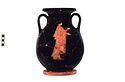
| Section Φ Season of 1937 ... Eugene Vanderpool ... In antiquity the area included in Section Φ lay outside the Agora proper and were apparently occupied only by houses and small buildings. The earliest period of which any considerable remains were found ... 25 Jan-17 Jun 1937 ... Pottery from the 2nd and 3rd quarters of the 6th century B.C. were found in a small hollow in the bedrock. A big well was excavated and black-figured and red-figured pottery was found. |
|
|