|
|
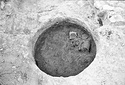
| Dimensions: 1.10m in diameter and 1,36m deep.
It could have been started as a well but then abandoned at a shallow depth (perhaps due to Persian invasion of Athens). BG vessels (including one inscribed ... 500-470 B.C ... It could have been started as a well but then abandoned at a shallow depth (perhaps due to Persian invasion of Athens). |
Unfinished well, all one fill; solid bedrock at a depth of -2.47m.
It contained masses of broken rooftiles and probably was used as a refuse pit after the sack of Athens by Sulla.
Twenty-three stamped ... Early 1st c. B.C ... It contained masses of broken rooftiles and probably was used as a refuse pit after the sack of Athens by Sulla.
Twenty-three stamped amphora handles; "Pergamene" ware; "Samian" ware and Pompeian-red ware must be intrusive; two-thirds of bowls long-petal. |
Geometric Well on the west side, in the line of the Roman Panathenaic way; 3.70m below paving block of street that overhangs well. It was neatly cut, 1.05m. in diameter, but it was dug only to a depth ... Late Geometric, end of 8th century B.C ... It was closed at the end of the 8th century, probably because of the drought that occurred in Athens at that time. |
| Rodney S. Young ... Disturbed burial (no remains), probably an infant pot inhumation.
Inhumation grave 17 in notebook. (E.L. Smithson: Grave XIX: PG).
Shallow oval cutting containing a banded amphora on its side, mouth ... LPG ... JP
Young: "It is possible that a baby whose bones have completely disappeared was placed in the larger coarse amphora, and that the other amphora was a Beigabe (offering)" The fact that no precedent exists in Athens at this time for a full-sized amphora as an offering in an infant or child grave renders such a suggestion unlikely.
|
Pit in SW corner of Heliaia Peristyle (mint).
The four Athenian imperial coins (Κ-1641 - Κ-1644) belong to the Athenian Imperial Group III, a series that can be very closely dated to the middle of the ... Mid 3rd c. A.D ... Use of the building as a mint need not have gone back much before 250 since there is a gap of one or two generations before the Group III coinage during which Athens did not coin. |
| Eugene Vanderpool ... Rectangular pit, oriented east-west, cut party into filling of Early Protogeometric pit-well (I 18:4), to a preserved depth of about 0.30m. A late Byzantine wall founded below the floor of the grave destroyed ... Middle Geometric I ... Although half of the tomb was entirely destroyed by later building activity, what survived constitutes one of the richest graves on the slopes of Areopagos and in Early Iron Age Athens. |
|
|