|
|
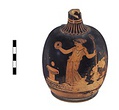
Squat ovoid body on ring foot; flaring rim with interior flange; rolled handles. Attic household ware; glaze wash inside, and traces of a glaze band below the handles.
On a somewhat more slender example ... Context ca. 435-425 B.C ... On a somewhat more slender example in the National Museum, Athens 2593, the conical lid, similar to 1558, is preserved; close, but the lid missing, Athens, Acropolis Museum from the Syntagma cemetery: Ἐφ., 1958, p. 93, fig. 159 (Grave LIX = 79, 1). |
NM 16176
Ring foot. On handle, ladder pattern interrupted by a panel with parallel verticals.
Shiny black glaze.
Probably later than the examples from the Isis Grave, C.V.A., Athens 1[1], 3[3], 8-10, ... LG I |
NM 16062
Flat bottom. Ladder pattern on beginning of handle at top; three glaze bands on rim inside.
Black glaze, brown where thin.
Like the mugs from the Isis Grave, C.V.A., Athens 1[1], 4[4], 1-4 ... MG II |
| Squat lekythos. Heavy rounded body with ring foot, one handle and a narrow neck; the handle and lip missing; a small hole broken in the back.
On the body, opposite handle, and on an egg-pattern band for ... 4 April 1935 ... By the same hand, P 5264 and P 5265.
Cf. National Museum, Athens. |
Lower part of wall and all of ring base. On underside of floor, three concentric circles with central dot. Most of the glazed fired red on the inside and on the outside below the figures. P.H. 0.15; diam ... Ca. 430 B.C ... Cf. just a few examples that may stand for many: two by the Veii Painter: South Hadley, Mass., Mount Holyoke College, 1932 BS II.5 (ARV2 906, 109; Addenda 303) and Berlin 2261 (ARV2 906, 116; Addenda 303); Oxford 1961.468 by the Painter of Bologna 417 (ARV2 917, 202; Addenda 304); the namepiece of the Group of Athens 1591 (ARV2 955, 1; Addenda 307).
... But in at least one example Eurykleia stands, in this case immediately after the recognition: Athens, N.M. 1914, a 4th-century Thessalian relief (see S. Karouzou, National Museum: Catalogue of Sculpture, Athens 1968, p. 155, pl. 46; C. |
|
|