|
|
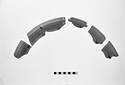
| Two joining rim sherds and four non-joining rim-to-wall fragments (about one-third of rim). Sloping rounded wall, flattish rim. Ancient repairs, remains of inset swallowtail lead clamps on inner face of ... 5-9 March 1936 ... Sloping rounded wall, flattish rim. Ancient repairs, remains of inset swallowtail lead clamps on inner face of wall, and nail-like clamp through rim.
|
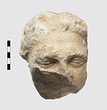
| Upper right part remains.
Head of a girl, rather less than life-size, her hair drawn back from the brow in wavy ridges.
Top of head roughly finished; heavy ancient weathering.
Parian marble. Finished From ... 2 February 1939 ... Upper right part remains.
Head of a girl, rather less than life-size, her hair drawn back from the brow in wavy ridges.
Top of head roughly finished; heavy ancient weathering.
|
Only the lower part remains. A massive steep-walled basin with flat underside. The bottom pierced while the clay was still soft with many round holes 0.005m. in diameter.
Buff biscuit containing much ... 10 July 1959 ... Only the lower part remains. A massive steep-walled basin with flat underside. ... House behind north end of Stoa of Attalos, set in bedrock to north of ancient road; under it a few sherds of late 4th. c. |
Fragments of Latin inscription.
Grave stone; Tweddell's Epitaph.
Fragment Β 66 (a), back rough picked; otherwise broken.
Five letters preserved.
Fragment ΚΚ 1190c (b), inscribed face only preserved ... a) (Β 66) 31 January 1934
b) (ΚΚ 1190b) 9 March 1939
c) (ΚΚ 1190c) 9 March 1939
d) (ΚΚ1261a) 14 June 1939
e) (ΚΚ 1261b) 14 June 1939 ... One line of the inscription remains.
Fragment ΚΚ 1190c (c), inscribed face and rough picked back preserved.
... The slab was probably made by sawing in two an ancient block; the rough picking on the back seems certainly to be ancient.
... Part of one letter remains.
Pentelic marble.
|
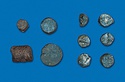
| Eleven pieces cut from a rod.
One of these is the remnant of the rod, become to short for further cutting. Eight pieces are "normal", two are scraps.
The cutting was done with a chisel anywhere from one ... 16 June 1953 ... Found in removing a little firm ancient earth from above the edges of the foundation blocks at the corner of the poros building. Remains of small furnaces of the late Helenistic and early Roman periods. |
| Three fragments:
a) Broken above and at right, perhaps also below. Left side smooth. Back badly pitted by cesspool acids, but probably nearly original. Preserved bottom similarly pitted; may or may not ... a) (Θ 1928) ca. 530-525 B.C., b) (Ε 626) last quarter of 6th c. B.C., c) ca. 600-590 B.C ... Pentelic marble with some bluish veins.
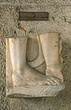
b) The top of a dog's head preserved, from the ear to below the eyes; the head is turned up and rests against his master's hand, of which the left thumb, lying along the animal's jowl, remains.
Island marble.
... a) (Θ 1928) North side of Turkish cesspool, in ancient fill at level of ancient strosis; back of relief towards cesspool.
b) (Ε 626) Found in marble dump east of S.E. corner of Eponymous Heroes.
c) Found in marble pile on west bank of Great Drain in front of Tholos. |
Mended with the missing pieces restored in plaster and painted, notably most of the mouth and handle. Glaze misfired reddish brown on back; abraded on inside of handle at join of neck. H. 0.181; diam ... Late 5th century B.C ... Mattusch, "Casting Techniques of Greek Bronze Sculpture: Foundries and Foundry Remains from the Athenian Agora with Reference to Other Ancient Sources" (diss. |
Four non-joining fragments of neck and shoulder. P.H. a) 0.125; max. dim. b) 0.16, c) 0.11, d) 0.99. E. Laufer, Kaineus: Studien zur Ikonographie [Rivista di archeologia Suppl. 1], Rome 1985, pl. 12:35 ... Ca. 470-460 B.C ... Cohen, "Paragone: Sculpture versus Painting, Kaineus and the Kleophrades Painter," Ancient Greek Art and Iconography, Warren Moon, ed., Madison, Wisc., 1983, pp. 171--192; E. ... From what remains of the Kaineus scene on Side A of 177, taken together with the curve of the krater's shoulder, it is likely that the composition was a symmetrical one, with the warrior flanked to left and right by a single centaur, similar to the one by the Pig Painter himself, once in the Lucerne Market, now in a Swiss private collection (ARV2 563, 7; Addenda 260).
|
|
|