|
|
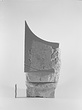
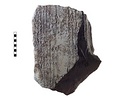
Inscribed fragment.
Inscribed face only preserved.
Ten lines of the inscription preserved.
Pentelic marble. Found in a wall of a Byzantine building, south of the altar of the Twelve Gods. Leica ... 20 May 1938 ... Ten lines of the inscription preserved.
... Found in a wall of a Byzantine building, south of the altar of the Twelve Gods. |
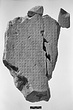
Fragment of inscribed stele.
Broken on all sides.
Parts of seven lines of the inscription preserved.
Hymettian marble. Found in late Roman context, south of the altar of the Twelve Gods. Leica ... 29 June 1933 ... Fragment of inscribed stele.
Broken on all sides.
Parts of seven lines of the inscription preserved.
... Found in late Roman context, south of the altar of the Twelve Gods. |
| Crowning moldings, hawk's beak with front, joint surface with anathyrosis at left, and concave top surface preserved.
Soft yellow poros with thin layer of fine stucco on surface; traces of red paint on ... 26 August 1946 ... Soft yellow poros with thin layer of fine stucco on surface; traces of red paint on fascia above hawk's beak. Two sharp cut grooves on upper fascia, probably curved corresponding to top surface, at left near joint surface.
From Altar of Twelve Gods.
... Packing for floor of Peribolos. |
| Mended from two pieces. Fragment from a large thin-walled closed pot; dilute wash inside. Warrior right; behind him a spectator, cloaked and bearded. At left, part of the side border of lotus buds, latticed, ... 18 December 1954 ... At left, part of the side border of lotus buds, latticed, and at edge of fragment part of a second scene (arm?). ... Planting hole between Great Drain and Altar of Twelve Gods. |
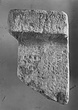
| Inscribed fragment.
Inscribed face and smoothly dressed right side preserved.
Five lines of the inscription preserved, trace of another above (?).
Pentelic marble.
ADDENDA Joins to I 5709. Found in a ... 19 May 1938 ... Five lines of the inscription preserved, trace of another above (?).
... Found in a wall of a Byzantine building, south of the altar of the Twelve Gods. |
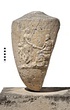
A segment from the back of the head.
The hair in deep wavy grooves, radiating from the crown of the head, runs down to a fillet, below which the surface is smooth.
Pentelic marble.
Joins S 539 (Ν 179) ... Early Roman period (?) ... A segment from the back of the head.
The hair in deep wavy grooves, radiating from the crown of the head, runs down to a fillet, below which the surface is smooth.
... Byzantine building, Room XXVII, above south corner of the Altar of the Twelve Gods. |
Complete; cracked but glued together.
Plain curved roof tile. Brick red clay with white grits; pale buff on surface.
Grave, which it covered, set in Roman fill, but burial probably dates from latest Roman ... 20 July 1946 ... Used as cover for a grave just south of south wall of Peribolos of the Altar of the Twelve Gods. |
| Inscribed statue base.
About the three exposed sides a band was left undressed around the bottom, and this projects ca. 0.025m. beyond the finished face above. This upper face would seem originally to ... Ca. 485 B.C ... On Site-Altar of Twelve Gods |
| Fragment of inscribed base.
Moulding and fascia above.
Broken away below and on the right; back preserved.
Inscription is on main part of the base and on the projecting fascia above.
Above, part of three ... 350 B.C ... Fragment of inscribed base.
... Above, part of three lines of the inscription preserved; below, remains of eight.
... Found in late Byzantine wall, south of the altar of the Twelve Gods. |
| Inscribed funeral lekythos.
Almost half of the circuference preserved; base and neck broken away; surface battered and worn.
At right, on a raised ground-line, a partly-draped bearded man is seated left, ... 26 May 1938 ... Almost half of the circuference preserved; base and neck broken away; surface battered and worn.
... Three lines of the inscription preserved; one over head of seated figure, one at left of standing figure, and one over the head of the boy.
... Found in a wall of Byzantine building, over the area of the altar of the Twelve Gods. |
| Broken at top and sides. Also small joining pieces (not included on photograph).
Same series as A 1266 (Η' 906). Altar of Pitt?
Poros. Not found 2016. From wall S.W. of Peribolos. Leica, XXVII-80 ... July 1947 ... On Site-S.W. of Altar of the Twelve Gods |
| Broken at top and back.
Soft yellow poros with very smooth sawn front surface; slightly less smooth back and bottom. Anathyrosis joint surface at side. Same series as A 1267 (Η' 907). Altar of Pitt?
Poros ... July 1947 ... On Site-S.W. of Altar of the Twelve Gods |
| Fragments of inscribed block.
List of names; possibly the list of those who lost their lives at Syracuse.
Fragment Η 419 a), broken away above, below, and to the left. The right side has anathyrosis ... Late 5th. century B.C ... Fragments of inscribed block.
List of names; possibly the list of those who lost their lives at Syracuse.
... a) (Η 419), found in a modern foundation wall, immediately south of the altar of Twelve Gods.
b) (ΗΗ 245), found in a Byzantine wall in the Church of Christ, in the area north of the Eleusinion.
c) (ΒΒ 39), found in the wall of the modern house 648/7, west of the Panathenaic Way. |
|
|