|
|
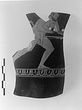
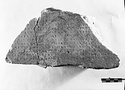
Wall fragment.
Hunting scene? Main zone: two standing figures, back to back, with shields on upraised arms; an animal, lion or dog, facing left hand figure. Upper zone: guilloche; traces of other ornament ... 10 April 1953 |
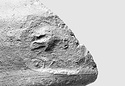
| Helmet.
Cf. Pridik (1917), p. 52, nos. 363-364, pl. IV, 17-18. Par: for name see Pridik 1917, Pl 4, nrs 17--18 and text p52,
nrs 3613--14(VG)* Finished Clay hole. [Θά]σιο̣[ν]
helmet
Π̣οῦλυς̣ Leica ... 8 April 1936 |
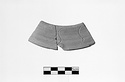
| Two joining fragments, broken at both ends, preserving small section of ring.
Inscribed. Straight wall. Buff slip on both sides. On the outside two "S"s inscribed before firing.
Very fine, hard, reddish ... 16 May 1936 |
Most of mouth missing; otherwise intact. Slender eggy body on flat slightly flaring base; body forms continuous double curve with neck; wide mouth, trefoil lip; rising handle, from edge of lip to shoulder, ... 14 April 1938 |
The end of the nozzle broken away; otherwise intact.
High straight sides rounding below into a flat bottom; no base. Flat top with central filling hole; two grooves near the outer edge. Broad flat-topped, ... 350-300 B.C ... Agora IV, nos. 236-240, pp. 61-62, pls. 8, 37. ... Corinth IV, ii, pp. 43-45, nos. 100-113, pl. ... Agora IV, no. 239, p. 62, pl. 8, 37. |
The greater part of the discus broken away.
Convex sides; ovules on panelled rim; pierced handle with double groove above and below; on reverse, in plain grooved circle the signature.
On the discus are: ... 17 June 1933 ... Corinth IV, ii, no. 608 ... Agora VII, no. 239, p. 92. |
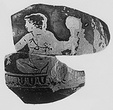
| Two joining pieces from body of toy oinochoe. Egg pattern ground line. A child seated, facing, head turned left, object resembling mallet (rattle?) in left hand.
Dull black glaze, partially fired red; ... 17-24 May 1940 |
Four (now five) fragments from the rim of a large lid, pierced for suspension. Around the periphery a band of geese moving right. Above them a band of sirens and lions.
Fine buff clay; free use of incision, ... 20 April 1934, 27 April, 9 May 1938 |
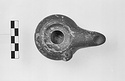
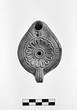
| End of nozzle missing, otherwise intact.
Sunken discus. Groove around rim; pierced lug; high ring foot.
Thin dull glaze, somewhat flaked.
Type XII of Corinth collection, type 34A of Agora collection ... 13 July 1949 ... Agora IV, no. 448, p. 106, pls. 16, 42 ... Agora XXVII, no. 239, pp. 164, 199, pl. 52. |
| a) Five joining pieces from the body preserve part of the egg ground line, and a nude silen running right, carrying a table, with cakes(?).
b) Fragment from lower body preserving one end of ground line ... 17-24 May 1940 |
Fragment of base only.
Low base ring. Letters moulded in raised charakters: "[Α Ρ Ι Σ Τ Ω] Ν Ο Σ". Traces of burning.
Metallic black glaze inside and out.
Type 51B (?) of Agora collection, type XVIII ... Possibly last years of 3rd. century-86 B.C. |
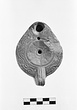
| On discus, rosette, with grooves around central filling hole.
Handle solid, triple grooved.
On bottom, double concentric circles.
Reddish-brown glaze.
Red clay.
Type XXVIII of Corinth collection.
ADDENDA ... 17 June 1931 ... Corinth IV, ii, p. 103, fig. 48, no. 2; p. 105, fig. 49, no. 4 ... Karivieri (1996), p. 233, no. 239, pl. 43 ... Agora VII, no. 1702, p. 150. |
| On rim, wavy lines.
On discus, star, indistinct, around central filling hole. Handle, solid, triple grooved.
On bottom, double concentric grooves signed indistinct: "A".
Red glaze.
Red clay.
Type XXVIII ... 18 June 1931 ... Corinth IV, ii, p. 105. fig. 49, no. 4 ... Karivieri (1996), p. 239, no. 255, pl. 43 ... Agora VII, no. 1980, p. 156, pl. 32. |
Mended from four pieces; the back half of the wall and rim missing, and a piece from the front near the nozzle. None of the inner edge of the rim preserved.
No base; the bottom rises to a rather large ... August-September 1932 |
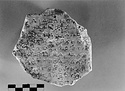
| Inscribed fragment.
Inscribed face and right edge preserved.
Fragment of decree mentioning sitophylakes.
Eleven lines of the inscription preserved.
Hymettian (?) marble.
ADDENDA With I 3238 (?). Removed ... 290/239 B.C. |
| Inscribed fragment.
Inscribed face and a bit of back preserved.
Mended from two pieces. Found face up.
Decree in praise of the sitophylakes of the archonship of Athenodoros.
Thirteen lines of the inscription ... 240/239 B.C. |
|
|