|
|
Lower body partly restored; handles and most of upper body missing.
Broad resting surface. Scraped groove at junction of stem and foot. Broad but pointed lower body. Opposing myrtle garland with single ... 290-275 |
Less than half preserved, but with full profile.
Angular foot; grooved resting surface; convex underside. Groove at base of wall. Slightly incurved rim. Rouletting. Shiny red glaze with black patches, ... 110-86 |
Lower half of body, all of torus foot, start of handle B/A. Strengthened with plaster. Thin reddish glaze on inside. Misfired reddish in places on outside. Pitted here and there. P.H. 0.035. R. R. Holloway, ... Ca. 440-430 B.C ... For a fuller kitharode scene than 8, see London, B.M. ... PE 26) with the seated judge on Side A: the manner in which the himation is pulled across the lower legs is, by comparison, rather mechanically rendered on 8. Also, the drawing of the ankle bone is more carefully articulated on vases by the painter: e.g., the namepiece, Ferrara 2893 = T.617 (ARV2 1038, 1; Paralip. 443, 1; Addenda 319; Reeder, Pandora, pp. 349--351, cat. no. 110; Matheson, p. 436, cat. no. ... Compare also the man announcing the victories in a contest for boy athletes on Taranto 52368 (ARV2 1040, 15; Addenda 319; Matheson, p. 439, cat. no. PE 19) with the judge on Side B of 8. |
Floor fragment with start of stem on underside. Max. dim. 0.054.
I, symposion. Man or youth (most of bent left arm, part of draped torso and left leg drawn up and shown frontally) reclining to left, playing ... Ca. 510 B.C. |
Several nonjoining sections, preserving one-fourth of rim, a few fragments of upper wall, one handle and half of the other; partially restored. Made in very fresh mold.
Scraped groove and ridge at top ... 225-200 |
Painted Vessel.
Fragment of wall.
From large, closed pot. Upper half of fragment glazed. In reserved band below, figure stands right. Face and upper body white, hair black; eye and nostril picked out ... Context of 110-75 |
Most of handle and parts of foot, underside, and body restored.
Low foot; flat resting surface; flat underside with some string marks still visible. Straight lower body, convex shoulder. Tapering neck ... 150-110? (Roman context) |
Rim chipped.
Flat bottom with groove around edge. Glazed groove at base of rim.
Dull red glaze.
Similar treatment of bottom and rim on 542. Similar profile: P 12154 (N 20:4, fill II), P 19922 (D 17:4, ... 150-125 |
Five-sixths of wall and rim missing.
Rounded resting surface; nippled underside. Irregular wall.
Downturned rim. Pink fabric (7.5YR 7/4), slightly poorer than normal, with abundant mica and some black ... 110-86(?) |
Bowl: Pergamene Sigillata?
Foot preserved, some chips missing.
Flaring foot with groove and ridge at top; broad, beveled resting surface with two grooves at inner edge. Concave underside. Graffito ΚΥ ... Context of 110-75 |
Part of handle and over half of body restored.
Angular foot; beveled resting surface; nearly flat underside. High lower body. Curved shoulder with smooth transition to long, nearly cylindrical neck. Torus ... Context of 150-110 |
Lid.
Knob and half of rim and flange missing.
Domed top offset from horizontal flange. Rim concave to outside, flat on bottom. Hollow knob base. Red tongues on flange; red band at junction of flange ... Context of 110-75 |
Two-handled Cup.
Handles and about half of body restored.
Pointed underside. Three large palmettes within coarse rouletting on floor. Light brown fabric (7.5YR 6/4); dull gray glaze inside, orange on ... Context of 110-75 |
Head of archaic figure. Mantle (?) over curly hair parted in middle. Head is hollow. Traces of white paint. Munsell (fabric) 5 YR 6/4 light reddish brown; (paint) 8/N white Oscar Broneer, Nb. No. 2. 26 ... 16 September 1932 |
Body.
Upper body missing; wall chipped.
Ring foot; flat resting surface; flat underside. Cylindrical body, tapering to top, projecting slightly at bottom. Decoration in orange glaze. Broad band with ... Context of 110-75 |
Body.
Full height apparently preserved; almost all of rim and much of body restored.
Ring foot; flat resting surface; convex underside. Cylindrical body with projecting flange at bottom. Decoration in ... 110-86 (context of 110 to early 1st century after Christ) |
Half of mouth, half of vertical section of handle, part of shoulder, most of lower body, and center of floor restored.
Low, flaring foot; flat resting surface; nearly flat underside. Lower body nearly ... Context of 150-110 |
Vertical section of handle and over half of body, foot, and underside restored.
Low, flaring foot; flat resting surface; well-formed, slightly convex underside. Lower body very high and nearly straight ... Context of 150-110 |
Krater.
Most of rim, part of body, and one handle restored. Foot chipped, hole in floor (probably intentional); some appliqué figures partly missing.
Molded foot; broad, flat resting surface. Low, hollow ... Context of 150-110 |
Barbotine Cup Or Jug.
Lower body and most of wall and rim restored.
Ovoid body, upper two-thirds decorated with five rows of barbotine bosses. Body angles in to rim at top. Low rim, convex to outside ... Context of 110 to early 1st century after Christ |
Lagynos.
Underside, parts of body, and most of handle restored.
Flaring ring foot; flat resting surface. Flattened globular body.
Fairly long, tubular neck. Flaring rim, flat on top and undercut on ... Second half of 1st century (context of 110 to early 1st century after Christ) |
Bowl fragment. Traces of burning at left (surface is gray). Max. dim. 0.04. H. A. Thompson, Hesperia 6, 1937, p. 13, fig. 6:a.
A, two women (bottom of chiton, left foot of one; right foot, a little of ... Ca. 510-500 B.C. |
No trace of wood, and no means of attachment. Grave 8, 13. Leica, 81-324 ... 23 March 1936 |
Medicine Bottle.
Half of rim missing; foot chipped.
Flat underside, pierced underneath. Irregular, angular profile with high shoulder. Vertical rim with groove at junction with body.
Micaceous, pink ... Late Hellenistic and Roman context |
Nozzle and fragment of rim only.
Vertical sides; broad rim sloping into centre. Short, broad nozzle with fairly large wick-hole.
Clay: fine reddish; very lustrous black glaze all over. Assembly Place, ... 1932 |
Rim and three-fourths of body restored.
Low foot; curved resting surface; nearly flat underside with spiral marks. Upper and lower body of equal height, both slightly curved.
Smooth transition to neck ... Late 2nd to early 1st century? (3rd-century context,disturbed) |
| On left, helmeted warrior with upraised shield facing right; on right, helmeted warrior with raised shield; two spears thrust out in front of these figures.
See also P 104 and P 2223. Nb. p. 620, #1 ... 7 September 1931 |
Rim fragment. Narrow reserved band on inside at rim. Max. dim. 0.097.
Below rim, egg pattern with dots on fascia; then a concave molding decorated with a ribbon pattern with dots in the interstices.
... Ca. 440 B.C. |
Floor fragment with start of stem. Two concentric circles with central dot on underside. Max. dim. 0.053. H. A. Thompson, Hesperia 28, 1959, pl. 22:b; Schefold, Göttersage, p. 154, fig. 203; LIMC V, 1990, ... Ca. 510 B.C. |
About two-thirds of one disk preserved with a bit of connecting spool. Streaky glaze on underside of disk. Iron stain at top. Diam. 0.113. ILN, Oct. 19, 1935, p. 648, fig. 4; L. Talcott, Hesperia 5, 1936, ... Ca. 480 B.C ... Brendel, Die Antike 12, 1936, p. 281, fig. 8; M. Robertson, Greek Painting, Geneva 1959, p. 110; L. Lacroix, Études d'archéologie numismatique, Paris 1974 [ pp. 67--106], p. 94, pl. 25:2; Themelis, Agora: Guide, fig. opp. p. 76; LIMC V, 1990, p. 1009, no. 11, pl. 632, s.v. ... There are no traces of gilding (Talcott, Hesperia 5, 1936, p. 335). |
Body fragment with small missing pieces restored in plaster and painted. P.H. 0.123; P.W. 0.172. M. F. S. Hood, ArchReports, 1957, p. 4, fig. 1:b; H. A. Thompson, AA, 1957, cols. 59--60, fig. 2; Fasti ... Ca. 490 B.C. |
Wall fragment. Max. dim. 0.12. Schwarz, Triptolemos, p. 37, cat. no. V 49, pl. 8:14; Hayashi, Triptolemosbildes, p. 136, cat. no. 37, pl. 5:1 (wrongly called a calyx-krater); Langridge, "Eucharides Painter," ... Ca. 490-480 B.C. |
Seven non-joining fragments, mostly of wall, a / e and f with shoulder, g of overhang of rim from near handle plate. Glaze rather dull on b and d. Max. dim. a/e) 0.107, b) 0.088, c) 0.073, d) 0.053, f) ... Ca. 500-490 B.C ... Thompson, Hesperia 27, 1958, pl. 42:n (fragment a); Agora XIV, pl. 65:b; S. ... Koumanoudi, ἈρχἘφ 1976, p. 214, fig. 1 (fragment b); Langridge, "Eucharides Painter," p. 348, cat. no. E 17.
A, departure with chariot(?). ... For good examples, see Berlin 1732 by Lydos (ABV 110, 37; Paralip. 44, 37; Addenda 30) and London, B.M. |
Most of one side preserved.
Flat-bottomed deep saucer type made of household (cooking) ware.
Red to brown clay.
Type 1. Agora Collection.
Early Attic. Protoattic Well. Leica, VII-92 ... 10-13 May 1937 ... Agora IV, no. 3, p. 8 ... Agora XXXI, p. 110. |
The vertical handle broken off; also the rim opposite, so it may have had two handles, cf. cups as P 7068 (ΠΘ 921). Restored in plaster. Flat bottom, left rough.
Attic clay. Roughly made on the wheel ... 26 January 1937, 13, 16 February 1937 |
Fragment with three nozzles from a large circular lamp.
On rim, alternating concentric half-circles, with small impressed circles and diagonal grooves setting off the nozzles; surrounding the discus, a ... 15 February 1932 |
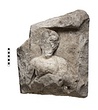
| Upper part of stele with part of molding at top preserved.
Original surface preserved along right edge. Dowel hole in back at lower right.
Upper part of standing, draped female figure, much battered.
Pentelic ... March 1956 |
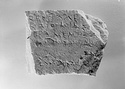
| Inscribed mortgage stone.
The inscribed face has a very rough uneven surface. The back is smooth finished. Top, bottom, left and right are broken surfaces, but stone probably in this condition when inscription ... 7 March 1936 |
Red clay, flat back; necklace? edge of garment and drapery. Carl Roebuck, Nb. No. 8. 414-5 ... 18 May 1938 |
The horizontal band handle at the back is broken off.
Dull black glaze over all, except under side of low base.
Type IV of Corinth collection, type 21C of Agora collection. Well. Latest Fifth-Fourth century ... 18 May-4 June 1937 |
|
|