|
|
Small chips missing.
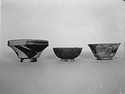
Broad, beveled resting surface; pointed underside. One pair of antithetical leaping dolphins, with white dot rosettes between them and flanking them; spiral wave pattern running right, ... 250-240 |
Amphora?
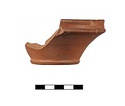
Fragment of rim and upper wall.
Nearly vertical wall flaring to molded rim. Hard, slightly micaceous, red fabric (2.5YR 5/6) with very small white inclusions; chalk-white lime wash inside and ... Context of 160-130 |
Part of rim missing.
Concave underside. Two grooves at base of wall, two more at about half height outside. Slight angle in body below rim. Rim inwardly beveled and slightly offset from wall on interior ... Mid-2nd century |
Neck.
Base of neck.
Concave neck. Brown band around base of neck. Hard, fine, only slightly micaceous, light red fabric (2.5YR 6/6); hard, dull, very pale brown slip (10YR 8/4) ... Context of 160-130 |
Body And Lid.
P 4077 a, b
Small segment of rim and flange of lid (a) and about one-third of circumference of pyxis rim (b).
Lid has vertical rim and domed top offset from flange. Trace of inwardly projecting ... Context of 160-130 |
Spreading ring foot, lipped. Reserved: center of underside with three circles and dot. Glaze peeled in parts.
The following look to be similar: New York 41.162.223 (ex Gallatin): CVA (8) Gallatin pl ... Ca. 425 B.C. |
Foot and one handle missing.
Small stemless cup; incurved rim. Light gray slightly gritty clay, thin black glaze roughly brushed on.
Similar fabric and finish, from the same deposit, 1475, Pl. 62 and ... Context ca. 490-450 B.C. |
Torus ring foot. Rim flat on top, sloping inwards, in- curving. Reserved: resting surface, underside with two glazed circles and central dot, and handle-panel.
Contemporary with this are P 21885-6 N 7:3 ... 475-450 B.C. |
Outturned rim; strap handles; ring foot. Wheelmade of cooking ware; thin fabric, smooth brown surfacing. Probably Attic.
Another from a contemporary deposit: P 24188 Q 15:2. For similar shapes, partway ... Context ca. 425-400 B.C. |
A bow fibula.
It has stilted fore-end.
Complete; corroded. Agora sample no. 630. Found with burial, inside geometric amphora (P 325). Ethafoam, low RH 1672 Leica, 2-133, LVII-30 ... 8 March 1932 ... Agora XXXVI, no. T6-4, p. 62, fig. 2.17. |
Piece of top missing.
Raised base, concave underneath. Concave wall with projecting flanges at top and bottom. Groove at inner edge of lower flange. Top has flat border and domed center, with concave ... 200-175 or perhaps later |
| Re-used.
Broken at right end. Above cistern; probably from it.
325-320 B.C. Leica, XX-100, 85-24 ... 25 May 1932 ... Kroll (1972a), pp. 226-227, figs. 244-247, no. 133 ... Agora XXVIII, no. P 4, p. 62, pl. 7. |
Globular jug on flaring ring foot; wide bell mouth; strap handle, concave on outer face, from neck. No join between the mouth and the neck, but placing of handle indicates approximate height. Red brown ... Context ca. 425-400 B.C. |
Part of stem and lower body preserved.
Cup or small krater. Fairly thin stem. Slightly angular foot, flaring below. Wall: swirling long petals, widely spaced. Metallic brownish orange glaze, red inside ... 100-50 ... Thompson 1934, D 41, p. 383, fig. 72 [H 16:4]), for similar wall pattern, but with jeweling, and P 14474 (Agora XXII, no. 345, p. 85, pl. 62 [M 20:1, lower fill]), with contiguous petals. |
Kylix base with part of stem. Black glaze. Inscribed on bottom in two lines. Oscar Broneer, Nb. No. 4. 178 88-402 ... 31 May 1937 |
| Nb. No. 1. Trench A, Assembly Place; filling of Period III. ΘΑΣΙΩΝ
ΠΟ[Σ]ΙΔΕΙΟΣ 62 ... Late 5th and first half of 4th century BC |
Upper part.
Round-mouthed jug fragment. Short straight neck, plain rim very slightly outturned; thick strap handle rising above rim; sloping shoulder. Slightly gritty gray clay, thin glaze, gray to brownish ... Context ca. 490-450 B.C. |
Half of rim, bases of handles, and a few fragments of lower body preserved; heavily restored.
Stubs of horizontal handles, round in section, joining just below rim and rising slightly. Two pairs of opposing ... 325-300? |
Moldmade Fragment.
Wall fragment.
Lower(?) part moldmade: vertical lines between ridges, over tips of pointed lotus petals. Upper body wheelmade. Decoration in dull black glaze: broad band on wheelmade ... Late Hellenistic context |
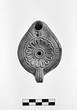
| On discus, rosette, with grooves around central filling hole.
Handle solid, triple grooved.
On bottom, double concentric circles.
Reddish-brown glaze.
Red clay.
Type XXVIII of Corinth collection.
ADDENDA ... 17 June 1931 |
Lower part of moldmade body and upper part of footpreserved.
Cup or small krater. Low, broad stem, flaring out and up to foot at bottom. Rosette medallion faintly visible on underside. Wall: long petals ... 100-86 ... For similar wall decoration see P 15736, P 14471, P 3124, P 3661 (Agora XXII, nos. 336, 338, 339, 341 pp. 84--85, pl. 61 [M 20:1, lower fill; M--N 18:1]). Shape perhaps as Courby 1922, p. 331, fig. 62:VIII. Similar but with thinner stem: Kyme I, MB 112, p. 71, figs. 5, 14, pl. 14; G. ... Edwards 1956, no. 92, p. 103, fig. 4, pl. 47. |
Most of foot and one-sixth of body missing.
Flaring foot. Spherical body with pentagons drawn in glazed grooves; groove around hole. Dull red glaze.
A small fragment of another, smaller (Diam. 5.0 cm.) ... 150-110 |
Fragment of torus mouth, neck, and start of shoulder, part of body on each side. Neck glazed on inside. Glaze misfired reddish brown; abraded in places, especially on mouth and on Boreas. P.H. 0.14; diam ... Ca. 460 B.C. |
Center of cup preserving part of wall with vertically incised ribs and central boss which is marked off by a scraped groove outside. The boss itself is in the form of a plastic negroid head. Glazed all ... 350-325 B.C. |
Several nonjoining sections, preserving one-fourth of rim, a few fragments of upper wall, one handle and half of the other; partially restored. Made in very fresh mold.
Scraped groove and ridge at top ... 225-200 ... P 10877 [Agora XXII, no. 189, p. 67, pl. 35, detail 3 (D 11:4, lower fill)]; G. ... Edwards 1956, no. 120, p. 107, pl. 50 [where other instances from the Agora are listed]). ... Chariot similar (but not from same stamp) to that on P 401 (Agora XXII, no. 152, p. 62, pl. 78 [H 6:4]). |
Wall fragment. Max. dim. 0.032. Matheson, Polygnotos, p. 418, cat. no. KL 64.
Warrior (most of head with pilos and left shoulder) to left, the shaft of a spear belonging to his opponent crossing his face ... Ca. 440-430 B.C. |
| Two rim and three plain fragments of a bowl with plain rim. The fragments do not certainly all belong together.
Two shallow grooves below rim inside. Agora samples no. 282. Cistern shaft.
1st c. B.C. 1706, ... 17 May 1935 ... Agora XXXIV, no. 62, p. 71, fig. 4, pl. 5. |
Spreading ring foot on short fat stem. Steep wall; thin jutting ledge at top of wall. Convex lid with acorn knob. Reserved: resting surface and center of cone beneath, outer edge of foot, outer face of ... 500-480 B.C. |
Mended and complete. Glaze abraded on one handle. H. 0.065; diam. at rim 0.19; diam. of tondo 0.106; diam. of foot 0.08. Themelis, Agora: Guide, fig. opp. p. 62; M. Lang, Socrates in the Agora (Agora Picture ... Ca. 500 B.C ... Themelis, Agora: Guide, fig. opp. p. 62; M. Lang, Socrates in the Agora (Agora Picture Book 17), Princeton 1978, fig. 11; S. Roberts, Hesperia 55, 1986, p. 16, cat. no. 22, p. 17, fig. 9, pl. 4 (outside).
|
NM 16123
Retrograde. -ΟΤΕΠΙΝ- Votive dump. -ΟΤΕΠΙΝ- |
Wall fragment from the receptacle of a rhyton(?). Max. dim. 0.063.
Maenad (most of draped legs, hanging leg of her nebris), probably dancing to right. Above her right thigh at the break is a bit of reserve ... Probably early 5th century B.C ... During his visit to the Agora in the summer of 1953, Beazley suggested that 1673 is a fragment of a plastic vase, presumably a rhyton. ... Hoffmann, Attic Red-Figured Rhyta, Mainz 1962, pl. 13), both from the Cow-Head Group; Naples Stg. 62 by the Eretria Painter (ARV2 1251, 37; Lezzi-Hafter, Eretria-Maler, p. 348, cat. no. 258, pl. 170); Boston, M.F.A. 01.8105 (ARV2 1551, 11; Hoffmannn, pl. 19:1, 2); and Ruvo, Jatta 1116 (ARV2 1551, 12) from the Group of Class W to which Hoffmann assigns a third, Bayonne 118 (p. 42, cat. no. 112, pl. 22:1) but which Beazley (ARV2 1704) places near the Group. ... Paul Getty Museum 4 [OPA 5], pp. 131--166. |
Mended with small missing pieces restored in plaster and painted. Lip offset on inside; foot offset on underside. Glaze slightly abraded on handles. H. 0.074; diam. of rim 0.18; W. with handles 0.238; ... Ca. 510-500 B.C ... Kurtz, JHS 103, 1983, pls. 3, 4; LIMC I, 1981, p. 178, no. 830, pl. 138 (A), s.v. ... Roberts, Hesperia 55, 1986, p. 18, fig. 10:25; p. 23, fig. 13:25; pl. 4:25; J. McK. Camp, The Athenian Agora: Excavations in the Heart of Classical Athens, London 1986, pl. 8, opp. p. 135 (I); LIMC III, 1986, p. 460, no. 428, pl. 349 (B), s.v. ... In 1958, Martin Robertson published detailed arguments supporting this attribution (AJA 62, 1958, pp. 55--66), a view he tells me he now no longer believes. |
The pointed end only remains.
The part next the blade was rectangular in section; the rest round. Trial pit in Stoa of Zeus Eleutherios, V layer. Leica, 5-226 ... 10 March 1933 |
| Full profile preserved; two small pieces of sides and rim missing; restored in plaster. Similar to P 8909 (Χ 58), but shallower; foot neatly profiled. Series of incised lines on interior of side wall ... 9 February 1937 |
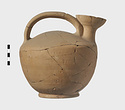
| Askos shaped vase, buff clay undecorated. Many fragments joined. Oscar Broneer, Nb. No. 2. 62 ... 30 Oct 1932 |
| Full profile preserved; about two-thirds of sides missing. Very low ring foot; slightly flaring concave sides; vertical rim with ridges, rouletted at top and bottom, the outer face concave.
At the center ... 26 April 1947 |
Part of red [?] of animal (outline incised). Resembles sphinx vase (AP 74). Clay apparently reddish, wash darker. C.H.M Nb. No. 17
Pit C 62 ... 28 Feb 1934 |
Lower end of a broad ribbon handle; near root, the stump of a small horn or projection.
Gritty brown clay; thick dark gray core; red burnished slip, inside and out. Well 4. 1669, 1884 Leica, 83-526, ... 13 May 1938 |
| Inscribed fragment.
Part of pediment and back preserved.
In the moulding is the letter "O", part of "ΘΕΟΙ". Below moulding is "AP", part of "ΑΡΧΟΝΤΟΣ".
Hymettian marble. Finished Found in a wall of the ... 9 October 1937 |
Round-mouthed, semi-glazed. Handle restored. Neck rather low.
Dull black glaze.
Cf. Agora XII, no. 150. Well beneath Stoa gutter. Leica ... May-June 1954 |
|
|