|
|
| Wall fragments and part of one handle restored in plaster.
Rounded bottom; flaring rim; one vertical and one horizontal handle.
Gritty red-brown to gray clay.
Cf. Agora XXXIII, no. 606. Cistern, upper ... February-April 1937 ... Agora V, no. F 85, p. 19, pls. 3, 72. |
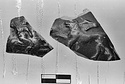
| Animal (dog?) running left with the leg of another animal above.
Pink clay; metallic black glaze.
Cf. P 75.
Cf. Agora XXII, no. 247. 2.40m. below lintel. Cave, south chamber, upper fill. 520 Leica, 80-26-8 ... 29 July 1931 |
All of one handle, half of the other, and small areas of rim restored.
Scraped groove in resting surface; concave underside with pronounced nipple. Lower body ribbed. Broad flange, convex on top, projects ... 275-260 |
Intact.
Flat underside. Convex-concave wall. Outturned rim. Strap handle from near bottom to rim. Soft, slightly micaceous, reddish yellow fabric (5YR 7/6).
Similar, from same context: P 28784, P 28792, ... 350-325 ... Similar, from same context: P 28784, P 28792, P 28800, P 28884--P 28886, P 28917. ... Thompson 1954, nos. 15, 16, p. 85, note 59, pl. 18 [O 18:2]), P 24304 (Agora XXVII, no. 140, p. 185, pl. 42, [P 10:3]). Similar, from later contexts: P 22810 (D.
B. Thompson 1954, no. 13, p. 105, note 89, pl. 18 [F 16:1, lower fill]), P 6767 (D 15:3), P 12404 (S 19:3, lower fill). |
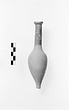
| The foot broken off.
Buff clay, the neck covered with thin, reddish glaze. Cistern. Leica, 97-3-24 ... 7 May 1934 |
| Typical shape, rising.
Light red clay, yellow near surface; cream slip.
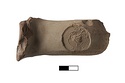
Impression slightly doubled; not quite complete; damaged but not worn: e.g. rose exceptionally well preserved. Stp: sl doubled* ... 17 June 1931 |
Wall fragment. Thin, brownish black glaze on inside. Glaze abraded slightly below pattern. Max. dim. 0.077. H. A. Thompson, Hesperia Suppl. IV, p. 130, fig. 97:c; Choes and Anthesteria, p. 85, cat. no ... Ca. 400 B.C. |
Neck, much of body, a little of foot preserved. Hard, dull, black glaze on inside. P.H. 0.076. P. E. Corbett, Hesperia 18, 1949, pl. 80:17; Choes and Anthesteria, p. 85, cat. no. 198, fig. 257.
Nude boy ... Late 5th century B.C. |
|
|