|
|
Foot, much of wall and most of both handles missing, restored.
Flaring rim, grooved at the edge. Edge of rim reserved, decorated with eggs enclosed by arcs.
Another fragmentary late bell-krater is P ... Late 4th c. B.C. |
Handles missing; rim and foot chipped.
Inner half of resting surface scraped; concave underside.
Low, concave stem. Rounded lower body. Shiny black glaze; miltos.
Shape and treatment of foot similar ... Ca. 300? |
Foot and lower part of body, one handle, and parts of upper body and rim restored.
Very high shoulder. Scraped groove at and below lower handle attachments. Concave neck. Flaring rim with flange below; ... 275-250 |
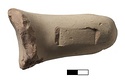
Mask Attachment From Large Closed Vessel.
Single fragment of wall and base of handle.
From fairly large vessel. At base of grooved strap handle, slave mask with shallow, lopsided trumpet, knitted brows, ... |
Flaring ring foot, plump body. Low strap handle with concave outer face. Ring just above junction of neck and body. Added red: two lines round body just below handle ... 550-500 B.C. |
Plate Or Bowl.
P 8591 a, b
Fragment of foot and lower wall (a); fragment of floor (b).
Low ring foot with angular profile; narrow resting surface. Parts of kiln supports embedded in floor and underside ... Context of 175-125 |
Mended with missing pieces restored in plaster and painted, notably all of the mouth, neck and handle, much of lower body, nearly all of ring base. Thin glaze on inside. Glaze pitted and flaked in many ... Ca. 450-440 B.C. |
Ring foot, projecting, a groove on its outer face. Rim flat on top. Reserved: resting surface and underside with glazed band. Graffito on underside: see Fig. 22.
P 2315, from a contemporary deposit, R ... 450-425 B.C. |
Less than one-quarter preserved but with profile complete nearly to center of floor. Broad very low ring foot; flat floor, lightly offset from low gently curving wall. Narrow rim rounded on top, slightly ... 1 June 1949 ... Agora XXXII, no. 61, fig. 3. |
Drapery across legs. Moved to Acropolis Museum, summer 1996. Now AK 17055. Oscar Broneer, Nb. No. 3. 107 ... 18 March 1937 |
Plate.
Parts of floor and rim restored.
Angular foot; rounded resting surface; irregularly convex underside.
Straight wall, slightly flaring at top. Plain rim. Micaceous, very pale brown fabric (ca ... Context of 110 to early 1st century after Christ |
Top of one handle restored; rim and foot chipped.
Flat resting surface, with part of inner and outer edge scraped; concave underside with nipple; no scraped groove between moldings of foot. Rounded lower ... 315-300 |
| Typical shape.
Fine clay, light red at core, yellowish near surface; cream slip.
Impression incomplete on top and bottom; letters barely legible. Finished Cave below lintel, cistern, south chamber, upper ... 23 July 1931 |
Ring foot with two torus mouldings at the edge. Straight stem. Mouth flanged to receive a lid, the vertical projecting edge bevelled. The handles are double tubes, vertically pierced for string. Reserved: ... Ca. 500 B.C. |
Most of body of pyxis with flange for lid, part of tripartite foot. On underside of floor, two concentric circles with central dot. Much of the glaze has flaked and abraded. Traces of burning on door (gray) ... Ca. 450 B.C. |
Lower part of moldmade body and upper part of footpreserved.
Cup or small krater. Low, broad stem, flaring out and up to foot at bottom. Rosette medallion faintly visible on underside. Wall: long petals ... 100-86 |
The vessel was probably a pitcher of some sort. Graffito on one side, at some distance above the base. After purchase. Possibly a skyphos.
Clay: fine soft buff. A fourth-century ... mentioned in various ... 1932 |
Rim, both handles, neck, start of shoulder, with missing pieces restored in plaster and painted. Chipped in places. P.H. 0.155; diam. of rim 0.29.
On Side A of neck, hanging lotus buds with dots in the ... Ca. 470 B.C. |
Ring askos, the sides rounding over into large central opening; saucer mouth; spout tilted back against handle. Buff slip or surfacing; good black glaze on rim, inside and out, on top of handle and for ... Context ca. 520-490 B.C. |
Barbotine Cup Or Jug.
Lower body and most of wall and rim restored.
Ovoid body, upper two-thirds decorated with five rows of barbotine bosses. Body angles in to rim at top. Low rim, convex to outside ... Context of 110 to early 1st century after Christ |
|
|