|
|
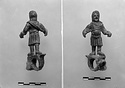
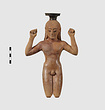
| Standing figure, wearing a skirted tunic reaching to the knees, and a scarf across his back, twisted round his arms, and held in his outstreched left hand.
He wears thick-soled boots, and a mask.
The figure ... 30 April 1936 |
| Complete.
Band of zigzag around wall; cross on bottom. On rim, four groups of vertical strokes separated by a dot.
Reddish-brown glaze. Near bedrock just outside broken edge of N.W. cistern system, lower ... 28 June 1963 |
Two-thirds of dome, one-third of flange, and part of cylinder preserved.
Scraped groove in face of flange, groove at base of dome and around nippled central area. Dome: ivy garland with leaves painted ... 275-265 |
Inscribed fragment.
Part of right edge preserved; otherwise broken.
Honorary tribal decree.
Hymettian marble. Found in the modern house 652/1. Leica ... 14 January 1959 |
Small fragment from rim, wall and discus.
On the rim in relief, trees flanking an arch.
Hard red clay.
Type XXXI of Corinth collection. Just above dirt floor. Cf. coins. no. 25-27 (10 March 1933). Leica ... 8 March 1933 |
Wall fragment. Max. dim. 0.075.
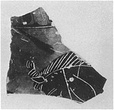
Wedding scene. At the left is the bride (mostly preserved from shoulders to knees), dressed in a himation, being led by the groom (right arm, his hand clasping her left ... Ca. 430-420 B.C. |
| From the shoulder of a closed pot. Above, tongues alternating red and black. Part of a horse's head left. Burned. Layer 2. B' building fills, B- fill to north. Leica ... 26 February 1935 |
Inscribed fragment of columnar grave monument.
Broken at top, bottom and sides; much of the back preserved.
On the left side cuttings showing reuse as doorsill.
Remains of four lines of the inscription ... 2nd.-1st. centuries B.C ... Hesperia 23 (1954), p. 267, no. 88, pl. 56 ... Agora XVII, no. 332, p. 83. |
About 20 fragments mend to three main pieces and several lesser ones. Part of the inturned rim, a fairly long section of the body and most of the spout preserved. The profile is restored in plaster.
Buff ... September 1932 |
| a) Bottom preserved.
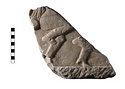
Part of a procession of dancing figures. In the center of the fragment, the legs and part of the trunk of a man dancing right, his weight on his left leg, his right raised high and ... a) (ΙΙ 332) 24 March 1938
b) (ΗΗ 318) 3 November 1938
c) (ΒΒ 220) 13 April 1939 |
Inscribed fragment.
Broken all around. Surface quite fresh.
Parts of eleven lines of the inscription preserved. "Λ" for "A" and the omision of the middle hasta in the "epsilons" suggests a date in the ... 2nd. century B.C ... Tracy (1990), p. 103 ... Hesperia 51 (1982), p. 62, no. 4, pl. 23 ... Agora XVI, no. 332 E, p. 463. |
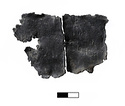
| Unfolded in shape of "T", possibly broken at one end.
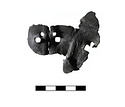
Found folded in five and transfixed by an iron nail with a large head. Holes remain from a second nail. Inscribed with many letters on both sides ... Card: ca. 325 B.C. |
| Two joining fragments broken at left and right, found folded over each other. Well, redigging of fill. 1345 Leica DA 13806 ... 28 July 1971 |
| Mended from many pieces; much of the boy's back and part of his right side missing. The hair hangs in a mass of conventionalized curls nearly to the middle of his back. The hands are lightly clasped, with ... Ca. 530 B.C. |
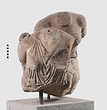
| A group of two girls, one carrying the other.
Missing, the carrier's head, body below the waist, left upper arm, left breast; of the carried, the head, left forearm, the legs from near the knees.
The ... 23 February 1934 |
|
|