|
|
| Part of rough-picked back and rough-picked upper surface, preserved. Otherwise broken.
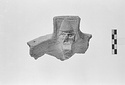
In low relief, a head left, of a youthful male figure, preserved to the base of the neck. Above, traces of a molding, ... April 1934 ... Agora XXXV, no. 49, pl. 15. |
Rim and both handles missing.
Lopas. Low ring foot. Unpierced spout attached to upper part of body. Reserved: resting surface, underside with three glazed circles and dot, junction of outer face of foot ... Late 5th c. B.C. |
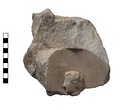
Polished celt; broken at both ends; apparently tapered toward one end.
The bottom is approximately flat, the upper surface convex, almost hemispherical in transverse section.
Steatite. Well 13. Leica, ... 1961 ... Agora XIII, no. 223, p. 49, pl. 15. |
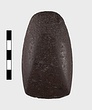
| Complete except for small chips on cutting edge.
Smooth polished towards cutting edge; roughened and rounded on other end.
Dark red stone. Λίθινος πέλεκυς. Σχεδόν ακέραιος. Modern fill in triangular cutting ... 16 March 1948 ... Agora XIII, no. 222, p. 49, pl. 15. |
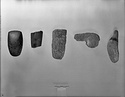
| Apparently from one end of a boat-shaped grinder, domed on one side, slightly concave and smooth-worn on the other.
Gray volcanic stone. Well V, green filling below brown, and above. Leica, 83-512 ... 10-15 June 1937 ... Agora XIII, no. 228, p. 49, pl. 15. |
| A natural pebble, roughly the shape of a thick knife-blade with a tang, which seems to have been worn smooth through use.
Gray schist-like stone. Well V, green filling below brown, and above. Leica, 83-530 ... 10-15 June 1937 ... Agora XIII, no. 226, p. 49, pl. 15. |
Fragment of tool; broken at both ends.
A long oval piece of gray schist-like stone, considerably worn. Well U, upper fill. Leica, 83-530 ... 16-17 June 1937 ... Agora XIII, no. 224, p. 49, pl. 15. |
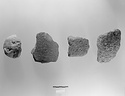
One side broken away.
Roughly dome-shaped; the flat side worn smooth.
Gray limestone. Finished Well 10; Neolithic. Leica, 83-512 ... 7-10 March 1939 ... Agora XIII, no. 227, p. 49, pl. 15. |
About half missing.
A roughly oval (?) object, flattened on both faces, and pierced somewhere near the center with a hole which shows signs of wear, as if the stone had hung from a string.
Hard purplish-gray ... 7-10 March 1939 ... Agora XIII, no. 225, p. 49, pl. 15. |
Mouth missing, hole in shoulder; otherwise intact. Bottom concave, with knob at center; egg-shaped body, shoulder sloping to join tapering neck; single-grooved handles, from middle of neck to shoulder ... 13 May 1938 ... Agora XXI, no. I 15, p. 85, pl. 49. |
Inturned rim. Banded inside and out, the glaze a thin black to brown, much worn ... Context ca. 500-480 B.C. |
| The lug and part of the rim of a Hellenistic brazier. Satyr's head with tall cap. The tip of the beard broken away.
Coarse red clay. Wall north of Church of Holy Apostles. Leica, 93-64-7 ... 13 July 1954 |
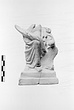
| Fragment a) draped legs of a partly nude figure.
Fragment b) Stepped base, with traces of feet.
Both encrusted with a heavy limey deposit.
Pale buff to gray clay, with fine buff surface.
ADDENDA: The ... Card: 2nd c. B.C. |
Inscribed fragment.
Parts of side, top and back preserved, roughly worked (?).
Boundary stone of private house (?).
Five lines of the inscription preserved.
Hymettian marble. Found in wall of the modern ... 22 November 1938 |
Base fragment.
Moulded bead and reel around lower edge. Dark red clay; hard creamy slip; fabric and finish close to 1867, from the same or a closely similar basin.
One other base fragment from the Agora, ... Context ca. 500-480 B.C. |
| From a large coarse open bowl with furrowed outward-turned rim.
Slipped; unglazed.
Incised inside. Red 5th. c. fill over road. B' building fill. Leica PD 1111-a ... 28 March 1935 ... Agora XII, no. 1885, fig. 20 ... Agora XXV, no. 135, pp. 15, 17, 49, fig. 8. |
| Coarse sherd of unglazed buff clay. Probably part of an ostrakon.
Suggested restoration: No. 324. Rectangular rockcut shaft. Leica, XXVI-49 ... August-September 1932 ... Hesperia 15 (1946), no. 4 ... Agora XXV, no. 139, p. 49. |
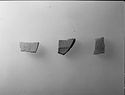
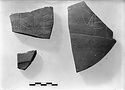
Two non-joining wall fragments. Very thin, brownish wash on the inside. Max. dim. a) 0.039, b) 0.022.
Fragment a preserves the legs (the left with the top of a boot) of a youth seated to right on a cloak, ... Ca. 400 B.C. |
Fragment of floor with start of central depression and ring base with grooved resting surface. Glaze misfired here and there; part abraded on the top side. Max. dim. 0.182; diam. of base 0.16. McPhee and ... Second quarter of the 4th century B.C. |
Fragment from the top of a stele; inscribed on a taenia along the upper edge.
Broken at bottom and sides; rough picked at the back, with a narrow chisel-dressed band along the upper edge; top fine picked; ... 164/3 B.C. (?) ... Hesperia 15 (1946), p. 221, no. 49 ... Agora XVIII, no. C100. |
Ring foot. Rim flanged to receive lid; strap handles. Glaze badly peeled.
From the same deposit and workshop, a twin, P 14152, von Bothmer, loc. cit.; similar, P 24173 Q 15:2. For a neck fragment of somewhat ... Late 5th c. B.C. |
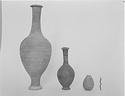
| A large unguentarium similar to the ordinary fusiform type, but with a high flaring ring foot instead of the stem. A slight ridge between neck and shoulder.
Gray clay. Cistern, upper fill. Leica, LIX-95 ... 2 February 1937 ... Agora V, no. F 49, p. 15, pl. 2 ... Agora XXXI, p. 184 ... Agora XXXII, no. 1765, pl. 88. |
Floor fragment with start of stem. Incised line on stem. Part of the glaze misfired to a reddish brown. Max. dim. 0.075; est. diam. of tondo 0.09. E. Vanderpool, Hesperia 15, 1946, p. 284, cat. no. 49, ... Ca. 510-500 B.C. |
Single large fragment from top of lid.
Dome divided into two zones by raised, reserved band with stamped egg and dart between grooves, with a ridge below. Above dividing band, a kernos sits on a mound, ... 350-300? |
Inscribed columnar grave monument.
Complete but somewhat battered.
Surface badly worn.
Coarse grained white (island) marble. Found in a lot on Sarri Street, north of the Agora, to which it had been brought ... 29 January 1947 |
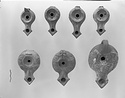
| Trefoil ended nozzle; vertical grooved strap handle, partly missing.
Relief decoration on upper body; bead and reel, and ring of dots; mask (?) on top of nozzle.
Top surrounded by high raised edge; three ... 25 May 1935 |
Small fragment from a large pot of rather coarse, pinkish buff clay, unglazed. The outside smoothed. Inscribed on the outside.
For the restoration see P 2702. No. 387. Rectangular rockcut shaft. Leica, ... August-September 1932 |
Large shallow bowl with ring foot and rolled rim. Glazed black to red; the center of the floor red from stacking in the kiln. An unusually large example of a common type. Cistern. Leica ... 30 May 1935 |
Half of body gone.
Profile similar to L 138. Broad fairly short nozzle.
Clay: fine red; black glaze inside and out; circles on base. Assembly Place, filling of Period III ... 1932 |
| Fragments missing from the rim. High base ring, coarsely moulded; deep body; the rim thickened by being rolled inward.
Buff clay; flaky black glaze, fired red on bottom and on the floor where another ... 3-12 March 1934 ... Hesperia 3 (1934), no. E 15 ... Agora XXIX, no. 685, fig. 49, pl. 61. |
| Large pieces of rim and walls missing. Restored in plaster. Small, medium-high foot, shallow sides, narrow turned-over rim. Inside in center, two concentric grooves.
Coarse brownish, almost purple, clay, ... May-June 1936 |
Fragments are missing from the lip. Similar to P 3314 in shape and fabric. Traces of another vase stacked on its floor for firing.
ADDENDA P 3314: High base ring, coarsely moulded; deep body; the rim ... 3-12 March 1934 |
| From large unglazed pot.
Red clay.
Cf. Ostraka of Boutalion P 4755, P 5004, P 5092. No. 325. Rectangular rockcut shaft. Leica, 2-435, XXVI-49 ... August-September 1932 |
| The outer ridge is broken away.
Flat bottomed round disk.
On upper side, four concentric circular ridges, rising ca. 0.035 from the floor of the disk. Through the inner ridges doors are cut, forming a ... 23 May 1935 |
Inscribed fragment.
Casualty list from Peloponesian war.
Fragment Ι 383 a), broken all round.
Parts of about nine lines of the inscription preserved; stoichedon.
Fragment Ρ 209 b), inscribed face only ... 430 (?) B.C ... Hesperia 15 (1946), p. 169, no. 19 ... Agora XVII, p. 12, pls. 49 b-c. |
Fragment of columnar grave monument.
Broken all around.
Parts of three lines of the inscription preserved.
Hymettian marble. Found in demolition of blacksmith shop, over the southwestern part of the Library ... 4 March 1933 ... Hesperia 15 (1946), p. 230, no. 61 ... Agora XVII, no. 609, p. 122, pl. 49. |
Part of top of columnar grave monument.
Broken below the third line of the inscription, and at the back.
Hymettian marble. Found built into wall of blacksmith shop, over the southwestern part of the Library ... 8 March 1933 ... Hesperia 15 (1946), p. 230, no. 60 ... Agora XVII, no. 593, p. 119, pl. 49. |
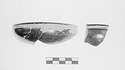
| Two non-joining sections of rim. Slightly incurved rim, rounded on top, thickened to outside. Offset on outside. Reserved band on outside, with miltos.
Shiny black glaze.
Cf. Agora XII, no. 979. Catalogued ... 27 June-5 August 1972 |
Fifteen non-joining fragments of wall, P 18278 b--c and P 19582 a--d of torus rim with zone of ornament below. Glaze mottled here and there; has a greenish cast in places; abraded in part on rim. Max ... Ca. 480 B.C. |
Bolster Krater: Pergamene.
Rim fragment.
Projecting rim, strongly convex on top. Top surface has pair of scraped grooves at either edge. At left, dolphin leaping right, with incised outline filled in ... Context of 250-175 |
|
|