|
|
Front part only, with rounded nozzle and plain lug.
Flat bottom, slightly depressed; rounded body; gently sloping rim.
Black glaze badly flaked. Wheel made.
Pinkish-buff clay.
Type XII (early spreading ... 22 February 1937 |
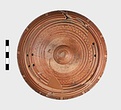
A single fragment preserving the profile, but not the center of the floor. High ring foot, flat floor, low vertical rim, concave-convex in section. Two wheel run grooves around the center of the floor ... 27 May 1935 |
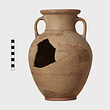
| Complete except for most of mouth and handle, now restored in plaster. Small hole in lower body. Band handle, trefoil mouth, plain foot. Glazed with banded, reserved zone.
Glaze brown to black, much ... 20 May 1959 |
| Handle broken at both ends.
gritty clay characteristic of Thasian amphoras.
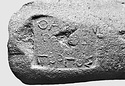
Device. Finished Area IV, foundation trench of monument base; layer XVI-D. Θασ̣[ί]ων
device
Γόργος 2105 82-5-13(15), 82-11-12 ... Probably late 3rd or early 2nd century B.C. |
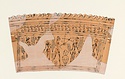
Wall fragment depicts draped female figure standing facing, her head turned right. She wears a pointed cap. Vines in the field. To the right, below, a curving line, perhaps the tail of an animal. White ... August-September 1932 ... Hesperia 15 (1946), no. 170 ... Agora XXIII, no. 1140, |
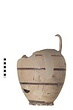
| Much of body and neck, one handle and all of base missing. Restored in plaster. Slender body; straight neck, outcurving rim with snakes in relief on it; one strap handle with snake, and snakes around shoulder ... 27 April 1937 |
Handle and part of base preserved.
The base is marked off by two incised circular grooves, inside of which is the beginning of the signature.
Pierced handle, triple grooved below; double above with herringbone ... 3 April 1936 |
Fragment of reverse and handle preserved.
Back of handle doubly grooved with stamped semi-circles at base.
Double concentric grooves on reverse, with signature.
Thin red wash.
Light red clay.
Type XXVIII ... 11 March 1936 |
Two fragments:
a) Animal and rosette decoration; purple paint;
b) Lions and deer, etc. Carl Roebuck, Nb. No. 6.
Well A. 15 ... 21 March 1938 |
| Four fragments in many pieces. From shoulder of pot. Part of rim and handle with projections.
Sloppy sphynxes and roses. Oscar Broneer, Nb. No. 4. 23 ... 13 April 1937 |
| Fragments of body missing, retored in plaster. Ring foot, short neck, convex lip; handles from below lip to upper part of shoulder. Decorated with plain glazed bands, one around foot, two around body, ... 22 June 1935 |
| Fragmentary: the neck, one handle, part of the other and large parts of the body missing. Decorated with plain glazed bands: one around the foot and three around the body; a large loop on the preserved ... 22 June 1935 |
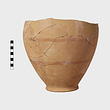
| Mended from many pieces and preserved to level of greatest diameter. Ring foot. Wide glazed bands on foot and around body at intervals.
Pinkish-buff clay. Finished Well, early Geometric. 6987 Leica, ... 25 October-3 November 1947 |
| Pyxis: mended from many pieces, chips and small fragments missing. Hatched maeander between bands on body; lower down, a row of dots. Lid: two small fragments and top of knob missing. Decorated with a ... 13 March 1947 |
One side preserved from bottom to join with top.
On the bottom, within circular grooves, one letter of a signature, with part of a palm branch.
Purple wash.
Dull pink clay.
Type XXVIII of Corinth collection ... 13 March 1934 |
Fragment of flat floor and small piece of low slightly curved vertical rim preserved. For the shape cf. P 3840.
Hard pinkish clay, firm red glaze.
Pergamene Ware. Early Roman well. Leica PD 1171-170 ... 16-27 April 1936 |
Much of rim and wall, and one handle missing; restored.
Thin fabric; black glazed overall, except for reserved line at junction of foot and floor on underside. Well in Stoa Shop VI. 3628 Leica ... December 1953 |
About half of wall and rim missing, with handle. Deep insloping flange for lid; fairly high ring foot with concave outer profile. Glazed over all except resting surface, edge of rim, and partly-scraped ... December 1953 |
Single fragment preserves part of floor and foot of a rather large heavy-walled bolsal. On the floor, an incised circle on which rest stamped palmettes (four preserved). Black glaze except inside foot, ... December 1953 |
Apparently complete.
Some kind of symbol or perhaps a ligature involving the letters alpha and delta: cf. two 6th c. B.C. ligatures of these letters from the precinct of Aphaia on Aigina, A. Furtwangler, ... |
|
|