|
|
Rim and about half of wall restored.
Two grooves at bottom and top of wall, which has slightly concave-convex profile. Flaring, angular knob; top of raised edge lightly grooved; pointed center. Knob: ... 120-86 ... Agora V, p. 12, note 12 ... Rotroff 1991, no. 88, p. 91, pl. 36. |
Floor fragment with stem and base fillet. Incised line at top and bottom of fillet. Max. dim. 0.041.
I, nude male (lower part of torso, start of thighs, part of each arm) to right with arms outstretched ... Ca. 510 B.C. |
Wall fragment. Glaze slightly abraded. Max. dim. 0.063.
Woman (filleted head) to left. In front of her, part of a large wing. Relief contour: face and neck. White: fillet. Dilute glaze: details on wings ... Ca. 420-410 B.C. |
Most of mouth, handles, and small part of body preserved.
Thin neck projects from concave body at ca. 45-degree angle.
Flaring rim, flat on top. Two strap handles on either side of neck, tucked beneath ... 225-175 |
Hemispherical Cup.
P 31754 a, b
Two nonjoining sections of rim.
Steep wall. Band of rouletting at top, bounded by two grooves at bottom and one at top. Straight rim. Very hard fabric, possibly overfired, ... Context of ca. 250-165 |
Lekanis and lid. Open bowl on disc foot; plain rim with interior flange, strap handles. Shallow conical lid with plain edge and low inverted-cone knob. Thin streaky red to black glaze wash on interior ... Context ca. 425-400 B.C. |
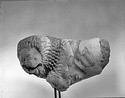
| Crouching lion mended from many pieces.
One large piece preserves most of neck, mane and part of forelegs of lion. Eight other fragments with original surface, at least one of which joins, and six pieces ... Last quarter of 6th c. B.C ... Agora XI, no. 91, pp. 28-29, pl. 12. |
Mended from many fragments, with missing pieces restored in plaster and painted, notable among them the left horizontal handle and part of the wall below it. Glaze fired greenish around left handle; abraded ... Ca. 430 B.C. |
|
|