|
|
| Agora 12, no. 1784. Agora 12, no. 1766. Agora 12, no. 2016. Agora 12, no. 1805. Agora 12, no. 175. Agora 12, no. 1778. Agora 12, no. 578. Agora 12, no. 1971. Agora 12, no. 741. Agora 4, no. 168. A. Bon ... Agora 31 148 SS 10988 Lot ΕΛ 55 Lot ΕΛ 65 ... 3rd quarter 5th B.C ... Agora 12, no. 1784 ... Agora 12, no. 1766 ... Agora 12, no. 1039 |
About a quarter preserved.
Ring foot; rilled rim, flat on top. Raised ring on underside. Shallow mouldings on under edge of rim. Totally glazed except for rim; glaze has peeled and cracked ... Ca. 375 B.C. |
| M. MacLaren, Hesperia, 7, 1938, pp. 470-473, no. 29, photographs pp. 472-473. J. Kirchner, I.G., II², 13132a. W. Peek, G.V.I., no. 1242. B. Meritt, Hesperia, 29, 1960, p. 50, no. 61, photograph pl. 13 ... Agora 17 182 I 4129 I 1402 I 2860 I 2836 ... 5 May 1936 |
| Much of neck and rim preserved to shoulder; handles missing. Short broad neck; lip heavily moulded in two degrees.
Thin firm red glaze on rim and at handle attachments. Hard orange fabric, smoothly surfaced ... 1947 |
Graffito:
Coarse red clay. Hellenistic fill in N.E. part of section. Leica ... 20 April 1935 |
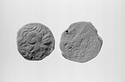
| Ptolemy XI, Ptolemaic Kings ... Πτολεμαίων, no. 1733 Head of Zeus Ammon r. Β-Α Eagle stg. l. on thunderbolt. C 651, 85-20-34 ... Ptolemy XI, 114--88 B.C. |
Wall fragment. Glaze slightly pitted and abraded. Max. dim. 0.068.
Woman (lower part of head to left, shoulders, upper part of torso), to right, dancing(?). She wears a brassiere (ταινι'α or ἀπο'δεσμος) ... Probably early 4th century B.C. |
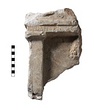
| Inscribed fragment.
Broken above, below and to right, and behind.
In the panel, object in relief; back of head (?).
There seems to be an iron nail in the top; in the lower left end of the pilaster, a hole ... Mid. 4th. century B.C. |
|
|
.png.icon.jpg)
.png.icon.jpg)