|
|
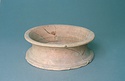
Intact.
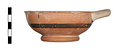
Slightly concave underside with string marks. Steep, convex wall.
Pink fabric (7.5YR 7/4); thin, dull black glaze.
Other fairly well glazed saucers of Hellenistic date: P 19872--P 19875 (Young ... 350-300 |
Mended from sixteen fragments; a few chips missing.
Very slightly concave underside with string marks. Wall slightly concave at bottom. Rim slightly offset on inside. Dull brown glaze.
Similar: P 19869 ... 325-275 |
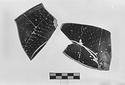
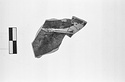
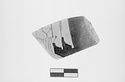
| Fragment from upper left corner of panel of an amphora. Hairy arm of a satyr, raised and bent back to touch head. Red line bordering panel; part of red band above panel. Red also on hair.
ADDENDA Same ... 18 July 1959 ... Agora XXIII, no. 42, pl. 5 ... Agora XXXI, p. 39, n. 5, pp. 127, 131. |
| Same pot as P 26742, non-joining.
Wall fragment; unglazed inside.
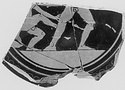
Hairy Satyrs moving left: two feet and tails of two preserved.
Red bands below decorated zone. Region of Archaic Building C; late 6th ... May 1937 ... Agora XXIII, no. 42, pl. 5 ... Agora XXXI, p. 39, n. 5, pp. 127, 131. |
| One side preserved, rim to base in four joining fragments. Double-convex profile, with low foot.
Pale orange clay, with deep red gloss, flaking off on floor. Brownish double-dipping streak.
Eastern Sigillata ... 1936 |
Head of a woman with a melon coiffure and knot in back.
Broken off at neck.
Pink clay. Mixed fill in Cut. Leica ... 13 March 1950 ... Agora VI, no. 127, p. 47, pl. 5. |
| a) Rim fragment from a bowl similar to P 8993 (ΛΛ 126), but with the impressions elongated and laid diagonally across the bowl. Reserved groove near bottom; lip slightly out-turned; deep grooves on lower ... 16 February 1937 |
Small parts of rim restored; handles missing.
Resting surface grooved and reserved; concave underside.
Low stem, thinner than 127. Thin, streaky red glaze.
Similar: P 14800, P 15864 (E 14:10), P 29188 ... 325-315 |
| Intact. The lip and foot slightly damaged during firing. Shape as P 5863 (ΠΘ 116). Decoration similar: the foot and lower body glazed, the lip glazed on top and for a short distance underneath. The shoulder, ... 30 May 1935 |
| Stump of thick handle, and about one-third of shallow bowl preserved.
Brown clay, gray at core; fire-blackened below. Well K, upper filling. Leica, 83-494 ... 24-26 April 1937 |
| Mended from five fragments; complete. Bottom flat, unfinished; concave sides.
Pink to buff clay. Unglazed. Pithos. Leica, 4-333, color slide PD 1231-3 ... 22 April 1932 |
Rim slightly chipped; burned.
Rounded bottom. Body pared. Yellowish red to light red cooking fabric (5YR 5/6--2.5YR 6/8) with mica, white inclusions, and voids.
Others in cooking fabric from contemporary ... 325-300 |
Flat projecting bottom rising to central tube. Spout nearly vertical. Groove under mouth. Reserved bottom. Glaze fired brown and black.
Contemporary, P 10818 G 12:22 Hesperia, Suppl. IV, 1940, p. 127, ... 475-450 B.C. |
Scraped groove on top of foot. Graffito on floor and under foot: ΔΕ, ligatured.
There are many cups of this shape from the same deposit; of the following, several carry graffiti: P 5116 Hesperia, V, 1936, ... 470-460 B.C ... There are many cups of this shape from the same deposit; of the following, several carry graffiti: P 5116 Hesperia, V, 1936, p. 337, fig. 4; Bloesch, FAS, p. 139, 8; P 5118-9; P 5120 Hesperia, ibid., p. 353, fig. 22; P 5121, P 5123-5; P 5128 ibid., p. 347, fig. 16, 1; ARV 1611, 7; P 5129-30. ... IV, 1940, p. 126, noted under a); P 10812 ibid., p. 127, fig. 94 a, is smaller and has no graffito.
Cf. Agora XII, no. 436. |
| Very low ring foot. On inside, part of a nude youth left, his right arm extended in front of him along the shaft of a spear. Glazed circles inside the reserved foot. Disturbed early (6th.-5th. c.) fill ... 30 April-1 May 1936 |
Mended from six fragments, with one handle and part of rim missing; burned.
Underside somewhat convex, with string marks. Straight, wheel-ridged wall. Very micaceous, reddish yellow fabric (5YR 7/6) of ... 350-300 ... Similar banding and shape of foot: P 16606, P 19051 and P 19052, P 18546 and P 18547, P 16734, P 19868 (Young 1951b, nos. 2:9, 4:8, 9, 8:7, 8, 10:4, 11:3, pp. 116, 118, 125--127, pls. 50--53 [A 20:3, B 18:1, B 19:5, B 22:3, B 17:4]). Similar banding but irregular raised base: P 9706 (Agora XII, no. 1569, p. 346, pl. 69 [F 5:2]), perhaps slightly later. |
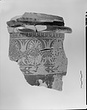
a) Two joining fragments, broken all around. Above plain, then two impressed horizontal stripes, then relief band of floral chevrons. Below is field of relief floral motifs - tendrils with flowers, etc ... 1 July 1970 |
| Fragment of floor and foot; mended from 5 pieces. Moulded ring foot; underside: three concentric moulded circles, black glazed, surrounding central reserved disk with dot and two painted concentric circles ... 1 November 1955 |
| a) Five joining fragments from the bottom of the bowl and upper part of foot. Bowl: rays(?). Foot: Egg and dart; palmettes, superimposed and circumscribed, alternating with lotus flowers; olive leaves ... 22 July 1964 |
Flaring ring foot; high double handle. Glazed: the neck, a band below the handle-attachment, and on the top surface of the foot.
There are three published examples from deposits of the second quarter ... 480-450 B.C. |
| Inscribed fragments.
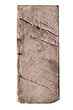
Two joining fragments, now doweled together. Fragment missing from lower right corner; chipped. Surface badly discolored and corroded from reuse.
Smoothly finished top, sides and back ... 4 August 1970 |
Torus ring foot; bell handle, glazed outside. Rim flat on top, projecting outwards, reserved. Inside, reserved central disc with three glazed circles and dot; outside, glazed band, outer and inner faces ... 520-500 B.C. |
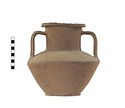
| Squat unglazed amphora with sharply profiled body, wide neck and flat ring base. Projecting rim slightly concave on top. Horizontal ridges around neck, and very shallow irregular vertical ridges around ... 16 April 1932 |
Hemispherical Cup.
P 31754 a, b
Two nonjoining sections of rim.
Steep wall. Band of rouletting at top, bounded by two grooves at bottom and one at top. Straight rim. Very hard fabric, possibly overfired, ... Context of ca. 250-165 ... Hemispherical Cup.
P 31754 a, b
Two nonjoining sections of rim.
... Very hard fabric, possibly overfired, mostly gray (2.5YR N5/), with trace of red near surface on rim (2.5YR 5/6), with mica and white inclusions; thin, dull black glaze.
Fabric similar to that of Knidian lamps (see Agora IV, Type 40 A, pp. 126--127); similar also to P 19759, P 23610, P 20047 (Agora XXII, nos. 393, 401, pp. 90--91, pls. 67, 68, 88, 89 [P--R 6--12]). |
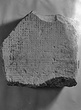
| Inscribed fragment.
Inscribed face, right side, bottom and back preserved.
Building contract embodied in decree.
Thirty lines of the inscription preserved; stoichedon.
Pentelic marble.
ADDENDA Rebuilding ... 307/6 B.C. |
Inscribed fragment.
Probably original edges at both sides, back and bottom. Broken at top.
Three lines of the inscription preserved and vacat.
Hymettian marble. Found in wall of the modern house 648/18 ... 10 March 1939 |
| Handle and much of wall and lip missing. Restored in plaster. Flat base; tubular central stem; low mouth set to one side.
Good black glaze; on the underside a red wash.
Cf. Agora XII, no. 1166. Tholos ... 26 May 1937 |
Fragment from wall of band cup. In handle zone, a panther to right. Purple on his chest and ears, white spots on his neck. Inside solid black. Stoa pit E, layer I. Box 305. 681 Leica, 5-339 ... 18 May 1933 |
Closed vase fragments.
a) Part of neck of a jug(?) showing a feline with reverted head; dot rosettes.
b) Wall fragment with parts of two animal zones, right; dot and incised blob rosettes.
c) From shoulder ... 28 April 1954 |
| Handle and much of wall missing. High base ring; steep wall with a flat rim that projects slightly both inside and out. Apparently a single horizontal handle.
Brownish glaze on inside, in bands on underside; ... 26 May 1937 ... Agora XII, no. 728 ... Hesperia Suppl. 5 (1941), p. 138, no. 24 ... Hesperia Suppl. 4 (1940), p. 127, fig. 94:d. |
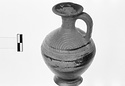
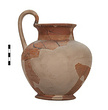
| Handle and much of wall missing; restored in plaster. Full ovoid body; round neck-mouth with concave profile; broad strap handle. Ring base.
A thick light brown wash over the whole with darker bands around ... 26 May 1937 ... Agora XII, no. 151 ... Hesperia Suppl. 5 (1941), p. 139, n. 294 ... Hesperia Suppl. 4 (1940), p. 127, fig. 94:b. |
Level, broad, ribbed; start of right angle curve.
Coarse clay; red, grey at core, yellow at surface; traces of light slip.
Impression shallow set, slightlyy incomplete on upper left part; twice stamped ... 1 March 1932 |
Mouth and handle missing and chips from base. Surface much worn. On shoulder alternate black and white strokes (summary ray pattern). Near top of glazed body, pair of narrow red bands.
Cf. Agora XII, ... August-September 1932 |
Fragments missing from wall; restored in plaster. The wall more drawn in at rim and above base than in P 15975 (ΓΓ 651); the fabric finer, the glaze better, and the foot thinner and more flaring. Same ... 2-19 May 1939 |
Reverse, nozzle, and part of rim missing.
Plain rim with herringbone panels. Stamped circles either side of handle.
Bear (or boar?) on discus, left. Solid handle, triply grooved above and below.
Thin purple-red ... 20 March 1936 |
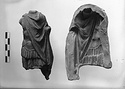
| Mold for front part of standing figure in cuirass and mantle over chiton.
Head, legs and right arm to be supplied from another mould: mold completely preserved.
Careful work.
Pinkish buff clay. Cistern, ... 26 May 1932 |
| Two non-joining fragments from the body of a closed vase - stamnos? A figure in chiton and mantle; both fragments may show the same figure.
Villa Giula Painter. Catalogued 8 August 1984. Pit. 965 84-19-15, ... 27 June-5 August 1972 |
Mended from two pieces, two fragments missing from rim. Flat bottom; out-turned rim. Thin streaky black glaze; bottom reserved, a line around the wall, the insides of the handles and the handle spaces ... 25 June 1952 |
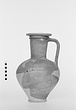
| Parts are missing from lip and side wall; restored in plaster. Low base ring; ovoid body; high neck, expanding toward the top; flaring lip; heavy ridged handle. A ridge encircles the neck at the level ... 3-12 March 1934 |
Stamped Plate.
Center of floor preserved.
Convex underside, with trace of groove around edge. At center of floor, six-petaled rosette within hexagon with concave sides, all within circular field. Reddish ... Late Hellenistic? (Roman context) |
|
|