|
|
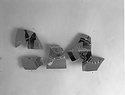
Wall fragment. Max. dim. 0.10.
Chariot (left hind leg of horse, hock of right; part of wheel) to left above pyre (top with flames). At the lower right, Nike (head with wreath, part of wing), also to left ... First quarter of the 4th century B.C. |
Wall fragment with start of handle. P.H. 0.128; P.W. 0.118. P. Arias, Rivista dell'Inst. Naz. d. Arch. e Storia dell'Arte, n.s. 4, 1955, p. 137, fig. 57; J. R. Green, Hesperia 31, 1962, pl. 30:10; Agora ... Ca. 410 B.C ... Arch. e Storia dell'Arte, n.s. 4, 1955, p. 137, fig. 57; J. R. Green, Hesperia 31, 1962, pl. 30:10; Agora XI, pl. 63:c; LIMC V, 1988, p. 363, no. 906 (wrongly numbered 150850), pl. 272, s.v. ... For a similar egg pattern articulating the inverted triangle of the handle root, see Ferrara 20410 = T.18 C VP from the Alexandre Group (ARV2 1213, 1; Addenda 347).
The Class of Agora P 15840 (ARV2 1697, sub p. 1518). |
Thirty-two non-joining fragments of rim, wall, and cul. Narrow reserved band on inside of rim, another 0.082 below rim. Glaze pitted on some fragments; has a greenish cast here and there. Max. dim. P 7282 ... Ca. 440 B.C. |
| (See revisions below under ADDENDA)
18 fragments; making up to 15.
a) Fragment of offset lip and body, with the shields of two warriors, one with device of lion's head, overlapping from body to rim. Inside, ... 1 February 1934 |
|
|