|
|
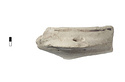
Rectangular version, to take portable oven, as 2027.
A rim fragment from a rectangular eschara in Aegina, Aegina Museum, preserves part of a low narrow spit-rest and, on the rim, written in the wet clay, ... Context ca. 420-390 B.C ... A rim fragment from a rectangular eschara in Aegina, Aegina Museum, preserves part of a low narrow spit-rest and, on the rim, written in the wet clay, the letters ΕΨΡΠ. |
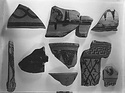
| Fragment from an openwork stand.
Step pattern above and bird's head and neck right.
Cf. fragment in the Aegina museum.
Subgeometric style. Geometric area outside house; from surface filling. Leica, 3-57, ... 1 April 1932 ... Cf. fragment in the Aegina museum.
Subgeometric style. |
Apparently complete.
Some kind of symbol or perhaps a ligature involving the letters alpha and delta: cf. two 6th c. B.C. ligatures of these letters from the precinct of Aphaia on Aigina, A. Furtwangler, ... Furtwangler, Aegina, Das Heilihtum der Aphaia, Munich, 1906, p. 466, nos. 367, 368. |
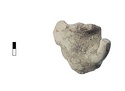
| Single fragment preserving small portion of shoulder, neck and lower handle of closed vessel.
Handmade. Shoulder curving in; vertical neck; vertical handle, circular in section, attached to upper shoulder ... 16 July 1973 ... Light-colored clay characteristic of Aegina, fired close to very pale brown 10 YR 8/4-7/4.
|
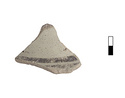
| Fragment preserves small portion of neck and upper shoulder.
Sloping shoulder; vertical neck. Decoration in dark brown, matte paint. Two horizontal bands at juncture of shoulder and neck.
Light-colored ... 16 July 1973 ... Light-colored fabric with gold mica characteristic of Aegina, fired close to yellow and very pale brown 10 YR 8/4-8/6.
|
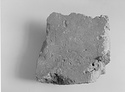
| Joint surface preserved at right end; the bed of a roughly cut rebate (?) at top; a more carefully cut notch at upper left corner; other edges broken. Front face finished with toothed chisel.
In face of ... April 1949 ... Granular brown poros of Aegina. |
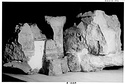
| From a lateral horizontal cornice, a cyma reversa soffit molding with a vertical fascia high above it. The nosing molding is much battered; possibly an ovolo. In the top two rafter cuttings, and at each ... 10 May 1937 ... Granular brown poros (Aegina?). |
| Fragment preserves portion of rim, upper body and one handle. Large thick-walled open vessel, upper body rising steeply to plain rim, slightly thickened on interior and flat on top. Pierced lug handle ... 16 July 1973 ... Coarse clay, with inclusions, including particles of gold mica characteristic of Aegina. Clay fired close to very pale brown 10 YR 8/3-8/4. |
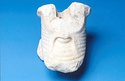
| Preserves the mouth, the beard (save tip), the cheek with a little of the hair and traces of front part of ears, the front upper part of neck with a little of the hair or mantle on either side.
The condition ... 3 February 1932 ... The shape of the bearded chin is like that or the Aegina heads; the lower lip is bared under drooping mustache; the beard in rendered by shallow, horizontal grooves.
|
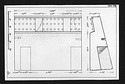
| Anta capital assembled from 36 fragments. Stoa Poikile series.
On the top of the capital note the following indications for the placing of the architrave: a relieving surface, 0.10m. wide and 0.003m. deep, ... April 1949, 17 March 1952 ... The material is the light brown granular poros of Aegina. The pigments were applied directly to the stone. |
|
|