|
|
A drain pit with red gravely fill. Coins:
5 April 1939 #1-#8
Pottery continuing to at least 3rd c. A.D. ADDENDA: See also tins Lot ΝΝ 70, ΝΝ 71.
ADDENDA: P 14822 probably also belongs ... Mixed Hellenistic to Roman ... Pit/Drain A |
| Filling in eastern channel at W. end of casting pit A 16:1. Early Roman (1st c. A.D.) but with some later disturbances (3rd. and 4th. c. A.D. and Byz.). P 25747 (VG thinks strayed from A 16:1)
Estimated ... 1st. c. A.D ... A/11,12-16/3,4 |
| Debris filling in a bronze casting pit and workshop, characterized by mold fragments but including also a few plain vases and fragments of wine jars. Third quarter of 4th. c. BC.
The pit was cut into the ... Ca. 350-325 B.C ... Hesperia 26 (1957), p. 100, pls. 28 a-b. |
| (RSY=Pyre 2). Pyre in the industrial area west of the Areopagus, in House B. In northern corner of room. No pit discerned. A deposit of small stones (a marker/) lay 0.30m above the level of the pyre, ... Third quarter of the 4th. century ... A 20:3 ... A 20:3 |
Grave over Drain A1 (House A)
*Now A 18:9 (SIR). Asterisk: A 20:2* ... Grave over Drain A1 (House A)
*Now A 18:9 (SIR) ... Asterisk: A 20:2* |
*Merged with A 20:7. Asterisk: A 20:8* ... *Merged with A 20:7 ... Asterisk: A 20:8* |
Grave (?) under wall 4. Infant burial(?); a kados, P 16747, lying sideways with a tall cylindrical stand, P 16748, set over it as a cover; the upper parts of the pots cut away ... Late 6th. c. B.C ... Infant burial(?); a kados, P 16747, lying sideways with a tall cylindrical stand, P 16748, set over it as a cover; the upper parts of the pots cut away. |
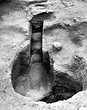
| Hole (Well) and adjoining water channel with 4th c. pottery, probably a dumped fill.
At a depth of about -5.70m we started yielding some very crude potsherds, clearly not made on the wheel (maybe Prehistoric) ... Prehistoric-Roman ... A 16:3 ... A 16:3 |
This shaft in the NE corner of House A, Room III, depth of one tile, is perhaps connected with drain A. Coins:
13 May 1940 #1-#13
14 May 1940 #2-#101 ... Early 3rd. c. B.C ... This shaft in the NE corner of House A, Room III, depth of one tile, is perhaps connected with drain A. |
Not a group, one object only.
Dug bedrock. Coins:
29 April 1947 #1 ... Not a group, one object only.
|
Scanty debris filling in a pit. The wishbone-handled bowl (P 16753) is of the middle of the third quarter of the 5th. c. century, as are also two red figured fragments, P 25820 and P 25821; the deposit ... Ca. 450-400 B.C ... Scanty debris filling in a pit. The wishbone-handled bowl (P 16753) is of the middle of the third quarter of the 5th. c. century, as are also two red figured fragments, P 25820 and P 25821; the deposit as a whole is somewhat later. ... Merged with A 20:8. |
| Grave over drain A1 (House A). Date based on the fact that the lopas has the upturned handle and the flat rather than domed lid, not found in examples from the later pyres. LT
West of House C. Pottery ... First half of 4th. c. B.c ... The pyre was excavated in two parts: the first in 1939 (A 18:3) and the second in 1940. Its integrity as a single pyre was not recognized until later. ... Originally A 20:2.
Published together with A 18:3 in Hesperia 47. |
| Sacrificial pyre, disturbed; a small pyxis (P 14864) is close to that from B 18:4. First half of 4th. c. B.C., perhaps first quarter.
West of House C. Pottery and cinders in pit in stratum. The pyre was ... First half 4th. c. B.C ... Sacrificial pyre, disturbed; a small pyxis (P 14864) is close to that from B 18:4. ... Its integrity as a single pyre was not recognized until later. ... Published together with A 18:9 in Hesperia 47. |
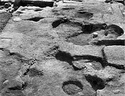
Pits ( A 19:3, A 19:4, A 19:5, A 19:6 in area 96-100/ΝΕ-ΝΘ (lower east slopes of Hill of the Nymphs, near extreme west edge of excavated area).
Sometimes called as "Pit 2". Pit with reddish black fill ... 350-300 B.C ... Pits ( A 19:3, A 19:4, A 19:5, A 19:6 in area 96-100/ΝΕ-ΝΘ (lower east slopes of Hill of the Nymphs, near extreme west edge of excavated area).
... Many fills in areas A 19 and A 20 similar in character to the fills in these pits can probably be cited only with area locations; many have container dates. 1-10-58
The early ΞΞ numbers given [to finds] come from the time the area was dug; the later from the time the pottery was sorted (1957). |
| A well in the industrial area of the Areopagus, about 7.00m. west of the West Bath, to a depth of 14.60m. This well was the direct successor to A 17:1, replacing it when it collapsed. The use filling at ... Second quarter 6th. c ... A 17:2 ... A 17:2 |
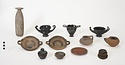
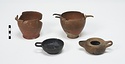
| A compact group of four complete vases and a lamp, found on a house floor; possibly the remains of a sacrificial pyre but without evidence of burning or the characteristic votive vases.
Layer II, "nest ... 425-400 B.C ... A 20:4 ... A 20:4 |
"South Triangle" abandonment filling over Brown House (House A) in the industrial area. Layers 1-3 and layer 4, to floor of second period. As late as the 3rd. c. B.C. but composed largely of earlier material ... 3rd c. B.C. and earlier ... "South Triangle" abandonment filling over Brown House (House A) in the industrial area. ... For fillings connected with construction and rebuilding of house, see
A 20:6. |
Rodney Young ... Grave. RSY Grave 50. Outside archaic cemetery on the lower slopes of the Hill of the Nymphs, cremation burial. Roughly square pit (0.80x1.00m). This pit contained a heavy deposit of cinders and ash; its ... Beginning of the last quarter of the 6th century ... A 18:2 ... A 18:2 |
| Listed in notebook as at 6/ΛΗ but later found to be at 12/ΛΗ.
Originally B 16:1.
Large cistern distinguished by a short (1.75m) blind tunnel running SW from its floor, and a shallow (ca. 0.80m originally) ... Ca. 150 B.C ... A 16:4 ... A 16:4 |
Pits in area 96-100/ΝΕ-ΝΘ (lower east slopes of Hill of the Nymphs, near extreme west edge of excavated area).
Scanty debris filling in a pit. Many fills in areas A 19 and A 20 similar in character to ... 325-300 B.C ... A 19:5 ... A 19:5 |
|
|