|
|
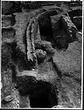
| Pyre in House N, room 2, layer 5 (RSY=Pyre 8).
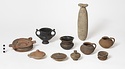
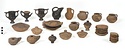
Near northern corner of room 6. Artifacts, bone, burnt logs, and cinders in square pit dug from level of layer 5, through layers 5 and 6; thin clay floor ... 325-300 B.C ... Hesperia 20 (1951), pp. 124-125, pl. 52 b (Pyre 8). |
| Pyre in House N, room 4 (RSY=Pyre 7), in the industrial area west of the Areopagus.
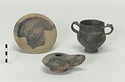
Pottery, mall pieces of calcined bone, log, wood cinders, and charcoal in diamond-shaped pit in floor sequence. The pyre ... Late 4th-early 3rd c. B.C ... Hesperia 20 (1951), pp. 122-123, pl. 49 b, pl. 52 a (Pyre 7). |
| Pyre in House C, Room 12 (RSY=Pyre 9) in the industrial area west of the Areopagus.
Notebook refers to House N.
Beside west wall of room 12. Pottery, burnt bone, and cinders in a roughly round pit; disturbed ... Ca. 250 B.C. |
Fillings in and to the north of Building A/Poros Building/Greek Building ("Strategeion"), the accumulation mostly a late archaic dump, but not deposited till near the middle of the century. Most of the ... First half of 5th c. to ca. 460-450 B.C. |
P 5302 may be from disturbed fill ("soft spot", container B 57, nbp. 1246) ... 12 March-6 April 1935
7 May 1935 |
| Eugene Vanderpool ... Infant grave near Phaidon street cistern. No offerings.
Roughly rectangular, almost elliptical cutting in bedrock, measuring 0.70m long, 0.35m wide, and 0.40m deep, oriented south-southwest to north-northeast ... Late Helladic III C/Early Protogeometric (date uncertain) |
| Pyre in cut in E-W street, layer 7 (Pyre 14). North edge of Piraeus street, west of the Great Drain Bridge, in the area west of Areopagus.
RSY-Pyre.
Pottery, a little burnt bone, and patches of charcoal ... 250-240 B.C ... Hesperia Suppl. 47 (2013), no. 52, p. 165, figs. 67, 100 ... Hesperia 20 (1951), p. 130, pl. 54 b (Pyre 14). |
|
|