|
|
From disturbances in original floor of Tholos with ash and burning. Probably reflects the military and political conditions of 307 B.C.
The broken pottery, both that left lying on the floor of the building ... Ca. 340-295 B.C ... Probably reflects the military and political conditions of 307 B.C.
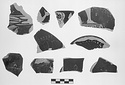
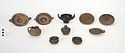
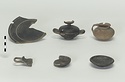
The broken pottery, both that left lying on the floor of the building and that swept up into various neighboring deposits, represents the household equipment of the Tholos during the preceding generation (third quarter of 4th c. B.C.) |
Excavations in Byzantine Building ... 2nd quarter 4th c. B.C. |
North of Eleusinion: Fill in Room 3 of Roman Building. 614 sherds (6 miniature shapes, 20 intrusive sherds).
Objects : terracottas; loom weights; spindle whorls; disks; handmade tray; lamps.
Early ware ... First half of 6th c. B.C.-Mixed Fill to ca. 480 B.C ... North of Eleusinion: Fill in Room 3 of Roman Building ... Some 2nd half of 6th c. B.C. intrusions; much Mycenaean and Middle Helladic; 4th c. B.C; Roman; Byzantine; Turkish. |
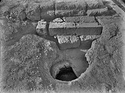
Tiled Well in Square Building Foundations, equipped with evenly spaced hand-holds, with a good supply of water. There was no period of use represented and the dumped fill consisted mostly of chunks of ... Third quarter of 4th c. B.C. |
| Royal Stoa, N. Annex building fill, N Trench, Layer 7 ... 4th quarter of 5th c. B.C. |
| Sacrificial pyre in Poros Building, NW Room (RSY= Pyre 1).
Against east wall of room 5 west. artifacts, bone, carbon and ash in pit in floor sequence. the pyre lay below a floor covered with marble dust, ... Middle of 4th c. B.C. |
Unfinished well, south of the annex to the Poros Building, west of the Areopagus. The shaft was apparently never used as a well. The lower dumped filling contained a quantity of clean red clay, as if from ... Ca. 350-325 B.C ... Unfinished well, south of the annex to the Poros Building, west of the Areopagus. ... The single lamp is of a type which comes into use in the mid-4th c. B.C. Supplementary upper fillings appear contemporary with the lower fill, but some possibility of disturbance was noted by the excavator. Lower fills, third quarter of 4th c. B.C. Upper fills of same date, possibly disturbed. |
| Pit and drain at SE corner of Apollo Temple. Antedates building of Apollo Temple which was assigned to a date 'late in the third quarter' ... 3rd quarter 4th c. B.C. |
Kernos Deposit (?): below floor of Building A, over and in cutting at 33/ΚΗ P 30162-P 30172 added on 4 May 1973 ... 4th c. B.C. |
Drain in corridor of Poros Building. Deposit is from the period of use of the drain. Cf. also containers 140 and 602 ... Late 5th-early 4th c. B.C. |
| Pocket, identified as sacrificial pyre by SIR. Possibly disturbed. Outside south wall of building. Concentration of pottery in a small pocket below a "Hellenistic" fill. There is no mention of bone or ... First quarter 4th c. B.C. |
Trial cut at 26/ΙΣΤ-ΙΖ, Layer I; Circular Building, 22m south of Eleusinion. P 30171, P 30172, L 5818 added on 7 May 1973 ... 4th c. B.C. |
House R, fill under drain tiles and fillings associated with house K in industrial area, including what was C 19:15, plus C 19:16 and
C 19:17.
a) House built as dwelling in second half of 5th.c.
b) Used ... Ca. 5th and 4th c. B.C ... Rebuilt as an industrial establishment about middle of 4th. c.
c) Area built over in Hellenistic times.
... Most of the material comes however from the second and third phases noted above: either the marble-workers' shop, or the heavy filling of dumped earth and marble chips thrown in over the area when the level was raised for the remodelling of the building at about the middle of the 4th c. B.C. It is not always possible to distinguish between these two periods; the objects from both, mostly of the late 5th into the first half of the 4th c., have been listed together. |
It was impossible to return to the digging of this well either in 1939 or 1940 [due to collapse of stereo] (nbp. 1432).
HAT compares pottery to that of Square Building fill. Coins
26 May 1939 #1 ... Second half of 4th c. B.C. |
| Laura Gawlinski ... Well in courtyard of Early Building I, adjacent to wall of Room B. Tile lined; upper course in situ, lower two collapsed probably in antiquity. Letters inscribed on rims (eta, phi, omicron, theta). Medium ... First quarter of the 4th c. B.C. |
| Handler ... Found in an area of disturbed fill north of a floor surface in Room 4 of the Classical Commercial Building. The floor surface (n. 3 on the west side of Room 4) was preserved at 52.503-52.544 masl., and ... 2nd half 4th c. B.C ... Found in an area of disturbed fill north of a floor surface in Room 4 of the Classical Commercial Building. The floor surface (n. 3 on the west side of Room 4) was preserved at 52.503-52.544 masl., and was excavated in Lot ΒΖ 1758 (2nd half of the 4th c. B.C.). The pyre was located in a shallow channel adjacent to the south face of Wall 4, where the floor surface was not preserved. |
Classical commercial building, room 3, against south wall. Small fragments of pottery dispersed in fill overlying two floor levels (at 51.897 and 51.941 masl). Five objects of pyre type: ribbon-handled ... 4th c. B.C. |
| Sacrificial Pyre = Pit in floor (identified as pyre by SIR); with the characteristic small plates and saucers. "Saucer Grave" at 12/ΚΑ.
Dimensions: 2m (length)x 0.70 (width).
North of north wall of building ... First half 4th c. B.C. |
| Pyre /Burial (?) disturbed, in the area of the Poros Building west of the Areopagus. In northeast corner of room 4 west.
Concentration of artifacts, tiny slivers of bone, and burning in a layer of fill ... Early 4th c. B.C. |
| Identified as pyre by SIR.
In room E. Burnt "pocket" found while digging red earth that contained late Hellenistic pottery, including a fragment of Pergamene (discarded). No pit was discerned, but concentration ... 3rd quarter 4th c. B.C. |
| Pocket with burning at 60/ΚΗ. "Is this perhaps a disturbed pyre burial." [Nbp. 2928].
Identified as pyre by SIR.
Near north end of corridor, beside its west wall. Concentration of artifacts, tiny scraps ... 4th c. B.C. |
| Marcie Handler ... The Pyre was revealed in a layer of 4th c. fill in the north end of Room 6, just south of Wall 8. Room 6 is defined by the street wall (Wall A) on the west, Wall 7 on the east, Wall 9 on the south (preserved ... 4th c. B.C. |
| Marcie Handler ... It was situated in the NW corner of Room 3 in the Classical Commercial Building, just S of Wall 11, the cross-wall that divides Room 3 from Room 4 to the north. The pyre pots were found surrounded by ... Late 4th c. B.C. |
| In room A. Concentration of artifacts and burning in stratum, no pit discerned. The pyre lay below a Late Hellenistic fill with a smooth earth surface. It is described as a black patch of earth with sherds, ... 350-250 B.C. |
| Laura Gawlinski ... Circular pit uncovered in Early Building II, south of Room E latrine, adjacent to the preserved latrine floor surface. Continues beneath the latrine surface and the western scarp (unexcavated). Fill relatively ... Late 5th c. B.C ... Circular pit uncovered in Early Building II, south of Room E latrine, adjacent to the preserved latrine floor surface. ... This pit seemed to be cut into surrounding harder fills that were also of the 4th c. B.C., including scattered votive deposit G 13:14 above.
|
|
|