|
|
http://agathe.gr/guide/stoa_of_zeus_eleutherios.html Stoa of Zeus Eleutherios Lying just south of the railroad tracks, along the west side, are the remains of the Stoa of Zeus Eleutherios (Freedom) (Figs. 8, 9). This cult of Zeus was established after the ... Stoa of Zeus Eleutherios Lying just south of the railroad tracks, along the west side, are the remains of the Stoa of Zeus Eleutherios (Freedom) (Figs. 8, 9). ... Reconstruction of the Doric Stoa of Zeus Eleutherios, ca. 430–420 B.C. ... Rooms were added to the back of the stoa in the Early Roman period and may have housed a cult of the Roman emperors. |
http://agathe.gr/guide/library_of_pantainos.html Library of Pantainos Lying partially under and behind the Late Roman wall are the remains of a building identified by its inscribed marble lintel block as the Library of Pantainos, dedicated to Athena ... The northern stoa runs eastward, along the south side of a marble street that led in Roman times from the Agora to the Doric gateway of the market of Caesar and Augustus, also known as the Roman Agora. ... (Fig. 46), and the western stoa of the library was incorporated into the Late Roman fortification. ... Reconstruction of the marble-paved street and stoa of the complex east of the Stoa of Attalos, ca. |
http://agathe.gr/guide/stoa_poikile.html Stoa Poikile Across modern Hadrian Street are the most recent excavations (2003), along the north side of the square. Here have been revealed the remains of another large stoa, identified on the basis ... Stoa Poikile Across modern Hadrian Street are the most recent excavations (2003), along the north side of the square. Here have been revealed the remains of another large stoa, identified on the basis of Pausanias as the Stoa Poikile (Painted Stoa). ... Reconstructed drawing of the west end of the Stoa Poikile as it would have appeared in about 400 B.C. |
http://agathe.gr/guide/late_roman_fortification_wall.html Late Roman Fortification Wall East of the East Building and Mint we arrive once again at the Panathenaic Way, which in this area is lined along its eastern side by a massive wall built in the 3rd century ... Late Roman Fortification Wall East of the East Building and Mint we arrive once again at the Panathenaic Way, which in this area is lined along its eastern side by a massive wall built in the 3rd century A.D. ... The wall was constructed in the years following the sack of Athens by the Herulians in A.D. 267; it starts at the Acropolis with a new gate, runs north down the east side of the roadway, takes in the ruins of the Stoa of Attalos, and then turns eastward toward the Library of Hadrian. The old Agora, former center of town, is not even within the fortified limits of the Late Roman town, which lay to the east. |
http://agathe.gr/democracy/theater.html Theater Western drama was an Athenian invention which developed late in the 6th century B.C. out of the festivals celebrated in honor of the god Dionysos. Originally held in the Agora, the plays were soon ... Theater Western drama was an Athenian invention which developed late in the 6th century B.C. out of the festivals celebrated in honor of the god Dionysos. ... (lines 40-43) An inscribed base set up by the King Archon Onesippos on the steps of the Royal Stoa (19.2) records the results of the dramatic festivals he administered in his year in office. ... This mold might commemorate two actors in a Roman troupe who performed in Athens in the second half of the 3rd century of our era. |
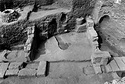
| Shop IV of the Roman stoa ... south 856 ... 11 Jul 1972 ... Shop IV of the Roman stoa. |
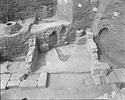
| Shop IV of the Roman stoa ... AMS south 856 ... 11 Jul 1972 ... Shop IV of the Roman stoa. |
| Debris floor of Roman Building, east of Stoa ... AMS Horizontal (normal) ... Debris floor of Roman Building, east of Stoa. |
|
|