|
|
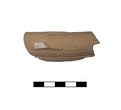
| Belly fragment of shallow cup.
Horizontal "thorn" motif on belly, ribbing below.
Light brown ware with grayish tint; clean breaks. Possibly from Rome region.
Date of context: ca. 50-20 B.C. Found with ... 15 May 1939 ... Possibly from Rome region.
Date of context: ca. 50-20 B.C. |
Plain rim.
Perhaps same potter as 962. Very similar, London 64.10-7. 1472 (F 202). See also Oxford 381: CVA 1(3) pl. 48(140) 42; Cambridge 167: CVA 1(6) pl. 41(279) 22, and cf. Rome, Vatican: Beazley ... Ca. 460 B.C ... See also Oxford 381: CVA 1(3) pl. 48(140) 42; Cambridge 167: CVA 1(6) pl. 41(279) 22, and cf. Rome, Vatican: Beazley and Magi, RG, pl. 22, G 77 and G 78, both with torus foot. |
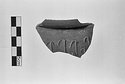
| Rim sherd of round-bellied jar with hollow bulging rim. Barbotine 'thorns' with arcs at tops: parts of 2 rows preserved on belly.
Thin gray to red/brown ware, polished at rim.
Possibly Rome or Naples ... 10-11 March 1936 ... Possibly Rome or Naples product. |
Small Plate With Projecting Rim: Rome Or Etruria.
Fragments of rim missing.
Angular ring foot; beveled resting surface; flat underside. Broad, projecting rim, curving down at edge and undercut on inside ... Context of ca. 275-210 ... Small Plate With Projecting Rim: Rome Or Etruria.
Fragments of rim missing.
... For plates of similar size and shape see Morel 1965, no. 127, pp. 72--73, pls. 10, 47; Morel 1969, p. 84, fig. 14 = Morel 1981, Type 1323b, p. 106, pl. 14 (dated by Morel between 305 and 265), from the workshop of the Petites Estampilles, an atelier perhaps located in Rome and dating from the late 4th to the mid-3rd century. |
| Broken all around.
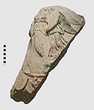
Left side of large-scale cuirass decorated with Athena and two Nikai.
Athena stands front in center with aegis and a shield in her left hand. To her left a winged victory helps to support ... 6 July 1972 ... Below Athena are indistinct traces of what should be the wolf of Rome.
White marble.
|
Floor fragment. Max. dim. 0.043; est. diam. of tondo 0.08.
I, youth (head, start of shoulder) bending over to right. Before him are an aryballos and sponge (part of each). Reserved line for tondo border, ... Ca. 510 B.C ... For the aryballos and sponge, see once Lucerne Market by the Epidromos Painter (ARV2 118, 14); Rome, Museo Artistico Industriale by Onesimos (ARV2 329, 129; Addenda 217); Oxford 1911.621 by Apollodoros (Paralip. 333, 9 ter).
|
Plate Or Bowl: Central Italian.
Foot and part of floor preserved.
Angular ring foot; rounded resting surface; pointed underside. Three circles on floor: four stamps within inner two circles; very fine ... Context of 150-86 ... This form of stamp is typical of central Italy and, according to Morel, is often found at Arezzo, Volterra, Cosa, Cerveteri, Rome, and Alba Fucens (Morel 1963, p. 50). |
Foot, lower body, half of rim, and fragments of wall missing.
Globular body. Offset at base of long, tubular neck. Torus rim.
Double-grooved strap handle. Decoration in orangish brown glaze: narrow band ... Context of 160-130 ... XLVIII (Cyprus); CVA, Stuttgart 1 [Germany 26], p. 46, pl. 40 [1252]:3 (Rome). For rays see comparanda to 1508. |
|
|