|
|
Wall and shoulder fragment.
Impressed and incised decoration: garland of ivy leaves with a zone of curved lines above and below; at shoulder curve, a row of large circles. Blister ware; clay gray, red ... Context 4th c. B.C. and earlier ... Similar patterns on other blister ware jugs, e.g. from Corinth, the Potters' Quarter, inv. KP 858; from Isthmia, on several large jugs (p. 208). |
Bottom wholly restored.
Incised wavy lines at level of both handle attachments and down outer face of handle.
Unglazed and handmade.
For ware, Hesperia 30 (1961), pp. 316-317.
For incised decoration ... 7th c. B.C ... No cooking ware jugs of comparably small size are reported from the Agora or Kerameikos, but see jugs like ours from Anavyssos: Πρακτικά, 1911, p., 124, especially nos. 25, 27. |
P 20858 a, b, c, d, e, f, g, h, i, j, k, l
Intact except for small chips.
Thirteen small jugs inventoried under one number. Raised base with flaring profile, slightly concave underside, and plump, pear-shaped ... 300-250 ... Thirteen small jugs inventoried under one number. |
Flat bottom and convex side wall.
The letters -AI- (Greek?) incised on the resting surface after firing with a sharp point. Left to right?
Coarse, pinkish buff clay, unglazed.
Jugs with flat bottoms ... Early 7th c. A.D ... Coarse, pinkish buff clay, unglazed.
Jugs with flat bottoms are veryy late in the Roman period: cf. |
Elongated one-piece shape; exaggerated trefoil rim with moderate spur at handle-attachment inside. Gritty micaceous pinkish clay; buff surfaces; mastic wash inside.
With 1623-1627, poor relations of the ... Context ca. 350-320 B.C ... The spur at the rim, characteristic for this shape, does not occur on other trefoil jugs. |
Globular body on flat bottom; tall neck, rolled rim, strap handles from middle of neck. Gray ware; the clay light in color and very slightly gritty; black glaze wash, thinly applied in broad stripes and ... Context ca. 460-440 B.C ... Fabric similar to 1475, also to the jugs, 1704-1706, Pl. 76 and the askos 1729, Pl. 80; the surface finishes vary. |
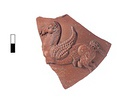
| Winged Pegasus flying left, in rather high relief. Edge of barbotine decoration above and to right.
The clay a pinkish-buff (not resembling Pergamene); the glaze orange-red, somewhat resembling Samian, ... 24 March 1936 ... ADDENDA Group of early Roman red glaze jugs with barbotine decoration etc. |
Similar to 1615 but rim flat on top and sharp-edged; light finger-grooves down outside of handle. Wet-surfaced; black glaze wash on rim, for a pair of bands at shoulder and one on foot.
A considerable ... Context ca. 415-400 B.C ... A considerable variety of jugs came from this deposit; for the same shape as 1616, in rather poor black, see 188, Pl. 10; also similar, but with trefoil mouth, 189, Pl. 10; and cf. p. 204, note 3. |
|
|