|
|
| The Athenian Agora; Volume 014; The Agora of Athens; The History; Shape and Uses of an Ancient City Centre; Shrines. The Athenian Agora; Volume 014; The Agora of Athens; The History; Shape and Uses of ... Agora 14 117 I 5510 I 7039 I 5675 A 3534 I 3226 ... Martin, Agora Grecque, pp. 168-169 ... Hesperia, 8, 1939, pp. 205f ... Guide², pp. 57-58 |
| T. T. Rapke, "Agora Ostrakon P 9945 - Two Possibilities," AntCl 24, 1981, pp. 153-155. Aristeides Lysimachou Alopekethen. Group E 4. L. Piccirilli, "Aristide di Egina?" ZPE 51, 1983, pp. 169-176. Group ... Agora 25 38 P 9945 P 7044 P 7045 P 10412 P 9942 P 22991 P 9943 P 23005 P 9944 P 23006 P 9973 P 12237 P 12238 H 12:14 |
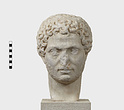
| The face is much rubbed and worn.
A middle-aged man with light beard and mustache, and curly hair.
The neck was cut to be inset. Drill holes for the attachment of a wreath.
Good workmanship.
Pentelic marble ... Period of Hadrian. |
Lagynos.
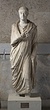
Fragments of neck and shoulder preserved; much restored.
Rounded shoulder. Two grooves at base of tapering neck. Finely incised floral garland on shoulder, possibly serving as guide for painted ... Context of 115-86 ... Finely incised floral garland on shoulder, possibly serving as guide for painted decoration. ... For other West Slope lagynoi see Keramopoullos 1932, nos. 57, 58, pp. 64--65, fig. 19:4, 5. |
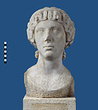
| Complete except for chip from nose and parts of curls at neck.
Life-size head made to set into a statue; the head turned slightly to the figure's right. The hair is parted in the middle and heavily waved ... 145-175 A.D. |
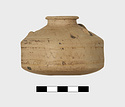
| Nearly complete; missing two handles, minor chipping at rim, cracked at body and base, paint badly worn.
Short, cylindrical, straight-sided body; sloping shoulder; very low neck; small mouth with flaring ... Mycenaean LHIIIA1 ... Mountjoy, Guide to Identification (1986), pp. 57-58, fig. 65 (FS 93). |
| Nose chipped; otherwise intact except for minor chips. Portrait of middle-aged man with close-trimmed beard and mustache. Hair simply treated and cap-like except for locks falling over forehead. Eyes have ... Late 3rd c. or early 4th c. A.D. |
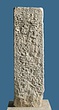
| Inscribed boundary stone of Agora.
The corners of its upper are much rubbed. All surfaces were roughly picked.
On the broad face that looks norheast, a band was smoothed with a toothed chisel across the ... 27 February 1938 ... Museum Guide (2014), pp. 66-67, fig. 39 ... Guide (2010), front cover, pp. 8, 55, fig. 26 ... Guide (1962), pp. 57-58, pl. |
|
|
.png.icon.jpg)
.png.icon.jpg)