|
|
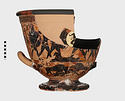
| About two-thirds of large black-figured krater by Exekias.
One side shows scene with the gods, the other side the fight over body of Patroclus. Καλυκόσχημος κρατήρας του Εξηκίου, με παράσταση, στην πρώτη ... 11-12 May 1937 ... About two-thirds of large black-figured krater by Exekias.
One side shows scene with the gods, the other side the fight over body of Patroclus. |
Four non-joining fragments, a -- c of shoulder, d of neck. Glaze misfired slightly on tongue pattern on fragment a. From a very large krater. Max. dim. a) 0.127, b) 0.15, c) 0.089, d) 0.093. G. Schwarz, ... Ca. 460 B.C ... E 140: ARV2 459, 3; Paralip. 377, 3; Addenda 243), on which the god's name is inscribed just as it is on 238; Athena appears in one of the very earliest examples, Reggio 4001, which is probably by Exekias himself, not in his manner (ARV2 147, 6; Paralip. 61, 6; Addenda 41; Schwarz, p. 29, cat. no. |
Mended with small missing pieces restored in plaster and painted. Lip offset on inside; foot offset on underside. Glaze slightly abraded on handles. H. 0.074; diam. of rim 0.18; W. with handles 0.238; ... Ca. 510-500 B.C ... Furthermore, when a master pot painter of this period chooses to decorate a cup, it is often a cup that approximates a pot in size, e.g., Munich 2044 by Exekias (diam. 0.305) or Munich 2620 by Euphronios (diam. 0.43). |
|
|